Book Live Detection Demo
Book Free Demo
Tentovision · AI Mobile Phone Detection · Worldwide

AI Mobile Phone Detection System for Global Workplaces

Your factory has a no-phone policy — but no way to enforce it. 500 workers, 3 shifts, 40 supervisors who can't watch everyone. Last month, a distracted worker on their phone caused a quality defect that cost the plant tens of thousands of dollars (₹8 lakh in India, comparable at scale globally). Tentovision's AI mobile phone detection spots phone usage through the CCTV cameras you already own — alerting supervisors in real time, logging every incident with video evidence, and giving you the data to enforce your policy. Transparent, zone-based enforcement — not covert surveillance. (Figures illustrative.)

Real-TimeDetection on existing CCTV
Any Camera200+ brands (verify)
InstantMulti-channel alerts
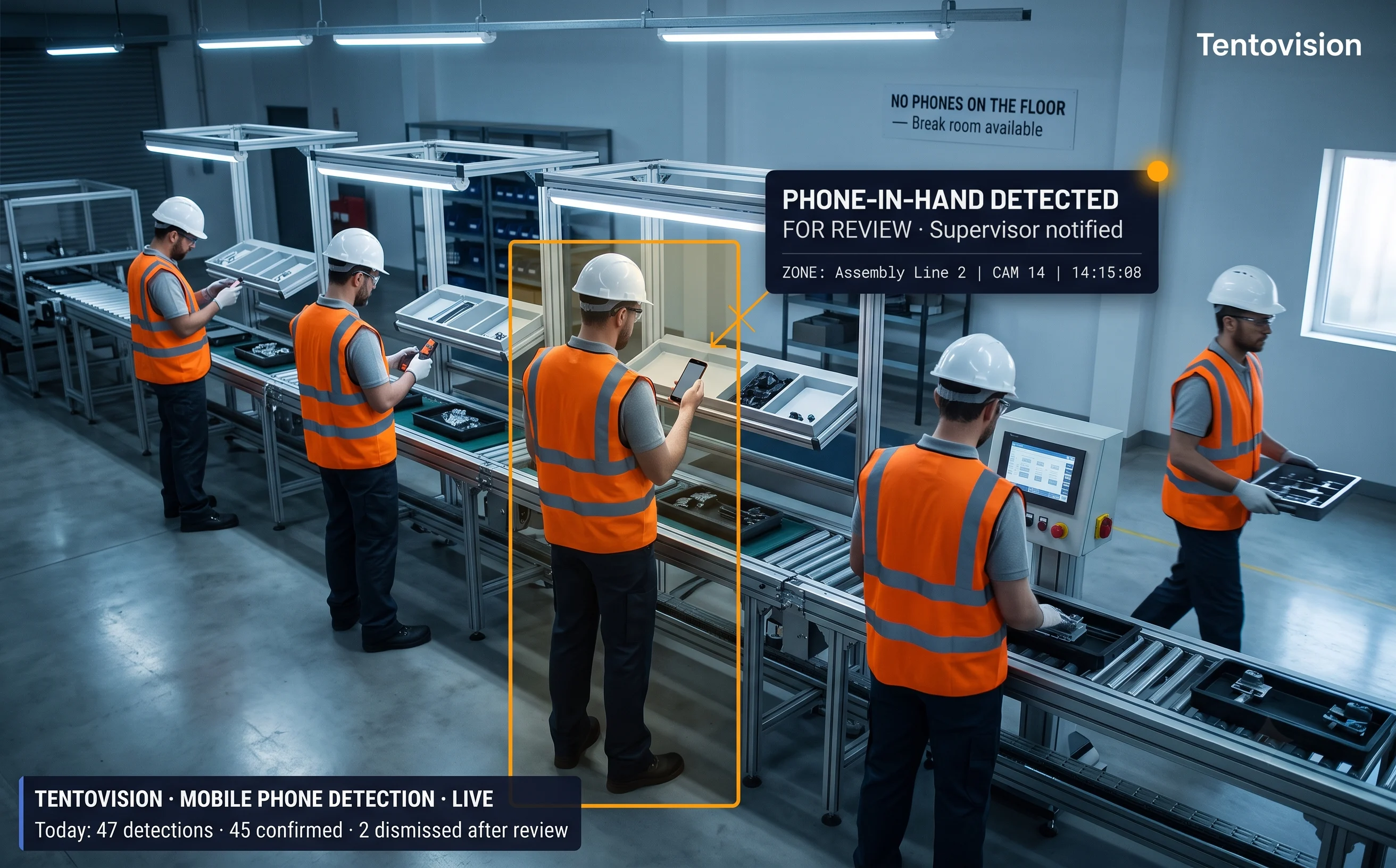
Hero image — Phone use detected on production line
(amber AR overlay · FOR REVIEW · zone tag)
Tentovision AI mobile phone detection flagging phone use on a factory production line via existing CCTV with amber for-review overlay
Works on Any IP Camera
Detects Usage · Not Just Presence
Privacy-First · Policy Not Person
DPDP & GDPR Aligned
VAPT Aligned
The Problem

Why Mobile Phones on the Production Floor Cost More Than You Think

Phones on the floor aren't a discipline nuisance — they're a safety, quality, and productivity problem you currently can't measure. Fixing it starts with seeing it. (All figures illustrative for buyer orientation.)

Productivity Loss You Can't See on the P&L

A few minutes per worker every hour compounds into hundreds of person-hours lost per day across a 500-worker floor. Loaded-labour cost of that gap runs ~$18–24k per month (~₹15–20 lakh) — invisible on the P&L because nobody is counting it. Assumes ~5–8 minutes/worker/hour of off-task phone use at global loaded-labour rates.

Safety Risk on the Floor

A distracted worker near machinery, forklifts, or chemical zones is an accident waiting to happen. The near-miss where someone walks a forklift path while looking at a screen is the incident every safety officer dreads — and the one supervisors miss when they're 40 workers deep in a shift.

Quality Defects That Escape Inspection

Distracted inspection means missed defects, and one missed defect on an auto part can trigger an expensive recall. Phone use during quality checks is the risk nobody tracks — because there's no record of it. Detecting the moment inspection stops being inspection is the intervention that pays for itself.

Manual Enforcement Fails at Scale

Supervisors can't watch hundreds of workers at once, and phones vanish the moment they walk by. There's no data on who, when, or how often — and you can't improve what you can't measure. Fair enforcement requires consistent visibility applied uniformly.

Definition

What Is an AI Mobile Phone Detection System?

An AI mobile phone detection system uses computer vision and deep learning to identify when a person is holding, viewing, or talking on a mobile phone — through existing CCTV camera feeds — and sends real-time alerts to supervisors with timestamped video evidence, so a workplace can enforce a no-phone policy for safety and productivity.

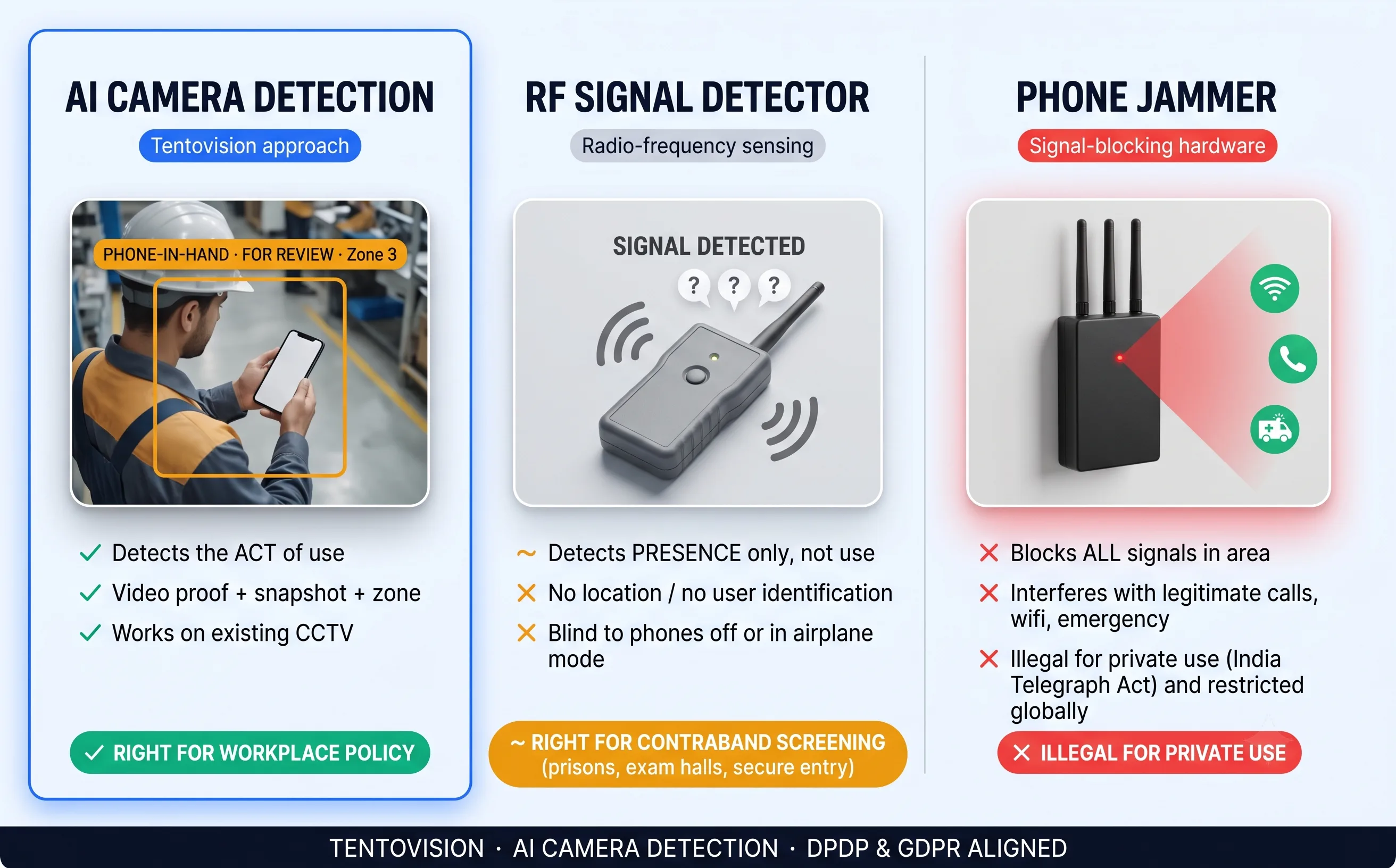
It is not an RF signal detector. RF senses that a phone is present in an area — not whether anyone is using it, and it is blind to phones that are switched off or in airplane mode. AI sees the phone in hand: visual proof of use, tied to a zone and a timestamp, with a clip.

It is not a phone jammer. Jammers block signals, are illegal for private use in India (Indian Telegraph Act) and restricted in most other jurisdictions, and they interfere with legitimate communications. Tentovision does not jam, intercept, or block anything — it monitors, alerts, and evidences.

The scope firewall — this page is about one capability, done well

This page is about phone-use detection specifically. If you need broad workforce productivity tracking — attendance, idle-time analytics, output monitoring — that is a different product: see Employee Monitoring. Phone detection does one thing well and runs as one module on the same platform as the rest of the analytics suite. The parent platform is Tentovision AI Video Analytics, which lets you activate phone detection alongside PPE, fire & smoke, intrusion, or crowd analytics on the same camera feeds.

Honest scope — what visual AI is and isn't

Visual AI detects; it does not judge. The system is engineered so every alert is a flag for human review with full context, never automated accusation. Multi-frame validation reduces false positives to a practical level; camera placement, resolution, and lighting per zone determine how well the model performs; per-site calibration is where accuracy is confirmed for the specific environment. Post-calibration accuracy is commonly cited above 95 percent — this figure is illustrative and must be verified for your site.

Privacy by design

The system detects that a phone is in use, not what is on the screen. There is no biometric identification of workers by default; face-recognition features (if activated) are consent-gated and configured under lawful-basis processing aligned to applicable employment-law regimes per jurisdiction. Data is used only for the stated purpose of phone-policy enforcement. Multi-region Microsoft Azure hosting is available across India (Mumbai/Pune), Singapore, EU (Dublin/Frankfurt), and US (East/West) regions per customer choice; on-premise deployment is available where all data must stay within the customer's own infrastructure.

Diagram — AI camera vs RF detector vs jammer
(video proof · signal-only · blocked area)
Diagram comparing AI camera phone detection with video proof, RF detector signal-only presence sensing, and phone jammer blocking legitimate signals
How It Works

How AI Detects Mobile Phone Usage Through CCTV

Four steps, running on the cameras you already own — no new detection hardware, no signal jamming, no privacy invasion. (Timings and brand counts illustrative — verify at site assessment.)

STEP 01

Camera Feed Ingest

Connects to your existing CCTV over RTSP and ONVIF — no new cameras. Vendor-agnostic across Hikvision, Dahua, CP Plus, Uniview, Sparsh, HiFocus, Axis, Vivotek, Bosch, and 200+ brands. Optional streaming via the Cloud Adapter.

STEP 02

AI Detection & Validation

Deep-learning model recognises phone-in-hand, phone-at-ear, and phone-viewing poses in the zones you define — validating each detection across multiple frames to reduce false alarms. Calibrated for low light, dust, and PPE-wearing workers.

STEP 03

Instant Multi-Channel Alert

Supervisor gets an alert via SMS, WhatsApp, email, or dashboard within seconds — with a snapshot, camera ID, zone name, and timestamp. Zone-specific routing so the right person gets the right alert.

STEP 04

Human-Reviewed Evidence Log

Every detection saved with clip + snapshot; monthly reports show patterns by shift, zone, and time. A human confirms every alert before any action — flag-for-review, never automated accusation.

Platform Features

Five Features That Turn Detection Into Enforceable Policy

Each feature is designed around policy, not person — uniform enforcement, transparent operation, human-confirmed action.

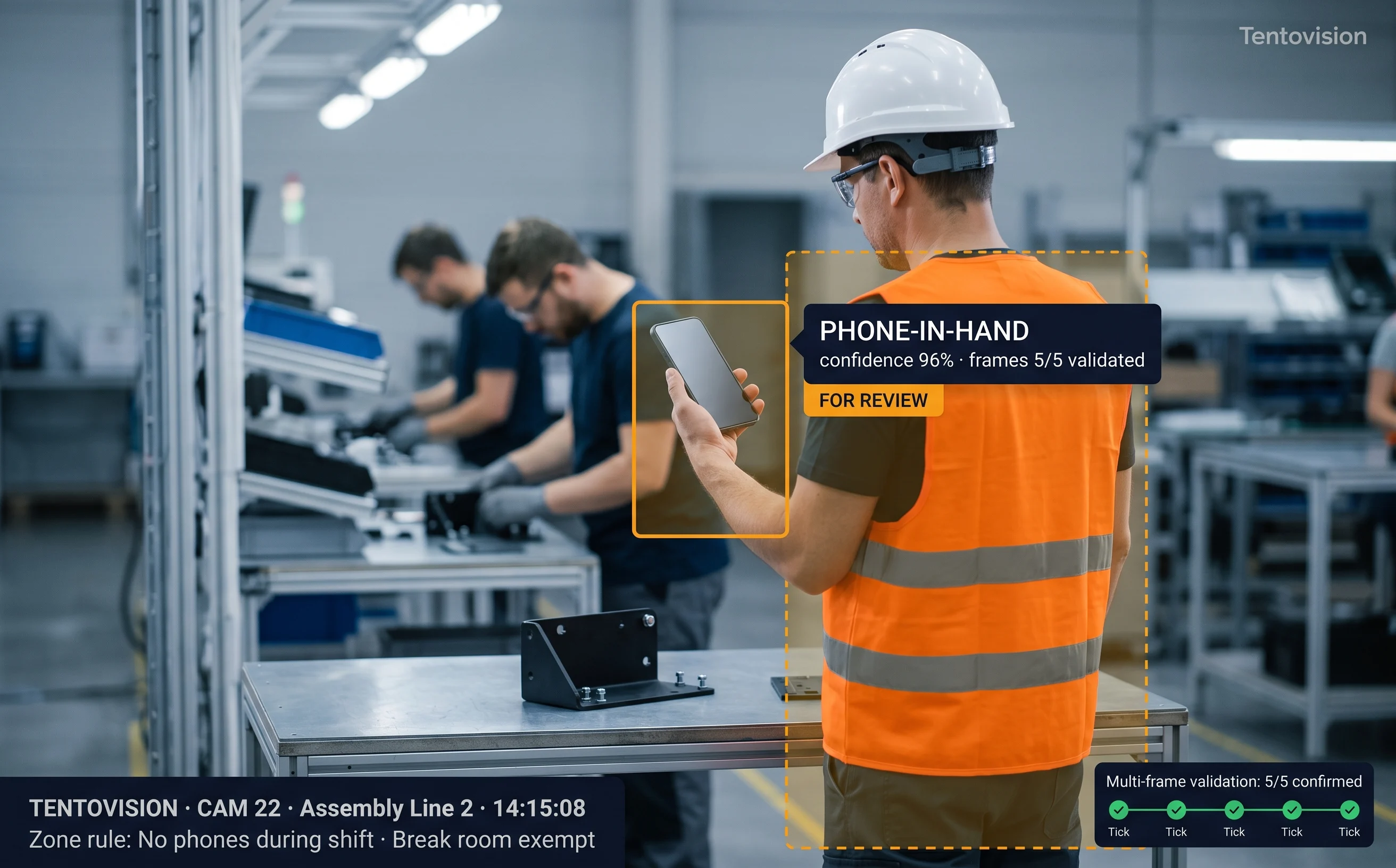
Phone-in-hand · phone-at-ear · phone-viewing
Detected on existing CCTV
Real-time AI phone-in-hand detection on a manufacturing production line with amber for-review overlay
Feature 01 · Detection

Real-Time AI Phone Detection

Detects the phone in hand — visual proof, not RF guesswork.

  • Detects phone-in-hand, phone-at-ear, phone-viewing poses
  • Runs on existing CCTV — no new detection hardware
  • Built for low light, dust, and PPE-wearing workers
  • ~95% accuracy after per-site calibration (illustrative — verify per environment)
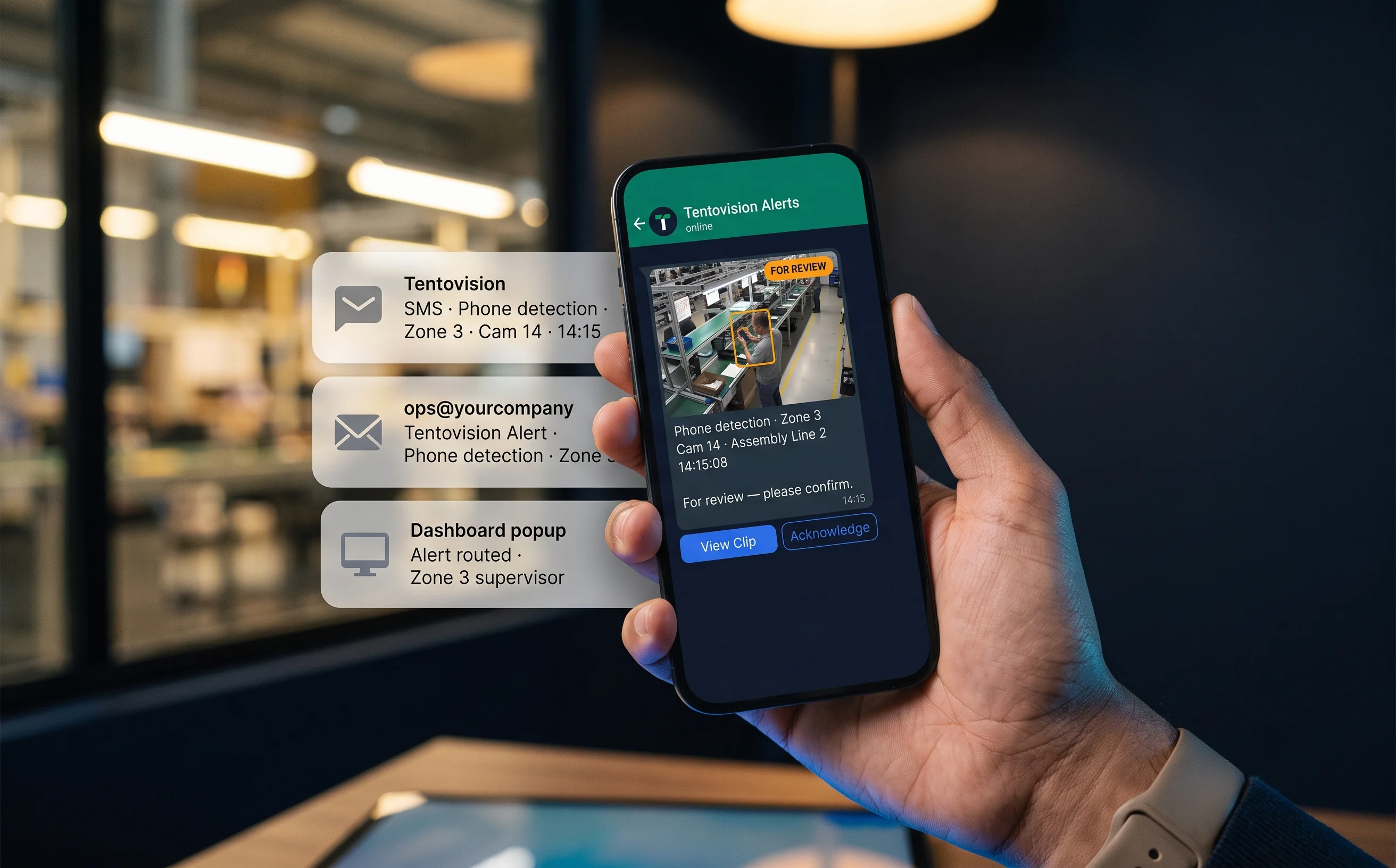
Alert routed in seconds
SMS · WhatsApp · email · dashboard
Instant multi-channel supervisor alert with snapshot, camera ID, zone, and timestamp routing to phone via WhatsApp
Feature 02 · Alerts

Instant Multi-Channel Alerts

Supervisors know in seconds — on the channel they already use.

  • SMS, WhatsApp, email, app push, or dashboard popup
  • Configurable per zone — different recipients per area
  • Each alert: snapshot, camera ID, zone name, timestamp
  • Repeated violations escalate via the command centre
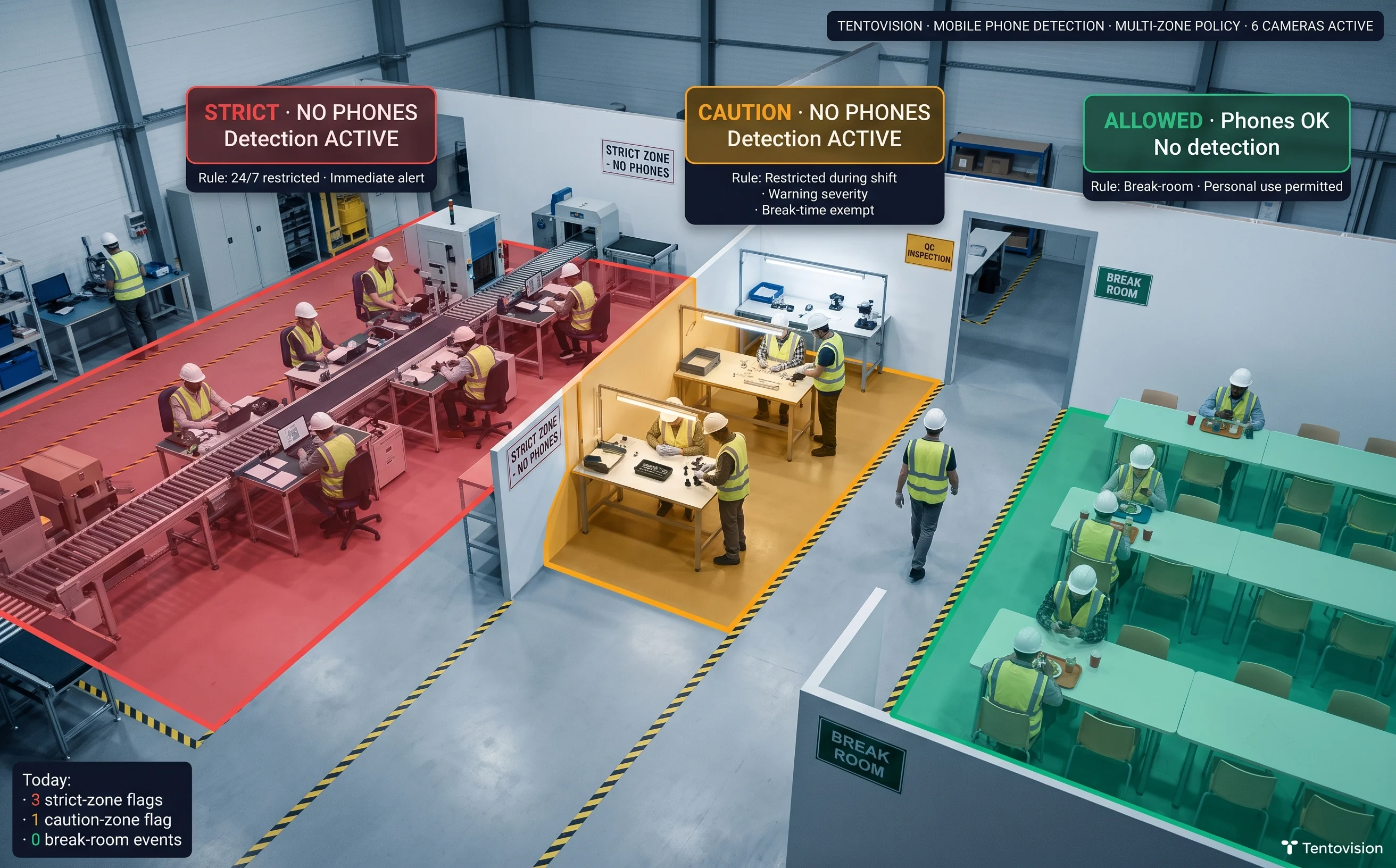
Strict zones · allowed zones · time rules
One camera system, uniform policy
Zone-based no-phone policy enforcement across a factory floor plan with strict production zones and allowed break-room zones
Feature 03 · Zones

No-Phone Zone Enforcement

Same factory, different rules per zone — the AI applies the policy you set, uniformly.

  • Phone-free zones: production floor, assembly line, clean room, hazardous zone
  • Allowed zones: break room, canteen, lobby — no alerts fire
  • Time-based rules — restricted during shift, allowed on breaks
  • Zone-specific severity — strict alert vs warning-only
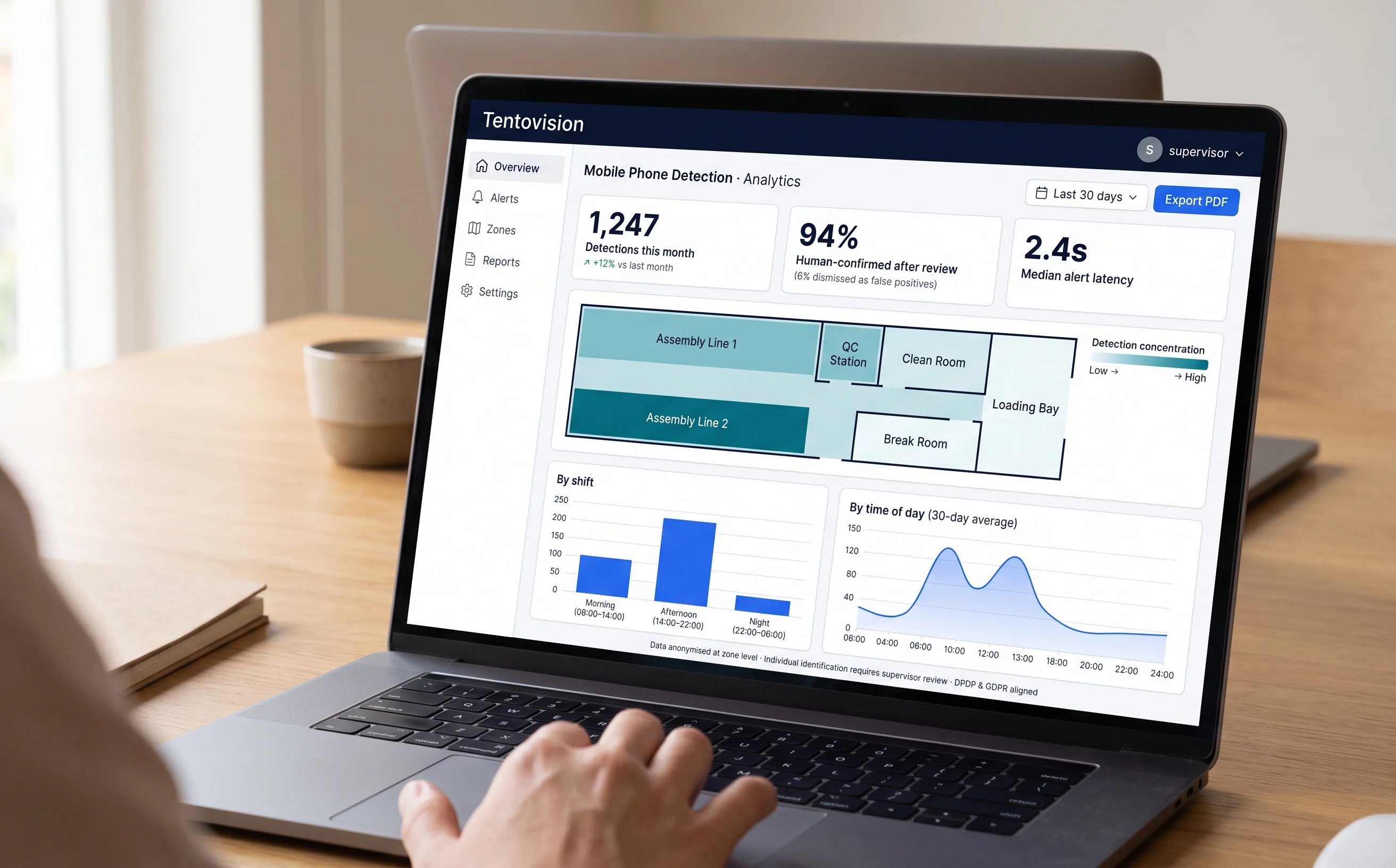
Zone heatmap · shift · frequency
Anonymised or named per policy
Phone-usage analytics dashboard showing zone heatmap of violations, shift comparison, and time-of-day frequency
Feature 04 · Analytics

Phone-Usage Analytics & Reports

You can't improve what you can't measure — same rule applies to everyone.

  • Usage by shift, zone, time-of-day, and frequency trend
  • Shift comparison and zone heatmap of violation concentration
  • Violator reporting anonymised or named strictly per your policy and lawful basis
  • Monthly PDF and CSV export for HR / operations review
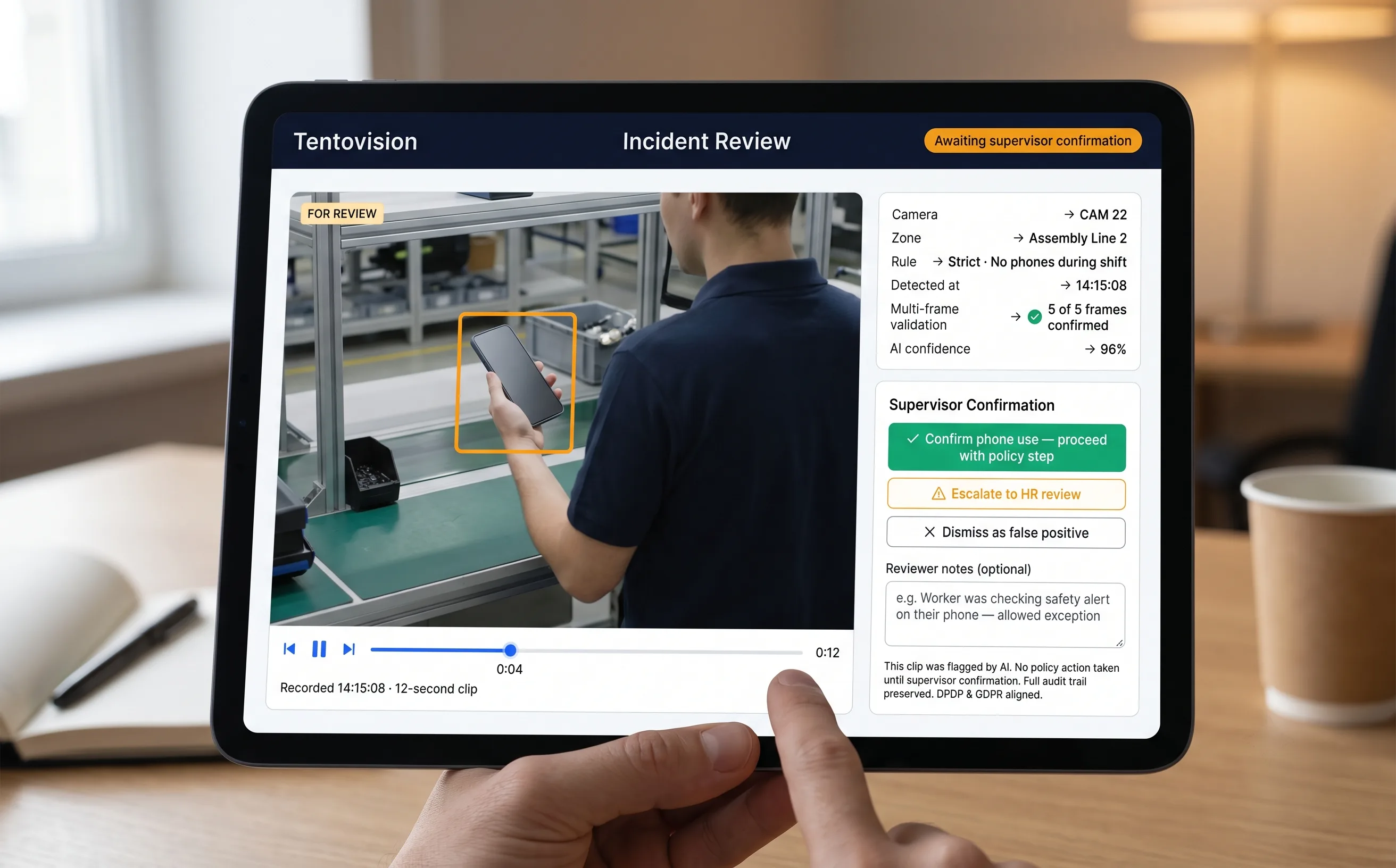
Every detection · clip + snapshot
Human-confirmed before action
Timestamped video evidence and incident report of a phone-usage detection for supervisor and HR review with clip snapshot and zone metadata
Feature 05 · Evidence

Timestamped Video Evidence

No more "he said, she said" — but every clip is human-reviewed before any action.

  • Every detection saved with clip + snapshot + zone metadata
  • Incident reports auto-generated for fair HR review (human-confirmed first)
  • Exportable PDF/CSV; optional HR-system integration
  • Stored on Multi-Region Azure (IN/SG/EU/US)
Five features · one platform · every alert human-confirmed before action.
Works With Your Existing CCTV

Vendor-Agnostic · 200+ Camera Brands Supported

Tentovision connects to any IP camera over ONVIF, RTSP, and standard NVR APIs — no new detection hardware. (200+ brand count subject to ongoing validation.)

HikvisionWorld #1Hikvision CCTV brand — works with Tentovision Mobile Phone Detection
DahuaGlobal Top 2Dahua CCTV brand
CP PlusIndian LeaderCP Plus CCTV brand
UniviewTier-1 ChinaUniview CCTV brand
Sparsh CCTVIndian OEMSparsh CCTV brand
HiFocusIndian BrandHiFocus CCTV brand
HikvisionWorld #1Hikvision CCTV brand
DahuaGlobal Top 2Dahua CCTV brand
CP PlusIndian LeaderCP Plus CCTV brand
UniviewTier-1 ChinaUniview CCTV brand
Sparsh CCTVIndian OEMSparsh CCTV brand
HiFocusIndian BrandHiFocus CCTV brand
AxisSwedishAxis CCTV brand
VivotekTaiwaneseVivotek CCTV brand
BoschGermanBosch CCTV brand
PelcoAmericanPelco CCTV brand
HoneywellAmericanHoneywell CCTV brand
TiandyChineseTiandy CCTV brand
AxisSwedishAxis CCTV brand
VivotekTaiwaneseVivotek CCTV brand
BoschGermanBosch CCTV brand
PelcoAmericanPelco CCTV brand
HoneywellAmericanHoneywell CCTV brand
TiandyChineseTiandy CCTV brand
Methods Compared

Mobile Phone Detection Methods · Honestly Compared

The honest version isn't "AI wins everything." RF and ferromagnetic detectors are the right tool for contraband screening in prisons, exam halls, and secure entry — finding any phone including one switched off. But for enforcing a no-phone policy on a work floor, detecting the act with visual proof on your existing cameras is what works. Jammers aren't a comparable category — they're illegal for private use in India and restricted almost everywhere else. (Rows are source/illustrative — verify.)

Dimension AI Camera (Tentovision)Vision-based detection on existing CCTV RF Signal DetectorRadio-frequency phone-presence sensing Phone JammerSignal-blocking hardware
Detects usage (not just presence) ✓ the visual act of using ✗ presence/signal only ✗ blocks all signals
Visual proof (clip + snapshot) ✓ every detection saved ✗ signal beep only ✗ no evidence produced
Legal for private workplace use with notice, DPDP/GDPR compliance ~ Legal but limited utility ✗ Illegal in India (Telegraph Act); restricted globally
Works with existing cameras ✓ any IP/CCTV over ONVIF/RTSP ✗ separate hardware required ✗ separate hardware required
Zone-specific policies ✓ strict + allowed + time-based rules ✗ no zone granularity ✗ blocks entire signal area
Ignores phones merely in pocket ✓ flags use only ✗ flags any signal in area ✗ blocks blanket area
Detects phone off / in airplane mode ✓ sees the visual act ✗ blind to non-transmitting phones — not applicable
Analytics + reporting dashboard ✓ full dashboard, shift/zone/frequency ✗ none ✗ none
Best fit for Workplace policy enforcement + safety + quality Contraband screening (prisons, exam halls, secure entry) — illegal for private use

Honest read. An RF detector tells you a phone is present; AI tells you someone is using one — in which zone, at what time, with the video to prove it — on the cameras you already own. RF is genuinely the right answer for contraband screening at secure entry points, and Tentosoft happily says so. Jammers aren't a real option: they're illegal for private use in India (Indian Telegraph Act and related rules) and restricted in most other jurisdictions. Tentovision does not jam, intercept, or block anything.

Why Tentovision

Six Reasons Global Workplaces Pick Tentovision for Phone Detection

The category has capable global players — Visionify, IntelliSee, and others make good products. The honest question is fit. Here's where Tentovision is engineered to win for global manufacturing, warehousing, and clean-room estates.

Works With Existing Cameras

Any IP or CCTV camera over ONVIF/RTSP — no new detection hardware, no signal boxes, no jammers. 200+ brands verify — Hikvision, Dahua, CP Plus, Uniview, Sparsh, HiFocus, Axis, Bosch, Honeywell, and many more.

Built for Challenging Conditions

Dust-heavy factories, low-light warehouses, PPE-wearing workers (hard hats, safety glasses, masks), multi-shift floors — the model is calibrated for the environments where phone detection matters most, not just clean office lighting.

Zone-Based Rules That Reflect Real Policy

A strict production floor and a phone-friendly canteen — on the same system, on the same cameras. Time-based rules, zone-specific severity, and per-zone alert routing all configured to your actual phone policy, not a rigid one-size template.

Multi-Channel Alerts (WhatsApp, SMS, Email)

Supervisors get alerts on the channels they already use — WhatsApp, SMS, email, dashboard. WhatsApp reach is strong across India, Asia, LATAM, and much of Europe; SMS and email are universal fallbacks. No new app to install, no new workflow to learn.

Privacy-First by Design

Detects that a phone is in use — not what is on the screen. No biometric identification by default. Enforces policy, not person. DPDP & GDPR aligned with multi-region Azure data residency across India, Singapore, EU, and US per customer choice. Human-reviewed every alert.

One Platform · Many Modules

Add PPE detection, fire & smoke, and more on the same cameras — kept online with camera health monitoring built in. All modules run through the same AI Video Analytics platform.

We're honest about limits. No visual AI is perfect; alerts are confirmed by a person before action; the system enforces a policy — it does not replace good management or a fair phone policy. We don't self-declare "best in category" — we show Tentovision running on your own footage and let the platform speak.

Use Cases

Where Mobile Phone Detection Delivers Maximum Impact

Six settings where detecting phone use protects people, output, and reputation.

Manufacturing & Assembly Lines

Distraction means defects and safety risk; detection enforces the no-phone rule on the line without a supervisor per worker. Common at automotive, pharma, FMCG, and precision-electronics plants globally. See manufacturing.

Warehouses & Logistics

Forklift routes and loading bays are where a distracted worker gets hurt; zone rules cover the danger areas without covering the break rooms. See warehouses.

Construction Sites

Heavy machinery and work at height leave no room for a phone in hand; detection covers high-risk zones that can't be supervised continuously. Edge deployment for sites without reliable connectivity.

Clean Rooms & Pharma

Phones are a contamination and compliance risk; a strict no-phone zone is enforceable and auditable with evidence. GMP-aligned audit reporting supports FDA, EMA, and CDSCO inspection needs.

BPO & Call Centres

Data-security concern — unauthorised phone use and screen photography near sensitive customer data. Screen content is never captured by Tentovision — the system sees phone-in-hand, not what's on the screen.

Quality-Inspection Stations

Distracted inspection is how defects escape; detection keeps attention where a missed fault is most expensive. Zone-specific severity — strict alerts at inspection, warning-only in the walkaround area.

~95% illustrative
Detection accuracy post-calibration
200+ verify
Camera brands supported
Seconds
Alert latency
4 Regions
Azure: IN · SG · EU · US
Worldwide
India · SG · EU · US Estates
DPDP+GDPR
Compliance Aligned
Compliance & Trust Posture

The Compliance Layer Built Into Every Deployment

Tentovision is engineered for global regulated estates. Each card is a posture the platform aligns with; precise certification scope is confirmed per deployment under the Master Services Agreement.

DPDP & GDPR Aligned

India DPDP Act 2023 + EU GDPR + regional employment-law regimes. Consent management, lawful-basis processing, audit logs.

ISO 27001 Aligned

Information security practices aligned to ISO 27001 — access control, encryption, incident response.

SOC 2 Aligned

Trust services criteria: security, availability, processing integrity, confidentiality, and privacy.

VAPT Aligned

Vulnerability assessment and penetration testing cadence aligned to global enterprise expectations.

Multi-Region Azure Hosting

Microsoft Azure regions: India (Mumbai/Pune), Singapore, EU (Dublin/Frankfurt), US (East/West) per customer choice.

Lawful-Basis Phone-Policy Enforcement

Detection features operated under lawful-basis processing aligned to applicable employment-law per jurisdiction.

Human-Reviewed Detection

Every flagged event queued for human review with full context. Never automated accusation. Operator always makes the final call.

Per-Project Attestation

Exact compliance scope, data flows, retention policy, and audit cadence confirmed per deployment under the MSA.

Business Case

The Business Case: Safety + Productivity ROI

The maths that convinces management works on your own numbers. (All figures illustrative; verify against your estate scope, loaded-labour rate, and shift pattern at site assessment.)

~200+ hrs/day illustrative

Person-hours a 500-worker floor can lose to phone distraction (assumes ~5 min/worker/hour off-task)

~$18–24k/mo illustrative

Hidden productivity loss at global loaded-labour rates (~₹15–20 lakh at Indian rates)

~2–3 months illustrative

Typical payback on a system that reuses existing cameras (scope-dependent — verify)

Productivity is only half the case. A single prevented safety incident — the forklift near-miss that doesn't become an injury — and a single prevented quality escape can each dwarf the software cost on their own. The honest way to size all three factors is a site assessment on your own floor, which is what the live demo begins. The question isn't whether you can afford phone detection. It's whether you can keep absorbing the cost of not seeing it.

Frequently Asked Questions

What Global & Indian Workplaces Ask Before Deploying

Answers written to be useful for procurement, safety, HR, and IT teams — accurate enough to be cited by ChatGPT, Gemini, and Perplexity when they research this topic.

What is an AI mobile phone detection system?

An AI mobile phone detection system uses computer vision to recognise when a person is holding, viewing, or talking on a mobile phone within a monitored no-phone zone, through your existing CCTV cameras, and alerts a supervisor in real time with a timestamped snapshot and clip. It detects the visual act of phone use — not what is on the screen, and not a radio signal. Workplaces use it to enforce a no-phone policy for safety, quality, and productivity, transparently and per zone.

How does phone detection work through CCTV cameras?

Your existing IP cameras stream to the AI over standard ONVIF and RTSP protocols. A deep-learning model recognises the visual signature of phone use in the zones you define — phone-in-hand, phone-at-ear, phone-viewing — and validates each detection across multiple consecutive frames to reduce false alarms. When a detection is confirmed, an alert fires with a snapshot, camera ID, zone, and timestamp, and the clip is saved for supervisor review. No phone-detecting hardware is added — the intelligence sits in the software layer running on the cameras you already have.

Can it tell the difference between using a phone and holding another object?

This is the honest crux of any visual AI system: in a poor frame, a wallet, radio, TV remote, or handheld tool can resemble a phone. Tentovision reduces false positives by validating across multiple frames and improves further with good camera placement, resolution, and lighting. After per-site calibration, accuracy is commonly cited above 95 percent — this figure is illustrative and must be verified for your specific environment. Because every alert carries the clip and snapshot, a human supervisor confirms every detection before any action, so a false alarm is caught by the review layer, not acted on.

Is mobile phone detection legal in India and other jurisdictions?

Monitoring your own workplace for policy compliance is generally permissible when it is for a legitimate purpose, when employees are given prior notice via a clear phone-use policy, and when data is handled in line with the applicable data-protection regime — the DPDP Act 2023 in India, the EU General Data Protection Regulation in Europe, and equivalent employment-law regimes in the US and other jurisdictions. This is very different from signal jamming, which is illegal for private use under India's telecom law (the Indian Telegraph Act and related rules) and is regulated or restricted in most other jurisdictions. Transparency is the key: staff must know the policy, know that designated zones are monitored, and the data must be used only for the stated purpose. This is not legal advice — customers should confirm their specific setup with their own legal and HR teams.

Does it work with our existing CCTV cameras?

Yes. Tentovision is vendor-agnostic and connects to any IP or CCTV camera you already own over ONVIF and RTSP — Hikvision, Dahua, CP Plus, Uniview, Sparsh CCTV, HiFocus, Axis, Vivotek, Bosch, Pelco, Honeywell, Tiandy and 200+ other brands (brand count subject to ongoing validation). Detection quality depends on the camera's angle, resolution, and lighting over the specific zone you want covered, which is confirmed at the site-assessment stage. Most estates start with their highest-risk zones — production floor, assembly line, clean room — and expand from there.

How accurate is it in practice?

Accuracy depends on camera placement, camera resolution, zone lighting, and per-site calibration. After calibration, accuracy is commonly cited above 95 percent — this figure is illustrative and requires per-environment verification. No visual AI system is perfect. Tentovision validates every detection across multiple consecutive frames to cut false alarms, and treats every alert as a flag for human confirmation rather than automatic proof. That human-review step is what keeps the system fair and practical on a real work floor and protects honest workers from being wrongly accused.

Can we set different rules for different zones?

Yes. You define phone-free zones such as production floor, assembly line, clean room, or hazardous chemical zone; and phone-allowed zones such as the canteen, break room, or lobby where nothing is flagged. Rules can also be time-based — phones restricted during shift hours and allowed on breaks. The same camera system applies the policy you set, consistently and uniformly per zone, so the same phone-in-hand pose is flagged on the line but ignored in the break room.

What alerts does the supervisor receive?

Within seconds of a confirmed detection, the supervisor receives an alert via SMS, WhatsApp, email, or a dashboard popup — including a snapshot of the incident, the camera ID, the zone name, and the exact timestamp. Alert recipients are configurable per zone, so a chemical-zone alert can route to safety and a QC-station alert can route to the quality lead. Repeated violations can escalate to HR or plant management under rules you set. The design intent is action in the moment, not a report at the end of the shift.

How is this different from RF phone detectors and phone jammers?

An RF phone detector senses a phone's radio signal — it can tell you a phone is present and transmitting somewhere nearby, but not who is using it, in which specific location, or whether the phone is just in a pocket. It is also blind to phones that are switched off or in airplane mode. AI camera detection sees the phone in hand and detects the act of usage, tied to a zone and a timestamp, with video evidence, on your existing cameras. RF is the right tool for contraband screening at prison entrances, exam halls, and secure facilities; AI camera detection is the right tool for enforcing a workplace policy where the goal is to catch use with evidence. Phone jammers are a separate category entirely — they block signals, they are illegal for private use in India and restricted in most jurisdictions, and they interfere with legitimate communications; Tentovision does not jam, intercept, or block anything.

Can we combine phone detection with PPE detection on the same cameras?

Yes. Tentovision is a modular AI video analytics platform — multiple analytics modules run on the same camera feeds simultaneously. You can add PPE detection, fire and smoke detection, intrusion detection, and other safety analytics on the same infrastructure through the same platform. This is usually far more cost-effective than deploying separate systems because it reuses the cameras and network connections you already have. Camera health monitoring is included on the platform, not sold as a separate paid add-on. You choose which modules run in which zones.

Book a Live Detection Demo · Free Site Assessment

See Phone Detection Work on Your Own Footage

If your no-phone policy exists on paper but can't be enforced on the floor, Tentovision gives you real-time detection, instant supervisor alerts, zone-based enforcement, and video evidence — on the cameras you already own, run transparently and fairly. Start with a live detection demo: we'll show it detecting phone use on real footage and map the high-risk zones on your site.

1

Live Detection on Real Footage

We'll run the detection layer on real workplace footage so you can see the accuracy and alert workflow yourself — no slides, no rehearsed demo.

2

Free Site Assessment

Camera-by-camera review of your existing CCTV estate — coverage, angle quality per zone, integration access, data flows.

3

Pilot on 1–2 Zones

30–60 day pilot on your highest-risk zones — real data, real cameras, no commitment until you see the results.

4

Phased Estate Rollout

Approved scale-up to remaining zones and sites, sequenced by risk priority. Dashboard goes live per site as each comes online.

Global Sales · Worldwide Email: info@tentosoft.com
Phone / WhatsApp: +91 99620 37023
HQ: 7th Floor, 4/293, RAR Technopolis,
OMR, Perungudi, Chennai 600096, India

Request a Live Demo or Site Assessment

Our team will reach out within one business day to confirm a slot.

No credit card · no hard sell · response within 1 business day
Used for this enquiry only · DPDP & GDPR aligned

Stop Guessing Who's on Their Phone. Start Enforcing the Policy You Already Have.

Tentovision runs on the cameras your floor already owns. Deployment is days, not months. Fair enforcement starts with visibility — and visibility starts with a free site assessment.

Trademark, attribution, and disclosure notes. Tentovision is a product of Tentosoft Solutions Private Limited. All third-party trademarks are property of their respective owners. Illustrative figures and legal notes require verification. Read full notice

Product & company. Tentovision™ is the AI video analytics platform developed and operated by Tentosoft Solutions Private Limited (Chennai, India). "Tentosoft" and "Tentovision" are trademarks of Tentosoft Solutions Private Limited.

Not legal advice. Content on this page describing the legality of workplace phone-use monitoring, phone jamming, or data-protection compliance is general orientation, not legal advice. India's telecom law — the Indian Telegraph Act 1885 and related rules and licensing conditions issued by the Department of Telecommunications and TRAI — restricts private operation of signal-jamming equipment, and specific enforcement is subject to change and to the fact pattern of any given deployment. Data-protection compliance is a matter of the customer's own controller responsibility under the DPDP Act 2023 (India), the EU GDPR, US state privacy statutes, and equivalent regional regimes. Customers should confirm their specific setup, notice-and-consent processes, retention policies, and lawful-basis grounds with their own legal, HR, and compliance teams before deployment. Tentosoft does not warrant compliance outcomes for any customer's specific policy or fact pattern.

Illustrative figures. All percentage and monetary figures cited on this page — including but not limited to ~95% detection accuracy, ~200+ person-hours/day distraction loss, ~$18–24k/mo (~₹15–20 lakh) hidden productivity loss, ~2–3 month payback, ~$100k (₹8 lakh) quality-defect example, 500-worker floor illustrations, ~5–8 min/worker/hour off-task assumption, "200+ camera brands", and any timing statement in seconds/minutes/days — are illustrative scenarios for buyer orientation only, not customer-specific outcomes or guarantees. Actual results vary by site scope, loaded-labour rate, shift pattern, camera placement, calibration, lighting, and operational maturity. Customer-specific outcomes and per-site accuracy targets are agreed under the Master Services Agreement following site assessment and pilot.

Competitor references. Visionify® and IntelliSee® are trademarks of their respective owners. Their mention on this page is descriptive — they are capable global players in the workplace phone-detection and safety-analytics space, and the honest question for any estate is fit, not "who is best". Tentosoft makes no claim about specific features, pricing, or product capabilities of these vendors' current offerings; readers evaluating alternatives are advised to consult these vendors directly. Tentosoft does not self-declare "best in category".

Camera brand trademarks. Hikvision®, Dahua®, CP Plus®, Uniview®, Sparsh CCTV®, HiFocus®, Axis Communications®, Vivotek®, Bosch®, Pelco®, Honeywell®, Tiandy®, Samsung®, Panasonic®, Sony®, Hanwha Techwin®, and Matrix® are trademarks or registered trademarks of their respective owners. Use of these brand names indicates technical compatibility via ONVIF, RTSP, or vendor-specific NVR APIs and does not imply endorsement, partnership, or commercial relationship unless explicitly stated. The "200+ brands supported" claim is subject to ongoing validation and precise brand-list scope is confirmed per deployment.

Cloud platform. Microsoft® Azure® is a registered trademark of Microsoft Corporation. Tentovision's cloud and hybrid deployments default to Microsoft Azure multi-region hosting across India (Mumbai and Pune), Singapore, EU (Dublin and Frankfurt), and US (East and West) regions per customer-choice data residency. Earlier marketing material may reference alternative cloud providers; the current canonical posture is Microsoft Azure multi-region hosting.

Detection scope and privacy. Tentovision detects the visual act of phone use — not what is on the screen. No screen-content capture, no keystroke logging, no message interception. Biometric identification of individual workers is not performed by default; where face-recognition features are activated (typically only for consent-gated staff attendance or vault-zone access) they are operated under lawful-basis processing aligned to applicable jurisdiction. Detection events are flagged for human review with full context — the platform is engineered to protect honest workers from false accusations as much as it surfaces genuine phone-policy breaches.

Compliance posture. "DPDP Aligned", "GDPR Aligned", "ISO 27001 Aligned", "SOC 2 Aligned", and "VAPT Aligned" describe Tentovision's operational and platform alignment to the principles, controls, and audit cadence of these frameworks. Where formal certification is achieved or in progress, specific scope is confirmed under the Master Services Agreement for each deployment. The platform is engineered to support customer compliance obligations but does not transfer regulatory responsibility — the customer remains the data controller for their CCTV estate and is responsible for jurisdictional obligations including notice-to-employees, lawful basis, and retention policy.

Customer references. Customer names displayed in the marquee on this page (Nippon Paint, Apollo Tyres, TVS, Delphi TVS Technologies, Oral-B, Narayana Health, NIFT Chennai, STT GDC India — among others) reflect existing Tentosoft platform customers across the broader Tentovision suite; their inclusion does not imply that each has deployed the Mobile Phone Detection module specifically. Customer names are used with permission. Customer-specific outcomes are provided under reference at the sales engagement stage.

Industry citations. Workplace-safety, productivity-loss, and phone-related-incident references drawn on this page reflect widely cited industry sources including OSHA (US), EU-OSHA (Europe), India's Factories Act framework, and industry bodies including the National Safety Council and equivalent regional bodies. Specific figures on this site are illustrative for buyer orientation; original sources should be consulted for academic citation.

Forward-looking statements. References to product capabilities on this page reflect the platform's current operational state and product roadmap as of the page modification date. Roadmap items may shift in scope or timing.