Get Assessment
Book Free Demo
Managed Security Service · 24/7 SOC

E-Surveillance System — 24/7 AI-Assisted Remote Monitoring

Your warehouse has 40 cameras. Your three night guards cost roughly ₹60,000 a month — and last quarter, one slept through a theft that cost ₹12 lakh in inventory. (Cost and incident figures illustrative.) An e-surveillance system replaces passive CCTV with active, AI-assisted monitoring by trained SOC operators who detect threats in real time, verify alerts instantly, deter intruders through remote voice-down speakers, and escalate to your contact or local police — all from one central operations centre.

24/7SOC monitoring (verify)
AI + HumanVerification
Voice-DownRemote deterrence (verify)
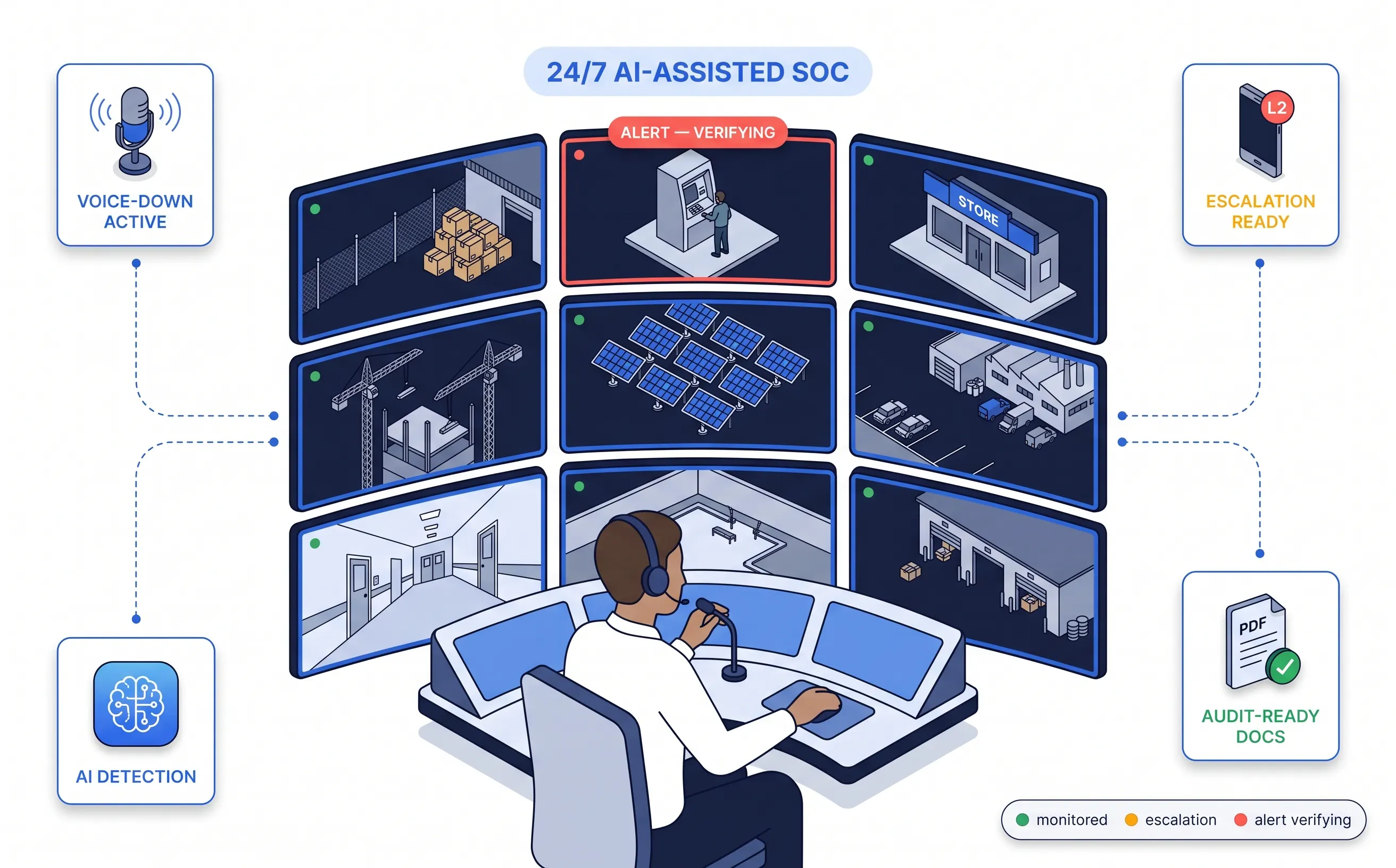
Hero image — SOC operator monitoring
(multi-feed wall + voice-down active)
Tentovision SOC operator monitoring live CCTV feeds with AI-assisted threat detection across distributed client sites
24/7 SOC Operations
AI + Human Verification
Voice-Down Deterrence
Works With Existing Cameras
VAPT Aligned
The Guard Problem

Why Physical Guards Alone Can't Secure Your Business

Guards aren't the problem — relying on guards to monitor cameras is. That's the weakest task in physical security, and the one e-surveillance fixes. (Figures below are illustrative market and industry ranges, not Tentosoft-measured numbers.)

Guards Sleep — Attention Fades Overnight

A guard on a 12-hour night shift can't stay alert for 12 hours — industry studies suggest attention falls sharply within a few hours of watching a static feed. At 3 AM, a warehouse guarded this way is effectively unguarded.

One Person Cannot Watch 40 Cameras

A 40-feed monitor wall looks impressive, but research finds one person effectively watches only a handful at once. An intruder past camera 37 goes unseen because the guard is looking at camera 4 — that's not a discipline problem, it's a perception limit.

Guard Costs Multiply Across Sites

Genuine 24/7 cover needs ~4 guards per site for relief and offs — roughly ₹60,000/month for one site at common market rates. A five-site operation can pay near ₹3 lakh/month and still suffer incidents from the two problems above. India guard attrition is widely cited around 200% annually, deepening this further.

No Evidence Trail When It Matters

A guard sees something and either does nothing or doesn't document it. There's no timestamped record of what was detected, how fast the response was, or what action followed — just one person's word, which holds little weight with insurance or in court.

Definition

What is an E-Surveillance System?

An e-surveillance system is a managed remote security monitoring service where trained operators in a Security Operations Centre (SOC) continuously watch live camera feeds using AI-assisted detection, verify threats in real time, deter intruders through remote voice-down speakers, and escalate confirmed incidents to the client or local emergency services — providing 24/7 active security coverage without relying on on-site guards to do the watching.

The first distinction is from ordinary CCTV: regular CCTV records; e-surveillance responds. A recording only has value after something has happened — an e-surveillance service is watching as it happens and acting on it.

Service, not self-monitoring software — the buyer distinction

The second distinction is the one buyers care about: this is a service, not self-monitoring software. Multi-site software gives you a platform to watch your own cameras; e-surveillance means we watch your cameras and you get a call when there's a problem. Prefer to monitor in-house? That's multi-site CCTV monitoring. Both run on the same Tentovision VMS and AI analytics — the only difference is who does the watching.

The Indian e-surveillance market and where Tentosoft fits

India has capable e-surveillance providers — Securens and Igzy are widely known in the market, alongside global names operating here — so the honest question for a buyer is fit, not superlatives. Tentosoft's positioning is AI-first, vendor-agnostic, India-hosted: our detection engine is built into the Tentovision platform (not a third-party bolt-on), the service runs on your existing mixed-brand cameras over ONVIF/RTSP, and data residency is in Microsoft Azure India regions (Mumbai & Pune) by default — important for DPDP-bound buyers.

Honest scope: what e-surveillance does and doesn't replace

E-surveillance doesn't replace all guards. Access control, visitor handling, hands-on physical response, and signed handovers still need a person on site. What it replaces is the monitoring function — the part guards do worst, especially overnight at multi-camera sites. For most distributed businesses the most cost-effective model is monitoring-led: outsourced SOC watching all cameras, with a minimal guard presence only where physical presence genuinely adds value.

The five-step workflow that defines the service

Every e-surveillance event follows the same path: AI detection → operator verification → voice-down deterrence → tiered escalation → automated documentation. The next section walks through this end-to-end, with the timings each stage targets (verify against your SLA before publishing).

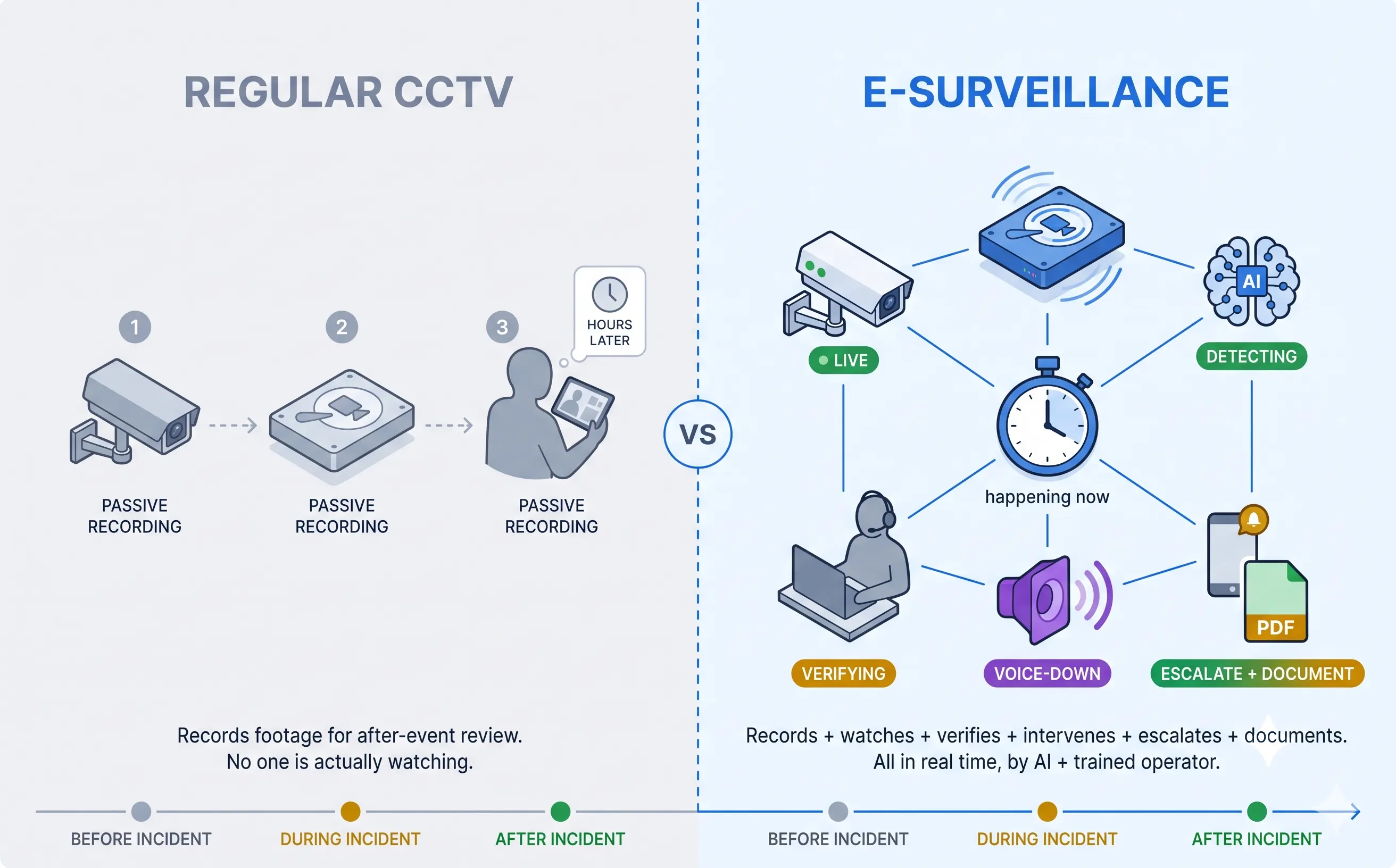
Diagram — Regular CCTV (records) vs
E-Surveillance (records + watches + responds)
E-surveillance actively monitors and responds in real time while ordinary CCTV only records for after-event review
How It Works

How E-Surveillance Works: From Detection to Resolution

The whole service is one five-step workflow — detect → verify → deter → escalate → document — and every capability maps back to it. (Timings are illustrative targets; verify against your SLA before publishing.)

01

AI Detection

Tentovision's AI watches every feed at once and flags motion, intrusion, or perimeter breach the instant it appears — no attention gap.

~seconds (verify)
02

Operator Verification

A trained SOC operator reviews the flagged event live — real threat, or false alarm from an animal, shadow, or vehicle.

~seconds (verify)
03

Voice-Down Deterrence

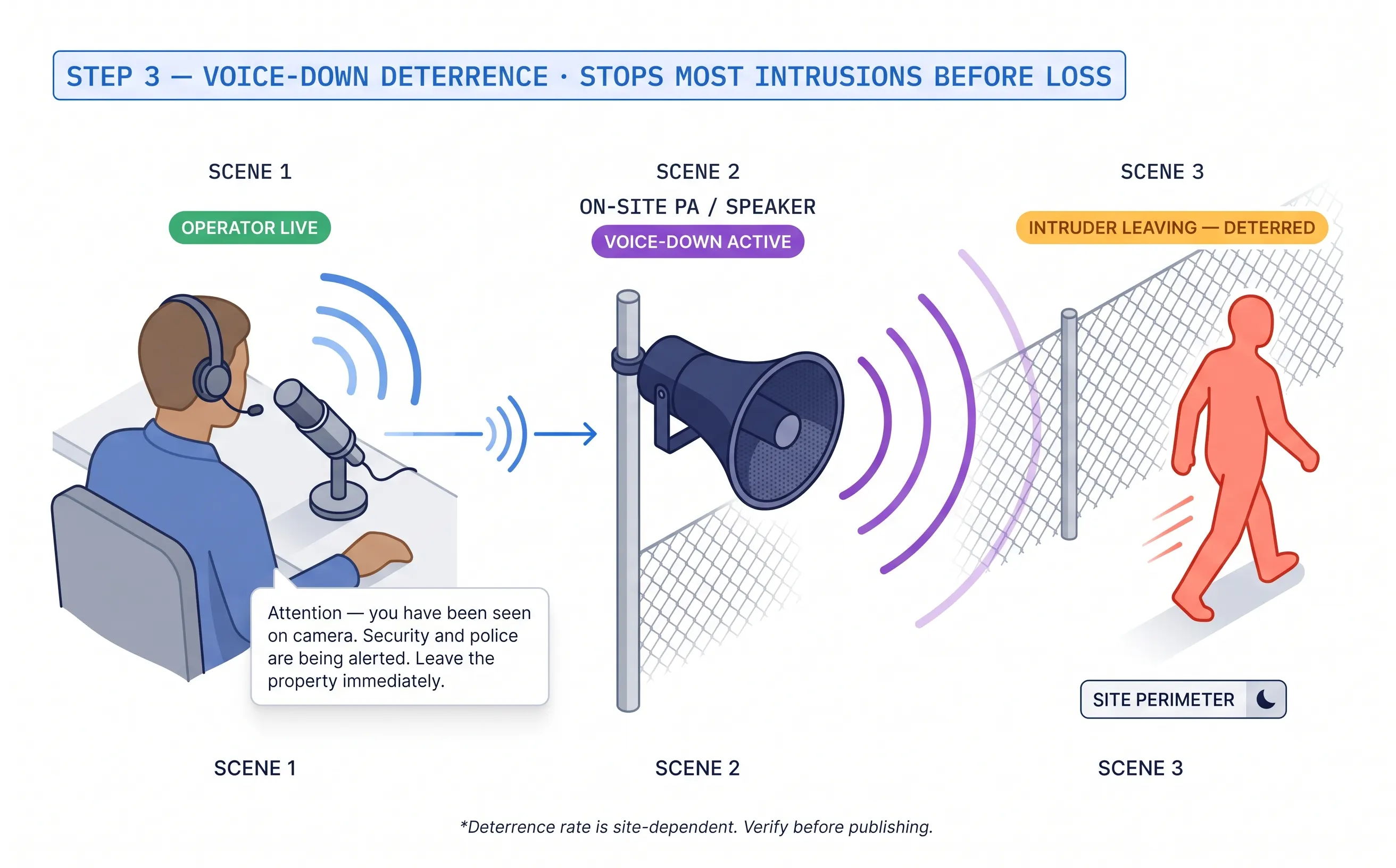
If confirmed, the operator speaks live through on-site speakers — most intrusions end here, before any loss.

immediate (verify)
04

Tiered Escalation

If the intruder stays, the operator calls your designated contact, alerts local police, and triggers on-site alarms — within agreed SLA.

within SLA (verify)
05

Incident Documentation

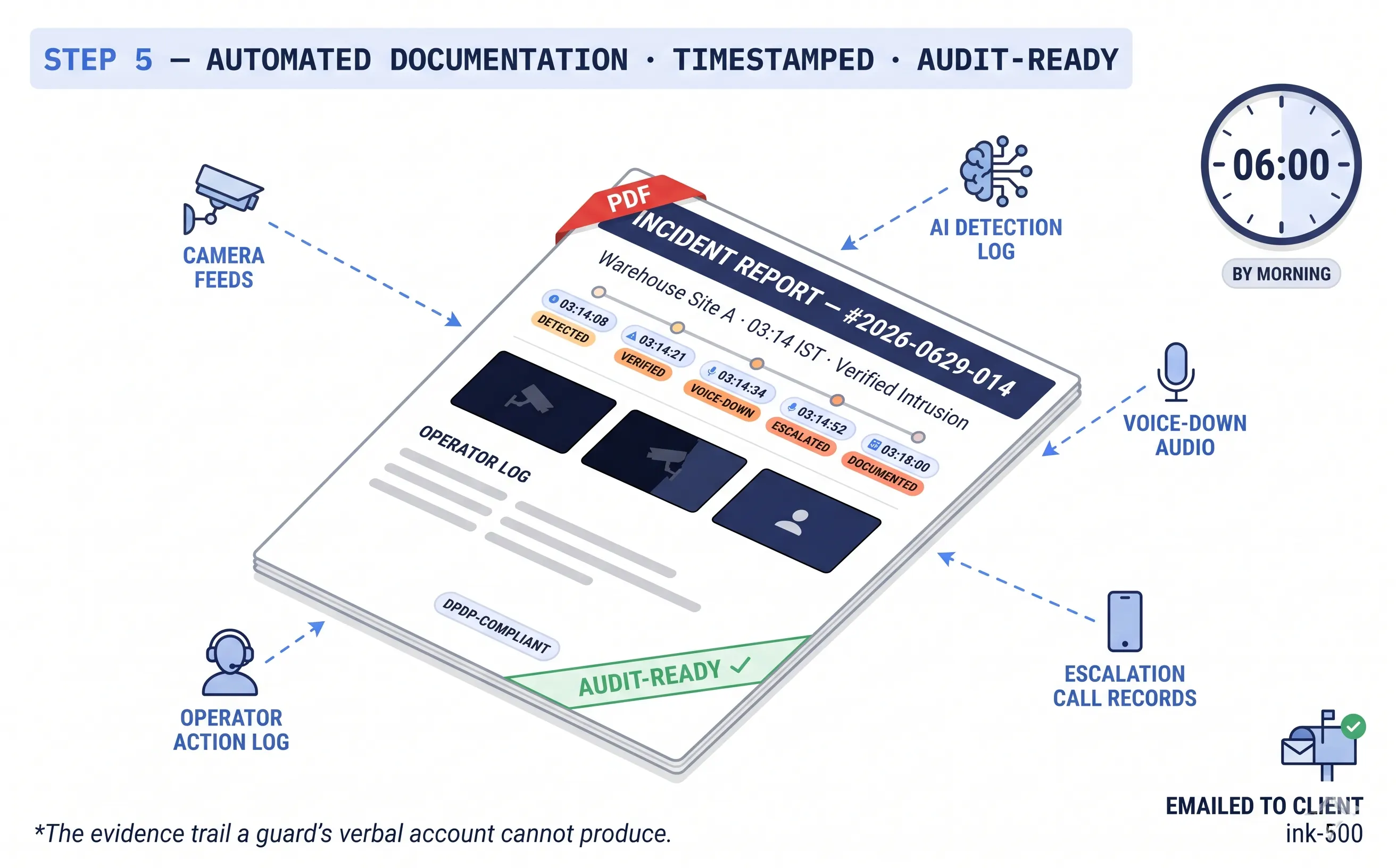
Every event is logged — timestamps, video clips, operator actions, outcome — as a compliance-ready report by morning.

automatic

Detection to documented resolution targeted in a couple of minutes, with a timestamped record at the end — instead of a verbal account the next day. (End-to-end timings vary by site and SLA tier; confirm at assessment.)

Service Capabilities

Six Capabilities That Make the Workflow Real

Each workflow step is delivered by a specific service capability — plus a sixth that addresses the #1 buyer concern with outsourced monitoring: how do I know they're actually watching?

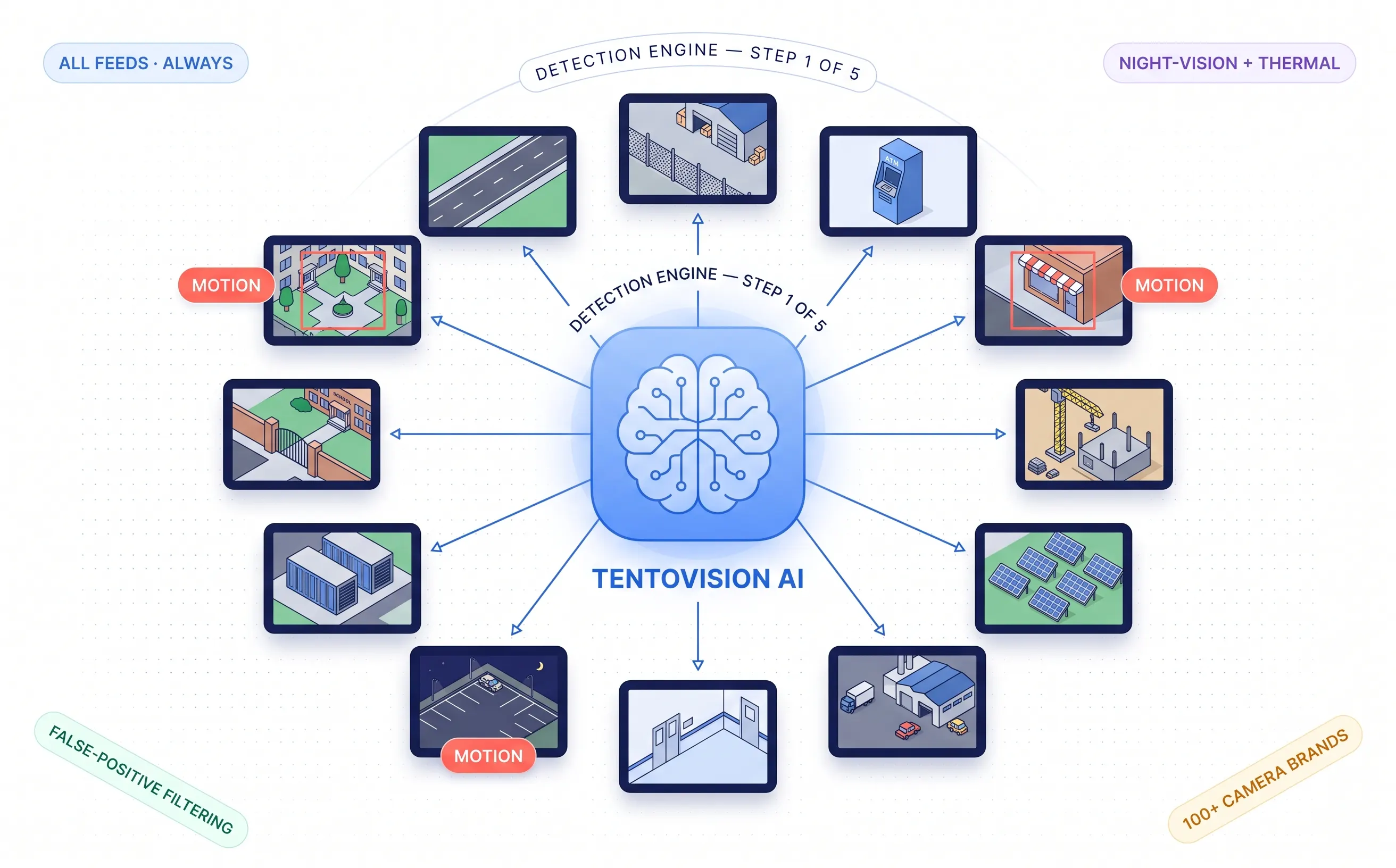
All feeds, all the time
AI detection across every camera
AI-powered threat detection monitoring all camera feeds simultaneously with night-vision and thermal support
Step 1 · Detect

AI-Powered Threat Detection

The reason a service watches what a guard cannot — every camera, all the time. Detects perimeter breach, intrusion, loitering, vehicle entry, and integrates with fire/smoke detection. Night-vision and thermal support for low-light, rain, fog. Adapts to site patterns to cut false alarms over time, so the SOC operator's queue is mostly real events. Powered by the Tentovision analytics engine — purpose-built, not a third-party bolt-on.

AI Analytics
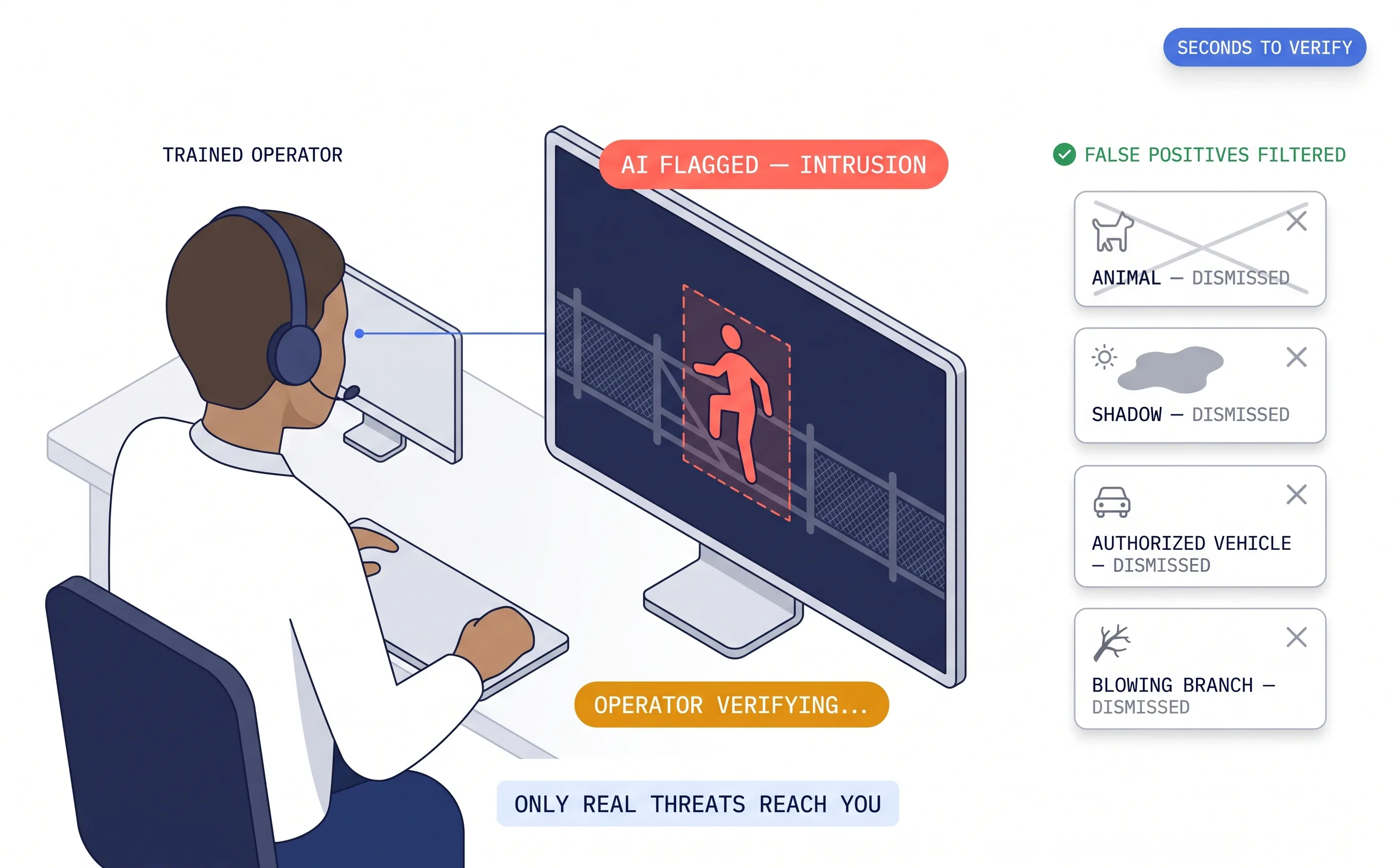
Human judgement
Real threats only reach you
Trained SOC operator verifying an AI-flagged event to filter out animals and shadows before alerting client
Step 2 · Verify

Trained Operator Verification

The human judgement that makes alerts trustworthy — AI detects everything; people decide what matters. SOC staffed by trained operators following per-alert procedures; false-alarm filtering so only real threats reach you; multi-language handling for client and on-site communication (coverage confirmed at assessment); operators briefed on site-specific layouts, schedules, and protocols. The operator is what stops your phone ringing at 2 AM about a stray dog.

Command Center
Real-time intervention
Operator speaks through on-site speakers
Remote voice-down deterrence — SOC operator speaking through on-site speakers warning an intruder in real time
Step 3 · Deter

Remote Voice-Down Deterrence

The capability that actually stops crime in progress — a recording-only camera cannot talk to a thief; an operator can. Two-way audio through site speakers or camera-mounted PA. Live operator addressing the intruder directly, with pre-recorded backups for common scenarios. The psychology is the product: being watched and addressed in real time ends most intrusions before any loss (deterrence rate is site-dependent; confirm before publishing). Works with your existing PA system or added speakers where missing.

Tentovision VMS
L1 → L2 → L3 → L4
Operator · client · police · management
Tiered incident escalation from operator voice-down through client security team to police and management
Step 4 · Escalate

Tiered Incident Escalation

Turning a verified threat into a guaranteed response, on defined timelines. L1 = voice-down handled by the operator. L2 = client security-team notification by phone and mobile app. L3 = local police or emergency services per site protocol. L4 = management notification on SLA breach. Every step is logged with timestamp and operator ID. Routed via the command-centre platform so context follows the alert at every tier.

Escalation Platform
Incident report PDF
Timestamped audit trail
Automated timestamped incident report with video evidence audit trail for compliance and insurance
Step 5 · Document

Automated Incident Documentation

The evidence trail guards cannot produce — every event captured, timestamped, retained. Compliance-ready PDF per incident plus monthly SOC performance reports. Audit trail acceptable for insurance and legal review, retained on Microsoft Azure India with AES-256 at rest under DPDP-aligned governance. Integrates with your existing incident-management process — no parallel system to maintain.

Cloud VMS
Hybrid portal
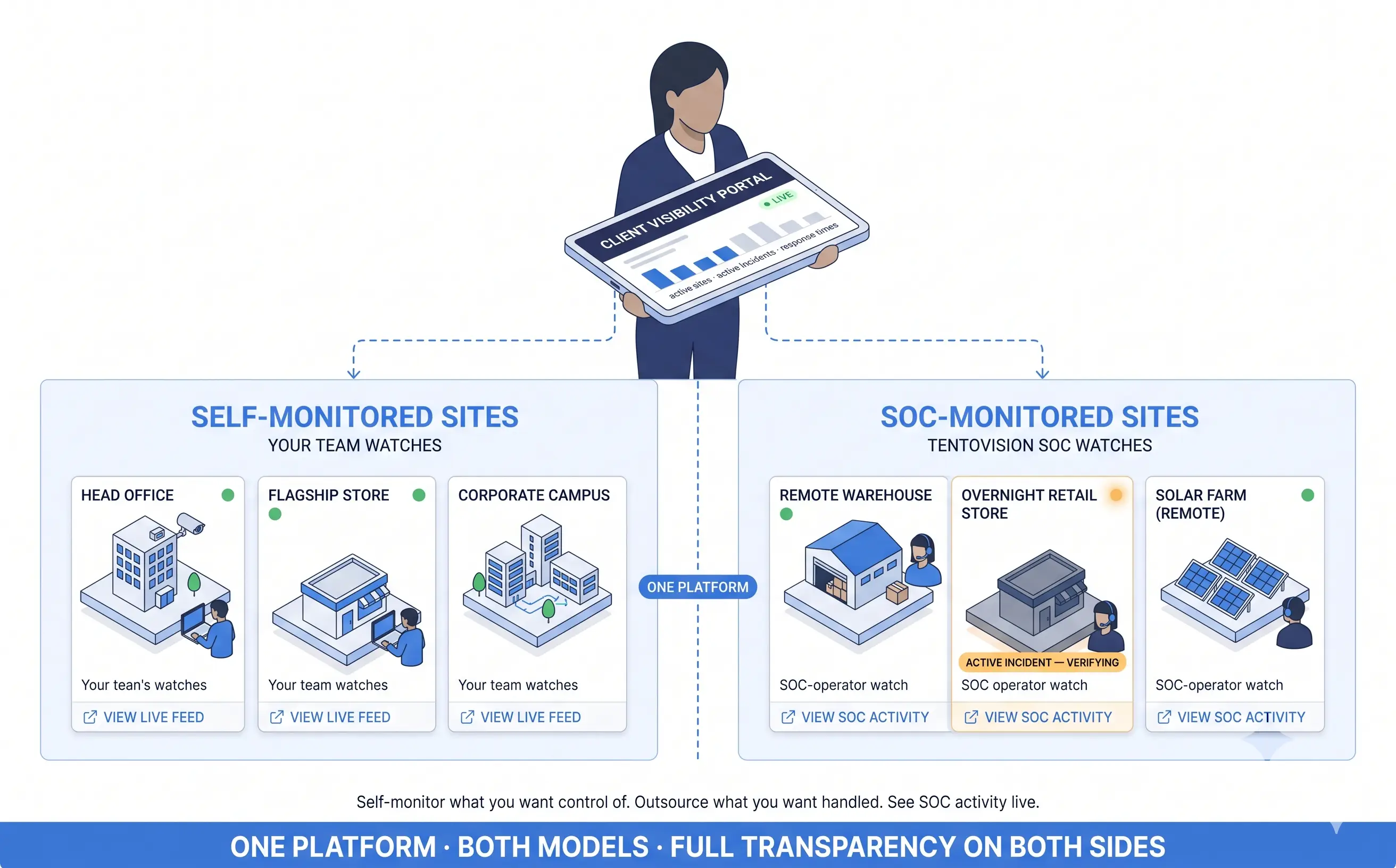
See SOC activity on your outsourced sites
Client visibility portal showing live SOC operator activity and active incidents on outsourced surveillance sites
Cross-Cutting · 06

Hybrid Monitoring & Client Visibility Portal

The #1 buyer fear with outsourced monitoring is "if I outsource, how do I know they're actually watching?" The client portal answers that. Live view of SOC operator activity on your outsourced sites, active incidents in flight, response-time metrics, and full incident reports — your own dashboard onto the outsourced service. Self-monitor head office and high-traffic sites through multi-site CCTV monitoring; outsource remote, overnight, or hard-to-staff locations to the SOC. One platform, both models, full transparency on both sides.

Multi-Site Monitoring
The five workflow capabilities run continuously; the sixth lets you watch us watching. Start with a free security assessment of one or two sites, see the portal on real footage, then scale.
Works With the Cameras You Already Own

No rip-and-replace · 100+ camera brands supported

Tentovision is vendor-agnostic over ONVIF, RTSP, and standard NVR APIs — the SOC monitors your existing mixed-brand estate. Speakers for voice-down and additional night-cameras are added selectively only where missing.

HikvisionWorld #1Hikvision CCTV brand — works with Tentovision e-surveillance
DahuaGlobal Top 2Dahua CCTV brand — works with Tentovision e-surveillance
CP PlusIndian LeaderCP Plus CCTV brand — works with Tentovision e-surveillance
UniviewTier-1 ChinaUniview CCTV brand — works with Tentovision e-surveillance
Sparsh CCTVIndian OEMSparsh CCTV brand — works with Tentovision e-surveillance
HiFocusIndian BrandHiFocus CCTV brand — works with Tentovision e-surveillance
HikvisionWorld #1Hikvision CCTV brand — works with Tentovision e-surveillance
DahuaGlobal Top 2Dahua CCTV brand — works with Tentovision e-surveillance
CP PlusIndian LeaderCP Plus CCTV brand — works with Tentovision e-surveillance
UniviewTier-1 ChinaUniview CCTV brand — works with Tentovision e-surveillance
Sparsh CCTVIndian OEMSparsh CCTV brand — works with Tentovision e-surveillance
HiFocusIndian BrandHiFocus CCTV brand — works with Tentovision e-surveillance
AxisSwedishAxis CCTV brand — works with Tentovision e-surveillance
VivotekTaiwaneseVivotek CCTV brand — works with Tentovision e-surveillance
BoschGermanBosch CCTV brand — works with Tentovision e-surveillance
PelcoAmericanPelco CCTV brand — works with Tentovision e-surveillance
HoneywellAmericanHoneywell CCTV brand — works with Tentovision e-surveillance
TiandyChineseTiandy CCTV brand — works with Tentovision e-surveillance
AxisSwedishAxis CCTV brand — works with Tentovision e-surveillance
VivotekTaiwaneseVivotek CCTV brand — works with Tentovision e-surveillance
BoschGermanBosch CCTV brand — works with Tentovision e-surveillance
PelcoAmericanPelco CCTV brand — works with Tentovision e-surveillance
HoneywellAmericanHoneywell CCTV brand — works with Tentovision e-surveillance
TiandyChineseTiandy CCTV brand — works with Tentovision e-surveillance
The Central Technical Argument

Why "AI + Human" Beats AI-Only or Human-Only

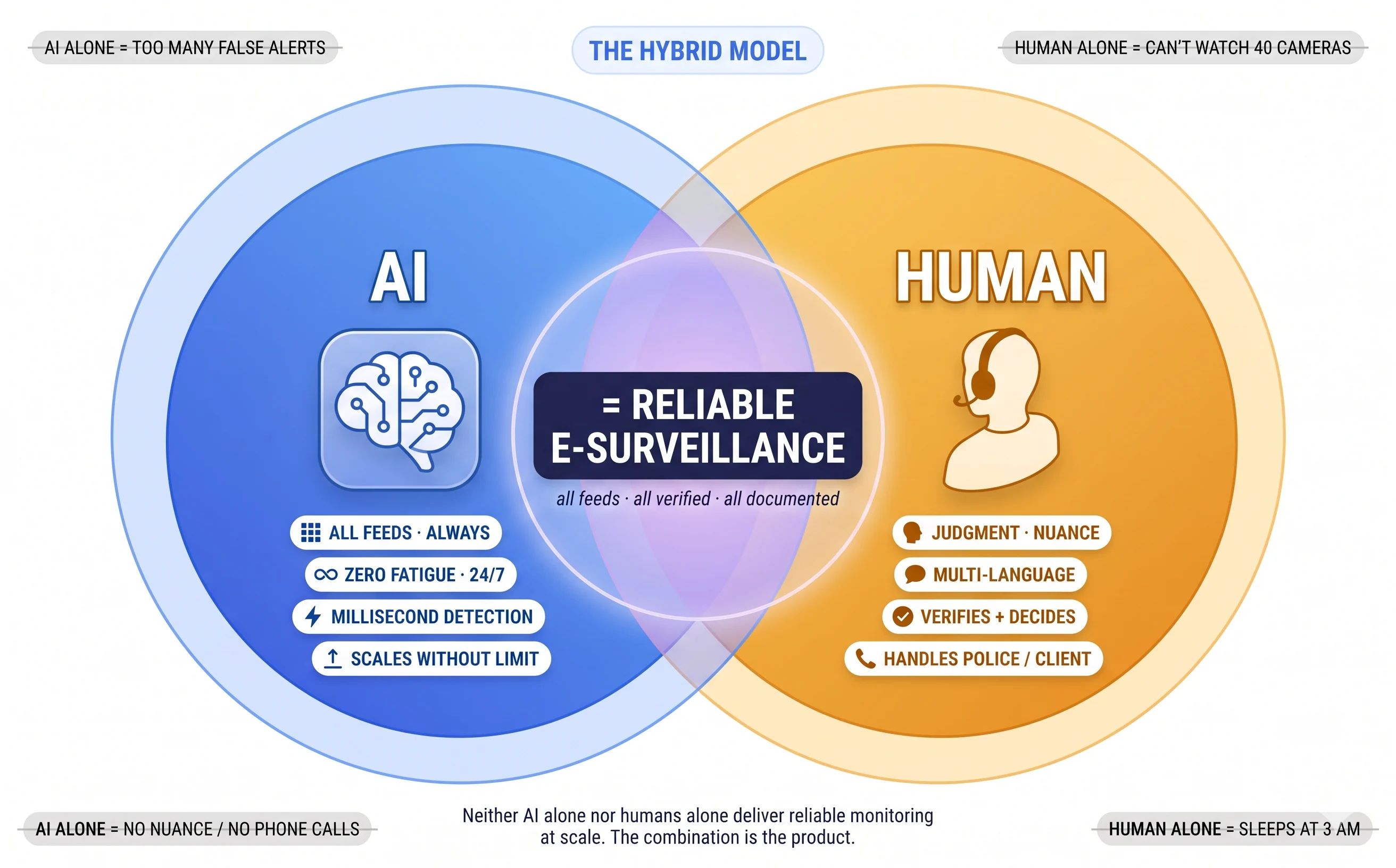
Neither AI alone nor humans alone can deliver reliable e-surveillance at India scale. The combination is what works.

The Hybrid Argument

AI does what humans cannot. Humans do what AI cannot. The service is the integration.

AI-only monitoring generates too many false alerts — animals, shadows, vehicles, blowing branches — and clients eventually disable or ignore the system. Human-only monitoring cannot keep up with multi-feed estates and degrades overnight as detailed in the Guard Problem above. The combination is what delivers reliable threat response at scale.

  • AI watches all feeds simultaneously — every camera, every second, with zero fatigue. One human operator can effectively monitor a handful of feeds; AI monitors hundreds.
  • AI runs without breaks, shift changes, or attrition — the operational reliability problem that drives 200%+ guard attrition rates is solved entirely.
  • Humans verify what AI flags — the false-positive rate of any AI vision system is high without human judgement; a trained operator separates the real threat from the stray cat in 5-10 seconds.
  • Humans handle nuance AI cannot — choosing the right voice-down language for the situation, judging escalation severity, communicating with police, briefing client management.
  • Both produce documentation automatically — every AI flag and every operator action is logged with timestamps, making the evidence trail audit-grade by default.

Tentovision's AI engine is built into the platform, not a third-party bolt-on layered onto someone else's hardware. The operator workflow is built around the AI's output, not parallel to it.

Feature image — AI + Operator collaboration
(AI detects, operator verifies, both document)
AI plus human operator collaboration model — AI detects every feed while operator verifies and decides
A Realistic Scenario

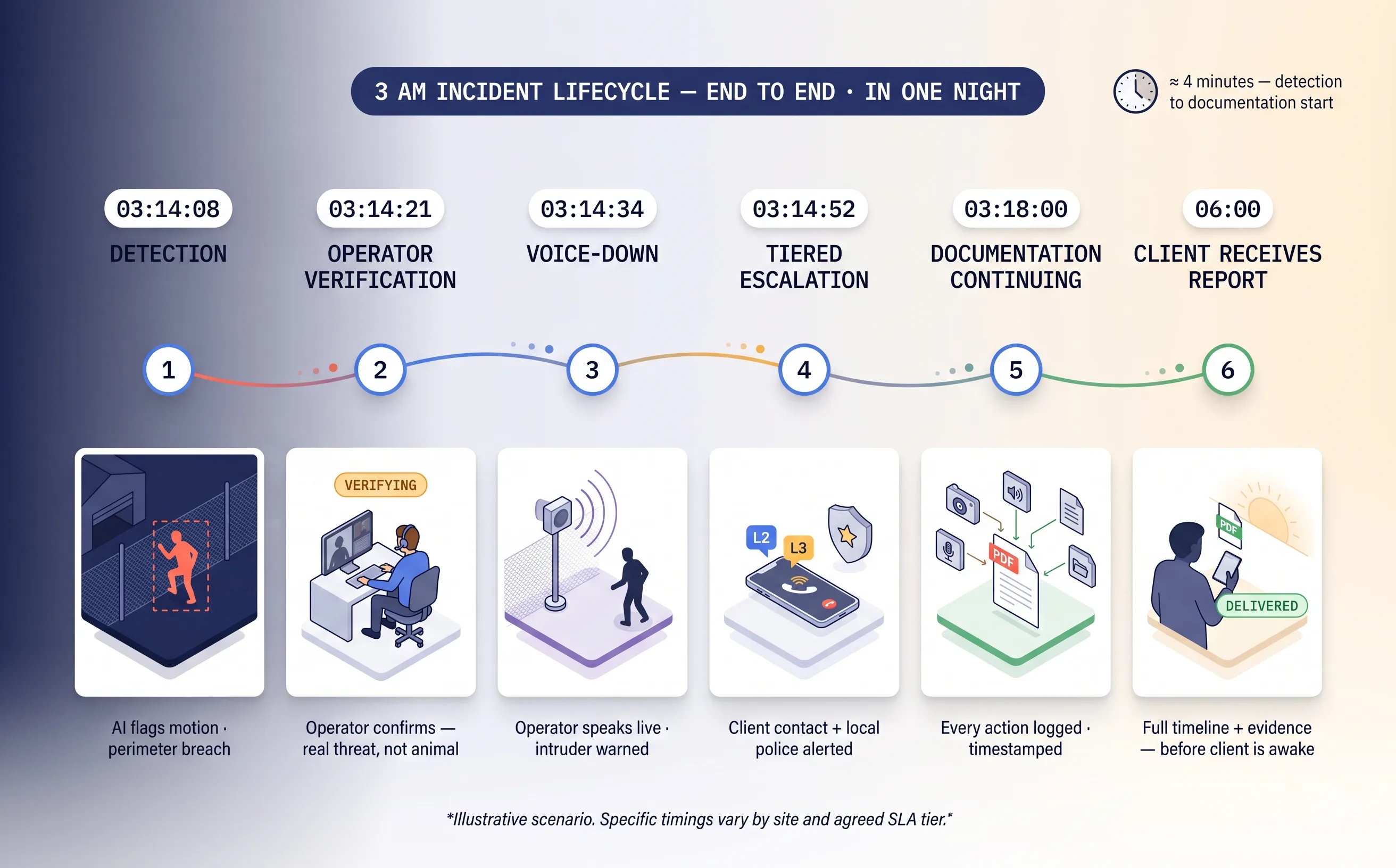
The 3 AM Incident Lifecycle — what actually happens, end to end

An illustrative walkthrough of how the five workflow steps play out for one real-shaped event. (Timings are illustrative targets; actual SLAs are agreed at assessment.)

  • 03:14:08 — AI flag. Motion detected at the rear perimeter of a warehouse site. AI classifies it as a person (not animal, not vehicle) and raises the alert in the SOC console.
  • 03:14:21 — Operator verification. SOC operator pulls the live feed, sees a person climbing the fence, and within seconds confirms the threat. False-alarm dismissals would close here.
  • 03:14:34 — Voice-down. Operator speaks live through perimeter speakers: "Attention — you have been seen on camera. Security and police are being alerted. Leave the property immediately." Most intrusions end at this step.
  • 03:14:52 — Tiered escalation. If the intruder doesn't leave: operator calls the designated site contact (L2) and local police station (L3), trigger any on-site alarms, and continue voice-down. Management gets an SLA-tier notification (L4).
  • 03:18:00 — Documentation continues. Every voice-down clip, every call timestamp, every camera angle is being logged in parallel. The PDF incident report is auto-generated and emailed to the client by 06:00 — before they're awake.
  • By morning. Client has a complete timeline: detection, verification, voice-down outcome, escalation responses, police arrival time, video evidence files. No "what happened last night?" conversation — the file is already there.

Compare to the same incident under guard-only monitoring: usually discovered at the morning shift handover, with missing footage, no timeline, and no escalation trail. The difference is what insurance and law enforcement actually want.

Feature image — 3 AM incident timeline
(detect · verify · deter · escalate · document)
Illustrative 3 AM incident lifecycle timeline showing detection, verification, voice-down, escalation, and documentation sequence
The Comparison

E-Surveillance vs Security Guards: A Practical Comparison

Not "guards are bad" — but for monitoring, a SOC outperforms a night guard on every axis that matters. (All figures illustrative market ranges.)

Dimension Security Guards (monitoring role) Tentovision E-Surveillance
Monthly cost per site~₹60K–₹1L for 3-shift cover~₹15K–₹30K (illustrative)
Night-shift reliabilityAttention fades after a few hoursAI-assisted, alert 24/7
Camera coverageA few feeds watched effectivelyAll feeds, simultaneously
Response to a threatMust notice, then react (minutes)Detect in seconds, act on SLA
DocumentationWritten up later, if at allAuto-logged, timestamped, instant
ScalabilityEach site needs ~4 more guardsSOC scales without proportional cost
Active deterrenceVisible presence onlyVoice-down intervention in progress
Evidence qualityOne person's accountTimestamped video + action log

Honest scope note: e-surveillance doesn't replace all guards. High-risk sites still benefit from a physical presence for access control, visitor management, signed handovers, and hands-on response. What it replaces is the monitoring function — the part guards do worst, especially at night — and the budget that goes with it. For most distributed businesses the most cost-effective model is monitoring-led, with a minimal guard presence only where physical presence genuinely adds value.

Why Tentosoft

Why Choose Tentovision for E-Surveillance

India has capable e-surveillance providers — the honest question is fit, not superlatives. Here's where Tentovision is genuinely different.

AI-First, Not a Bolt-On

The detection engine is built into the Tentovision platform — not a third-party analytics layer wrapped around someone else's hardware. The operator workflow is designed around AI output, not parallel to it.

Works With Your Cameras

Vendor-agnostic over ONVIF/RTSP — no proprietary hardware lock-in, no rip-and-replace. The SOC monitors your existing mixed-brand estate; speakers and night-cameras are added selectively only where missing.

Indian Data Residency · Azure India

Surveillance footage, telemetry, and incident archives stay in Indian jurisdiction by default on Microsoft Azure India regions (Mumbai & Pune). DPDP Act 2023 compliant. Not AWS-US — material for regulated buyers.

We Keep Cameras Online

Built-in camera health monitoring and downtime prevention mean the feeds the SOC relies on don't silently fail. No "we couldn't see your incident because the camera was offline" excuse.

One Platform · Both Models

Self-monitor head-office and high-traffic sites through multi-site monitoring software; outsource remote, overnight, hard-to-staff sites to the SOC. Software where you want control, service where you want it handled — both on the same platform.

India-Priced & Honestly Positioned

Securens, Igzy, and other established Indian providers are real options — the honest question is fit. Tentovision is priced competitively for Indian estates, integrates with existing camera infrastructure, and positions transparently against alternatives rather than claiming superlatives.

The Complete Suite

Tentovision Video Management — Software & Service

Each sibling page covers one mode of running surveillance. This page is the managed-service option — where we watch your cameras, not just give you the software to watch them yourself.

Video Management Software Parent Platform

The umbrella platform — VMS, AI analytics, health monitoring foundation.

Enterprise VMS

Multi-tenant, multi-site, role-based — the platform for large estates.

Multi-Site CCTV Monitoring

Self-monitoring software — you watch your own cameras across sites.

CCTV Command Center

Operator console — the platform our SOC operators use to run the service.

E-Surveillance System You Are Here · Managed Service

The outsourced service — our trained SOC operators watch your cameras 24/7, verify threats, voice-down intruders, escalate to police, and document every event. Same platform as the software products above; we just run it for you.

The software lets you watch your cameras. E-surveillance is when we watch them for you. Both run on the same Tentovision platform — switch sites between models as your needs change.

Industries

Where E-Surveillance Delivers Maximum Impact

Seven scenarios where the service earns its place — large perimeters, remote sites, valuable assets, night-time exposure. (Enterprise references shown with permission for prior platform deployments; scenarios illustrative.)

Warehouses & Godowns

Large perimeters, valuable stock, peak night-time exposure. Most warehouse theft happens 1–4 AM when guards are least alert. SOC watches the fence line 24/7 and voice-downs within seconds. (e.g. YNT Supply Chain, Emerson.)

Construction Sites

Equipment and material theft on temporary sites where relocating guards is costly. Deploys with temporary cameras and edge devices via the Cloud Adapter, then moves with the project across the build phases.

ATM Networks

Vandalism, gas-cutting, skimming, loitering. SOC monitors hundreds of ATMs simultaneously, spots suspicious approach, and voice-downs before an attack escalates. Compliance reports map to RBI documentation requirements. See banking.

Solar Farms & Infrastructure

Remote, huge perimeters, no nearby physical response. Panel theft is growing in rural India. Thermal cameras detect night-time intrusion where no guard can practically be posted; the SOC covers many sites from one operations centre.

Retail Chains (After Hours)

Stores covered in trading hours but exposed overnight. SOC watches closed stores through the night — break-ins, glass breakage, fire, flooding — without an overnight guard at every branch. See retail.

Industrial Facilities & Factories

Perimeter security, restricted-zone entry, and fire risk that still needs watching when the floor is empty. Combines intrusion detection with fire/smoke detection. (e.g. Nippon Paint.) See manufacturing.

Healthcare Campuses — Overnight Critical Areas

A dark camera over an ICU bed, a psychiatric ward door, or a narcotics cabinet is a clinical and medico-legal risk — not an IT problem to discover at the morning round. The SOC watches critical-area feeds continuously through the night, voice-downs unauthorised access, and produces timestamped reports acceptable to NABH auditors. Multi-block campus coverage with limited IT staffing is exactly the gap e-surveillance closes. (e.g. Narayana Health.) See healthcare.

Proven Capability

Platform Proven Across Indian Enterprise Estates

The Tentovision platform powering the e-surveillance service runs across enterprise deployments. (500+ figure and client references shown verify-before-publish; references describe platform use, not specific e-surveillance incident outcomes.)

Multi-hospital campus monitoring

500+ cameras across Narayana Health locations on the Tentovision platform. The same monitoring engine and operator workflow that the e-surveillance service uses; consent-gated reference for platform use.

— Narayana Health, healthcare (verified with permission)

Manufacturing perimeter and fire monitoring

Nippon Paint plant deployments combine intrusion detection with fire/smoke analytics — the integration pattern that makes e-surveillance valuable for industrial facilities where empty floors still need active watching.

— Nippon Paint India, manufacturing (verified with permission)

Data-centre construction perimeter

STT GDC India construction-site monitoring — the use case where temporary cameras, edge devices, and SOC-grade monitoring all matter for assets in motion. Pattern translates directly to construction e-surveillance.

— STT GDC India, data centre construction (verified with permission)

Distributed logistics estate

YNT Supply Chain and Emerson logistics deployments — multi-warehouse perimeters under one platform. The exact pattern e-surveillance is designed for: many sites, night-peak risk, mixed-brand cameras already installed.

— Logistics enterprise references (verified with permission)

Start with a free security assessment. We map your cameras, current guard spend, gap areas, and produce a side-by-side: what e-surveillance would cover, what physical presence still needs, projected monthly cost. You see real economics on your real sites before any pilot.

24/7(verify)
SOC operations
AI + Human
Verification model
5-Step
Service workflow
4-Layer
Escalation tiering
Azure India
Data residency
Vendor
Agnostic / ONVIF / RTSP
Compliance & Governance

E-Surveillance Operations Governance

A managed monitoring service handles client video data; the governance frame around it is part of the product. Tentovision's controls and reporting are mapped to the frameworks that matter to Indian enterprise buyers.

DPDP Act 2023

Data privacy compliant — video, telemetry, and incident archives governed under DPDP for surveillance use.

ISO 27001 Aligned

Information-security practices mapped to ISO/IEC 27001 controls for SOC operations.

SOC 2 Aligned

Operational controls mapped to SOC 2 Type II principles for security & availability.

VAPT Aligned

Internal vulnerability assessment and penetration testing for the platform and SOC infrastructure.

SOC Ops 24×7 (verify)

Continuous operations with shift rotation, dual-operator coverage at peak windows, and structured handover.

Microsoft Azure India

Mumbai & Pune regions for data residency. AES-256 encryption at rest; encrypted transit.

RBI Alignment

Reporting templates aligned with RBI surveillance documentation for banking and ATM monitoring deployments.

Per-Project Attestation

Formal SLA documentation, operator-roster confirmation, and audit-readiness packs per client deployment on request.

Frequently Asked Questions

E-Surveillance System FAQs

The questions buyers ask most — answered honestly, with the caveats made visible.

What is an e-surveillance system?

An e-surveillance system is a managed remote monitoring service where trained operators in a Security Operations Centre watch your cameras 24/7 with AI assistance, verify threats, deter intruders by remote voice-down, and escalate confirmed incidents to you or the police. Unlike ordinary CCTV — which only records for later review — it actively watches and responds in real time. It is designed to replace or reduce the night-time monitoring that guards do poorly.

How is e-surveillance different from regular CCTV?

Regular CCTV records footage so you can review it after an incident; e-surveillance monitors that footage live and acts on it as the incident unfolds. The cameras may be the same — the difference is that someone, AI plus a trained operator, is actually watching and can intervene by voice, escalate to police, and document everything. In short: CCTV is passive evidence; e-surveillance is active prevention.

Can e-surveillance replace security guards?

It replaces the monitoring function that guards perform worst — staying alert overnight and watching many cameras at once — not every role a guard plays. Access control, visitor handling, and hands-on physical response can still need a person on site. For most businesses, the most cost-effective model is monitoring-led, with a minimal guard presence only where physical presence genuinely adds value.

How much does e-surveillance cost in India?

It is normally priced as a monthly service per site or camera group rather than one fixed figure, because cost depends on camera count, monitoring hours, and response level — a common ballpark is roughly ₹15,000 to ₹30,000 per site, which you should confirm with a quote. The useful comparison is against guards: a single 12-hour guard shift is often cited around ₹15,000–₹18,000 a month and 24/7 rotational cover around ₹28,000–₹35,000, so monitoring multiple sites can cost less than staffing even one of them around the clock. Figures are illustrative market ranges, not a Tentosoft quote.

How does remote voice-down deterrence work?

When an operator confirms a real intrusion, they speak live through speakers at your site, telling the intruder they have been seen and that security and police are being alerted. This real-time intervention stops most intrusions before any loss — which a recording-only camera can never do. If the intruder does not leave, the operator escalates while continuing to document the event.

What happens when an intruder is detected at 3 AM?

The AI flags the movement within seconds and a SOC operator pulls up the live feed to verify it is a real person — not an animal or shadow. Confirming the threat, the operator immediately voice-downs through the site speakers; if the intruder does not leave, they call your designated contact and local police, trigger any on-site alarms, and keep recording. By morning you have a timestamped report of the whole event — detection, verification, voice-down, escalation, and outcome — rather than discovering a loss hours later.

Does it work with my existing cameras?

Usually, yes. The service is vendor-agnostic and connects to the cameras and recorders you already own over standard protocols, so there is typically no rip-and-replace. Where a site needs speakers for voice-down or better night coverage, those are added selectively to keep cost down. See the camera brands listed earlier on this page — 100+ supported via ONVIF/RTSP.

How is this different from multi-site CCTV monitoring software?

Multi-site CCTV monitoring software gives you a dashboard to watch your own cameras; e-surveillance is a managed service where our trained operators watch your cameras for you. Software is self-operated; e-surveillance is outsourced. Both run on the same Tentovision platform, so you can self-monitor some sites and outsource others. Compare: Multi-Site CCTV Monitoring.

What industries benefit most from e-surveillance?

Any operation with large perimeters, remote or unmanned sites, valuable assets, and night-time exposure — warehouses and logistics, construction sites, ATM networks, solar farms and infrastructure, after-hours retail, factories, and healthcare campuses with overnight critical-area monitoring needs. These are exactly the places where posting alert guards around the clock is expensive, impractical, or unreliable. The common thread is that the risk peaks when no one is watching — which is precisely what a 24/7 SOC fixes.

Can I monitor some sites myself and outsource others?

Yes — because both models run on one Tentovision platform, you can keep certain sites self-monitored through the software and hand others to our SOC as a managed service. Many businesses self-monitor their head office or high-traffic sites and outsource remote, overnight, or hard-to-staff locations. The client visibility portal lets you see live SOC activity, active incidents, and incident reports on outsourced sites, so transparency is preserved even on the outsourced portion. You can shift the balance over time as your needs change, without changing systems.

Free Security Assessment

Get a Free E-Surveillance Assessment for Your Sites

We'll map your existing cameras, current guard spend, gap areas, and project monthly cost — before any pilot. No obligation, no rip-and-replace pitch.

1

Site & Camera Audit

We review your camera count, coverage, brands, recording setup, and current guard arrangement across the sites you want assessed.

2

Coverage-vs-Cost Map

Side-by-side: what e-surveillance would cover at each site, what physical presence still needs, projected monthly cost — based on your real estate, not generic benchmarks.

3

SOC Walkthrough & Pilot Scope

If economics make sense, we propose a 1–2 site pilot — typically a high-risk warehouse or night-exposed retail location — to validate detection, voice-down, and reporting on real footage before fleet rollout.

4

Phased Rollout Plan

After successful pilot: scope the rest of the estate, integration with existing incident workflows, SLA documentation, and operator-roster onboarding — agreed before live cutover.

📞 +91 99620 37023
✉️ info@tentosoft.com
📍 7th Floor, 4/293, RAR Technopolis, OMR, Perungudi, Chennai 600096

Request Free Assessment

Fill the form and a Tentosoft solutions specialist will revert within one business day.

🔒 DPDP-aligned · data stays in India (Microsoft Azure India)
🛡️ ISO 27001 & SOC 2 aligned operations
📞 Response within one business day

Replace passive CCTV with active 24/7 monitoring.

Cameras you already own. A SOC that doesn't sleep, can watch every feed at once, and produces a timestamped report on every event by morning. Start with a free assessment of one or two sites — see the real numbers on your real estate.