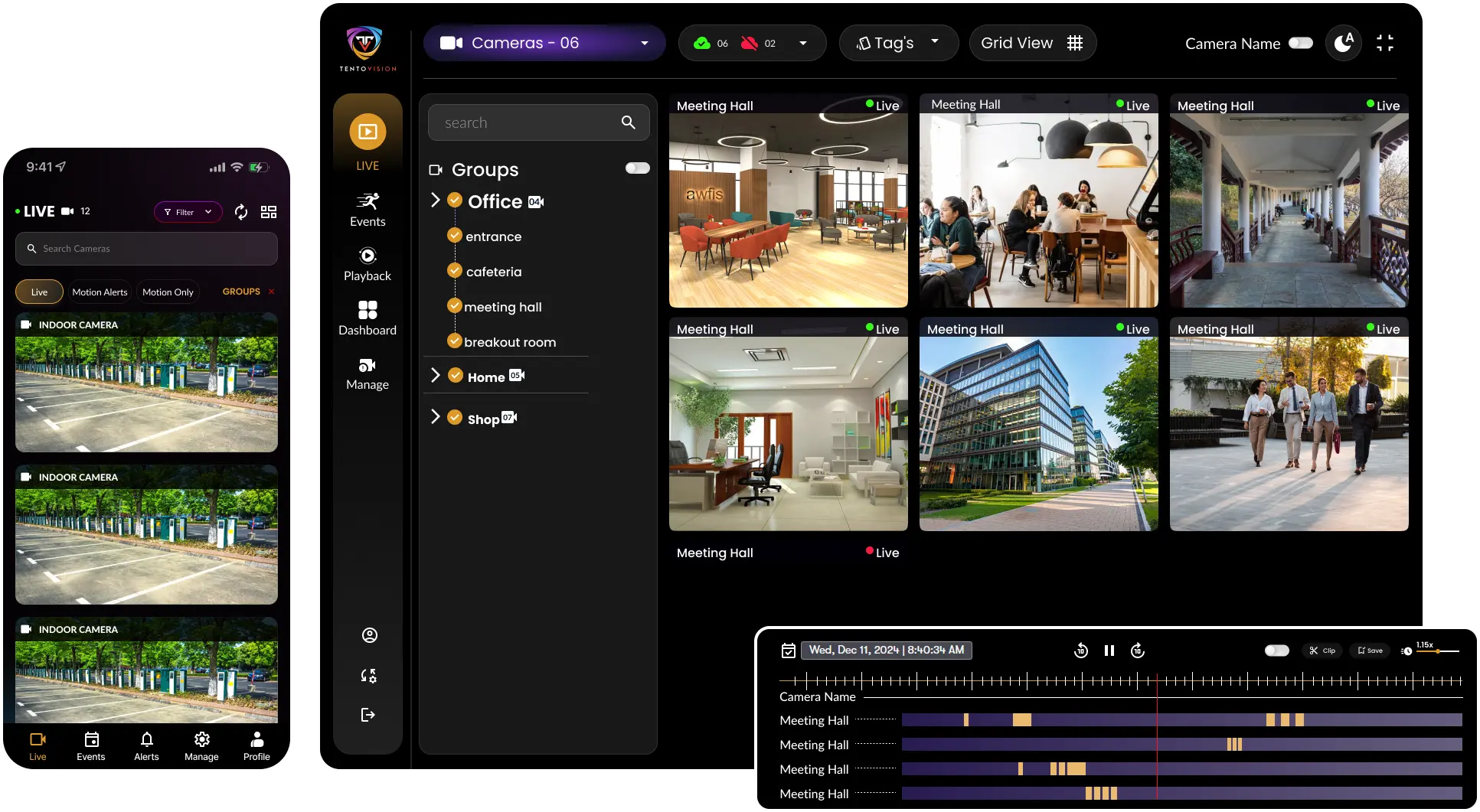
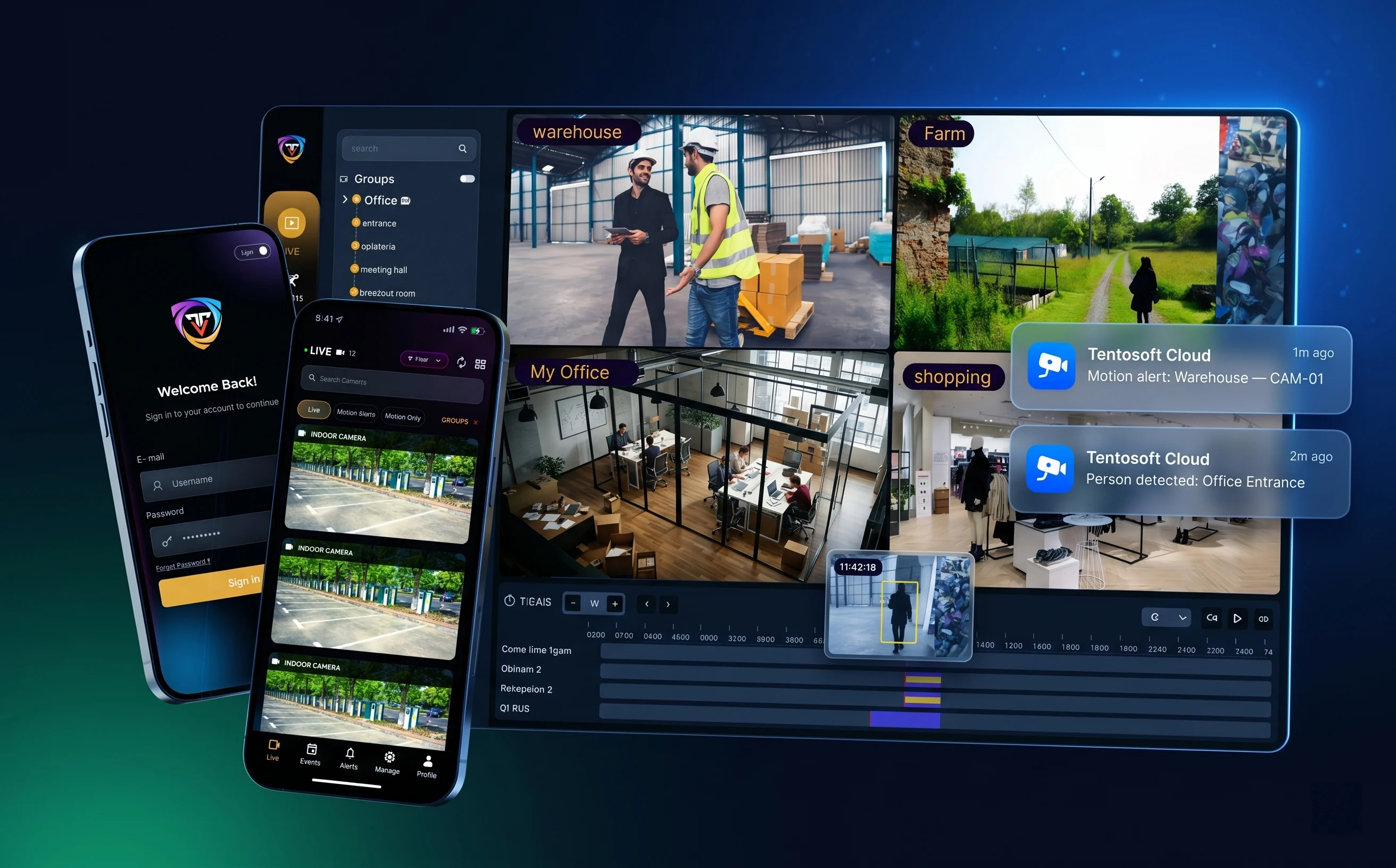
Tentovision is a cloud-based VMS and a direct SmartPSS alternative that works with your existing Dahua cameras over RTSP and ONVIF — no dedicated Windows PC, no port forwarding, no hardware to replace. Keep your Dahua IPC-HDW and IPC-HFW cameras exactly where they are; swap only the software managing them. You gain cloud backup, browser and mobile access, camera health monitoring, and 20+ AI analytics on top of the Dahua hardware you already own.
SmartPSS does its core job — managing a single-brand, single-site Dahua deployment from one Windows machine. But most installations have outgrown it, and Dahua's own software roadmap (SmartPSS, SmartPSS Lite, DSS Express, DMSS) has made staying put confusing. As soon as a deployment spans several buildings, mixes camera brands, crosses the camera ceiling, or falls under a compliance regime that expects offsite retention, the gaps below start to bite. Three limitations push IT managers, CISOs, and integrators toward a SmartPSS migration.
SmartPSS only manages Dahua devices. Add a CP Plus camera at a new branch or inherit a Hikvision install, and it can no longer give you one pane of glass. After India's BIS mandate reshaped procurement, multi-brand fleets are the norm — and a Dahua-only client becomes a liability.
SmartPSS is a Windows desktop app with no native browser client and a practical ceiling around 256 cameras. It stutters on multi-camera live view, and Dahua now steers users toward SmartPSS Lite or the server-based DSS Express — so the "right" client is no longer obvious.
For remote access, SmartPSS users fall back to the gDMSS Plus (now DMSS) app, which relies on P2P or port forwarding — exposure a CISO wants closed. No camera health monitoring, no AI analytics beyond basic motion, no real multi-site dashboard.
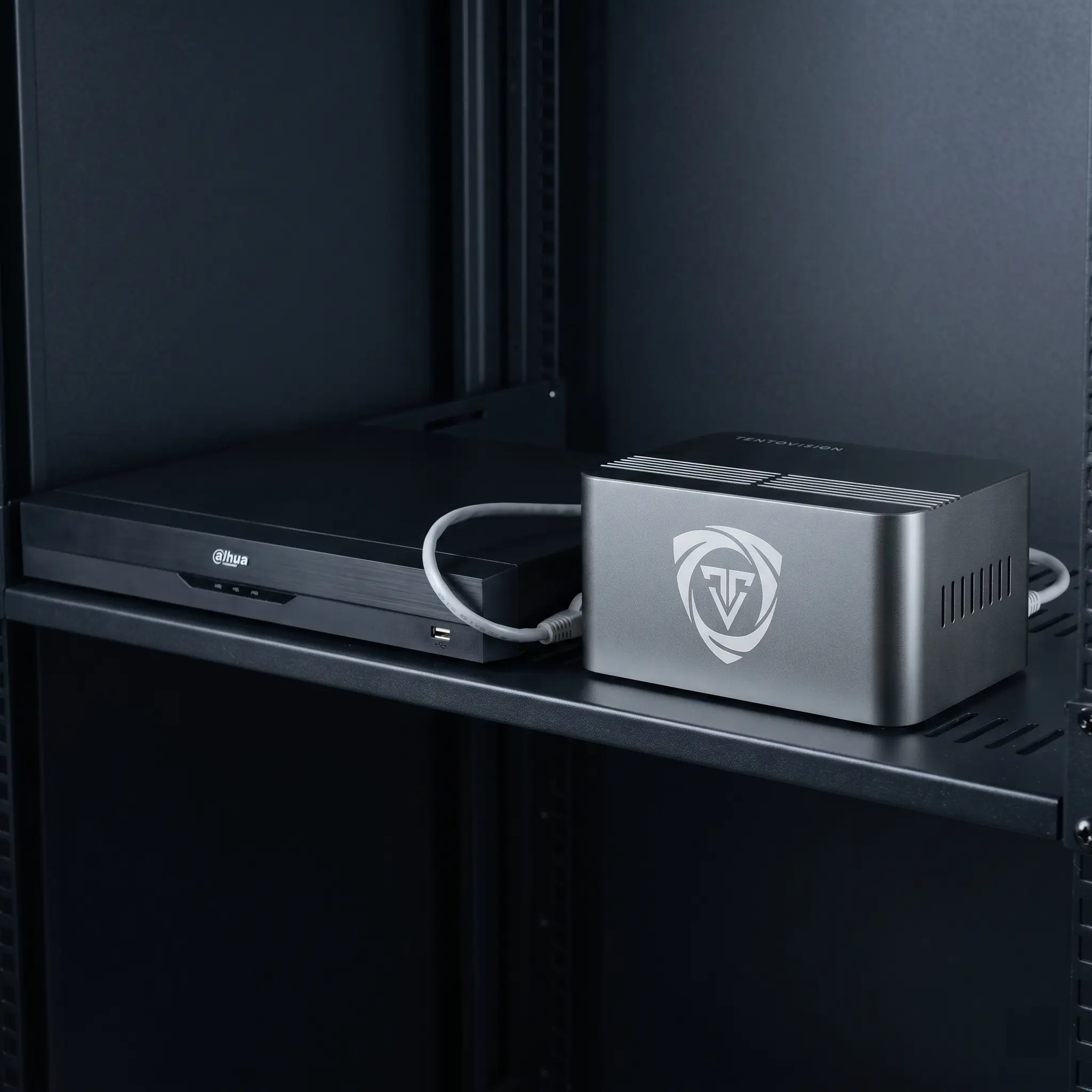
The Tentovision Cloud Adapter connects directly to your existing Dahua cameras and to DH-NVR4xxx, DH-NVR5xxx, and DH-XVR series recorders over the same network — no rip-and-replace. It mirrors the streams your Dahua devices already produce to the cloud, so the local recorder keeps doing its job while a second copy is secured offsite.
Channel mapping is direct: a DH-NVR5xxx's channels appear as individual cloud streams, so you choose exactly which Dahua cameras get offsite backup and at what retention. To keep upload bandwidth predictable, the Cloud Adapter sends the camera sub-stream to the cloud while the main stream continues recording locally on the recorder — the same dual-stream split used in the setup guide below.
Explore CCTV cloud storage →
gDMSS Plus (and the newer DMSS app) works for one user checking one site from a phone, but it scales poorly and carries security baggage. Tentovision is a gDMSS alternative built for organisations rather than individual devices.
Because viewing runs on the camera sub-stream by default, remote playback stays smooth even on constrained branch-site upload bandwidth, while supervisors still get full-resolution main-stream footage on demand. Mobile push alerts replace the gDMSS polling model, so an IVS tripwire or intrusion event on a Dahua IPC-HFW camera reaches the right person in seconds — with a full audit trail of who viewed what and when.
See the wider cloud VMS →
These are the three options a Dahua user actually weighs today. This is an honest comparison — SmartPSS is free and genuinely capable for the job it was built for, and the table reflects that.
| Feature | SmartPSS | DSS Express | Tentovision |
|---|---|---|---|
| Multi-brand camera support | ✗ Dahua only | ✗ Dahua only | ✓ 100+ brands |
| Cloud video recording | ✗ | ✗ | ✓ Azure-hosted |
| On-premise recording | ✓ via Dahua NVR | ✓ | ✓ |
| Hybrid (cloud + local) | ✗ | ✗ | ✓ |
| AI analytics (ANPR, PPE, People Counting) | ✗ basic motion | Add-on | ✓ 20+ analytics |
| Camera health monitoring | ✗ | Partial | ✓ |
| Deep Dahua-native config (IVS tripwire, SMD) | ✓ Strong | ✓ Strong | Via ONVIF |
| Multi-site management | Limited (~256 cams) | ✓ | ✓ Unlimited |
| Runs without a dedicated PC/server | ✗ | Server needed | ✓ Browser |
| Mobile + web browser access | gDMSS app only | Limited | ✓ Any browser + app |
| Pricing model | Free | Free tier (server) | Subscription / perpetual |
Read honestly, the table tells you when not to switch as clearly as when to. If you run a single Dahua-only site, record locally on a DH-NVR, never need remote access beyond the occasional gDMSS check, and have no appetite for a subscription, then SmartPSS is free, stable, and adequate — and it still wins on deep Dahua-native config (IVS tripwire, SMD) and fully local, air-gapped operation. The case for a SmartPSS alternative appears the moment any of those conditions break: you add a second brand or site, cross the camera ceiling, need offsite backup, want the port-forwarding exposure closed, or want AI analytics on cameras you already own.
Connecting Dahua cameras takes about five minutes. The steps below use standard Dahua addressing; confirm the exact paths against your camera's firmware, since some firmware lines and OEM rebrands vary slightly.
Check the device list in SmartPSS, or use the Dahua ConfigTool to scan the subnet. The Dahua factory default IP is 192.168.1.108 if the camera has never been configured.
In the camera's web interface, go to Setup → Network → Port → ONVIF (on some firmware, Network → Advanced → ONVIF) and enable it. If prompted, create a dedicated ONVIF user — on several Dahua firmware versions this is separate from the admin account.
Dahua uses a specific stream path on default port 554:
# Main stream
rtsp://username:password@IP:554/cam/realmonitor?channel=1&subtype=0
# Sub stream
rtsp://username:password@IP:554/cam/realmonitor?channel=1&subtype=1
Plug the Tentovision Cloud Adapter into the same network switch as your Dahua cameras or recorder. Power it on — a single blue LED indicates network connectivity.
Scan the QR code on the adapter with the Tentovision app to register it to your account. Pairing typically completes in under 60 seconds.
Use ONVIF auto-discovery to pull cameras in automatically, or enter the RTSP URL manually for any device you'd rather add by hand. Bulk-add supports CSV import for sites with 50+ cameras.
Confirm each live feed appears in the Tentovision dashboard, then set recording mode (continuous, motion, or hybrid) and cloud retention per camera. You're live.
IPC-HDW series (dome), IPC-HFW series (bullet), IPC-HDBW series (turret), SD series (PTZ), and the broader DH-IPC range. 40+ Dahua models tested and supported.
DH-NVR4xxx and DH-NVR5xxx (network recorders), DH-XVR5xxx and DH-XVR7xxx (hybrid/analog recorders).
/cam/realmonitor?channel=1&subtype=0, not Hikvision's /Streaming/Channels/101 format.channel= number; on a DH-XVR, analog channels use different numbering than IP channels.subtype=1) to the cloud and keep the main stream for local recording.Tentovision runs your existing Dahua fleet three ways, so the deployment matches the site rather than forcing the site to match the software.
Subscription, with no recorder required. The Cloud Adapter pulls your Dahua camera streams straight to Microsoft Azure, and there's nothing on site to maintain beyond the adapter. If you've inherited a Dahua deployment with an ageing DH-XVR, this retires the local recorder entirely.
One-time cost, running entirely without internet. Video never leaves the building, and your existing DH-NVR5xxx keeps recording locally as the system of record while the edge device handles management and analytics.
Your Dahua NVR handles instant local playback; the Cloud Adapter mirrors a sub-stream copy to the cloud for offsite resilience — the responsiveness of local storage with the security of the cloud. The most common choice for multi-site enterprises.
Mix modes across your estate and manage them together with full multi-site CCTV monitoring.
Your existing Dahua IPC-HDW and IPC-HFW cameras can do more than just record. Tentovision applies modern analytics to the streams they already produce — no specialist cameras, no hardware swap. A fixed IPC-HDW turret at a shop entrance is enough for people counting and shoplifting alerts; an SD-series PTZ covering a gate feeds ANPR and intrusion detection. Processing runs in the cloud for cloud and hybrid deployments, or entirely on the edge device where footage must stay on site.
Read and log vehicle plates at gates, car parks, and loading bays — with watchlist matching.
VehicleFlag missing helmets, vests, gloves, masks, goggles, or safety boots on industrial sites.
SafetyAutomated footfall and occupancy counting across retail, transit, and facility entrances.
RetailWatchlist matching, access verification, and VIP / repeat-visitor identification.
IdentityEarly visual detection of fire and smoke before conventional sensors trigger — including outdoor scenarios.
SafetyBehavioural anomaly alerts at high-risk retail zones — concealment, sweeping, abnormal dwell.
RetailReal-time crowd density heatmaps with safe / critical thresholds for stadiums, transit hubs, events.
CrowdPerimeter breach alerts for restricted zones, server rooms, off-hour office areas, R&D labs.
SecurityConfigurable virtual tripwires with direction logic — entry, exit, or both — across any camera view.
SecurityAlerts when a person remains in a defined zone beyond a configurable time threshold — ATMs, lobbies, restricted areas.
SecurityDetects abandoned bags, parcels, or items in public areas — airports, transit hubs, secure zones.
SecurityDetects removal of monitored items — products, equipment, displays — with timestamped clip evidence.
RetailDistinguish cars, trucks, motorcycles, bicycles, buses, and pedestrians in traffic and parking feeds.
VehicleRead and log vehicle plates at gates, car parks, and loading bays — with watchlist matching.
VehicleFlag missing helmets, vests, gloves, masks, goggles, or safety boots on industrial sites.
SafetyAutomated footfall and occupancy counting across retail, transit, and facility entrances.
RetailWatchlist matching, access verification, and VIP / repeat-visitor identification.
IdentityEarly visual detection of fire and smoke before conventional sensors trigger — including outdoor scenarios.
SafetyBehavioural anomaly alerts at high-risk retail zones — concealment, sweeping, abnormal dwell.
RetailReal-time crowd density heatmaps with safe / critical thresholds for stadiums, transit hubs, events.
CrowdPerimeter breach alerts for restricted zones, server rooms, off-hour office areas, R&D labs.
SecurityConfigurable virtual tripwires with direction logic — entry, exit, or both — across any camera view.
SecurityAlerts when a person remains in a defined zone beyond a configurable time threshold — ATMs, lobbies, restricted areas.
SecurityDetects abandoned bags, parcels, or items in public areas — airports, transit hubs, secure zones.
SecurityDetects removal of monitored items — products, equipment, displays — with timestamped clip evidence.
RetailDistinguish cars, trucks, motorcycles, bicycles, buses, and pedestrians in traffic and parking feeds.
VehicleEstimate vehicle speed across camera-defined zones — useful for parking lots, industrial yards, campus roads.
VehicleDetect helmetless riders entering campus, factory, or warehouse premises — critical for India compliance.
SafetyAlert when vehicles or people move against the designated flow direction — one-ways, ramps, exits.
TrafficTrack queue lengths at counters, checkouts, and entrances — open more lanes before customers walk away.
RetailVisualise where people linger across a floor plan — optimise retail layouts, signage, and staff coverage.
AnalyticsEstimated age range and gender distribution from anonymised CCTV feeds — for retail planning and footfall insight.
RetailDetect smoking in restricted zones — factory floors, warehouses, hospitals, fuel stations.
SafetyFlag mobile phone use in restricted areas — production lines, driver cabs, secure zones, exam halls.
ComplianceDetect persons fallen on the ground and unmoving — alerting staff in healthcare, eldercare, warehouses.
SafetyMonitor inter-person distancing in queues and shared zones — flexible for health-safety policies.
SafetyAlerts when a camera is blocked, blurred, sprayed, or repositioned — guards against deliberate evasion.
SecurityVehicle counts, lane occupancy, congestion patterns, and average speed across road segments.
TrafficEstimate vehicle speed across camera-defined zones — useful for parking lots, industrial yards, campus roads.
VehicleDetect helmetless riders entering campus, factory, or warehouse premises — critical for India compliance.
SafetyAlert when vehicles or people move against the designated flow direction — one-ways, ramps, exits.
TrafficTrack queue lengths at counters, checkouts, and entrances — open more lanes before customers walk away.
RetailVisualise where people linger across a floor plan — optimise retail layouts, signage, and staff coverage.
AnalyticsEstimated age range and gender distribution from anonymised CCTV feeds — for retail planning and footfall insight.
RetailDetect smoking in restricted zones — factory floors, warehouses, hospitals, fuel stations.
SafetyFlag mobile phone use in restricted areas — production lines, driver cabs, secure zones, exam halls.
ComplianceDetect persons fallen on the ground and unmoving — alerting staff in healthcare, eldercare, warehouses.
SafetyMonitor inter-person distancing in queues and shared zones — flexible for health-safety policies.
SafetyAlerts when a camera is blocked, blurred, sprayed, or repositioned — guards against deliberate evasion.
SecurityVehicle counts, lane occupancy, congestion patterns, and average speed across road segments.
TrafficAll 20+ analytics work on the Dahua cameras you already own — no camera replacement required. Cloud-processed for cloud and hybrid deployments, edge-processed for on-premise sites. Analytics that SmartPSS cannot provide at all run here on the same IPC-HDW and IPC-HFW feeds you are already recording.
/cam/realmonitor?channel=N&subtype=0 path. Just confirm the channel numbering, since on a DH-XVR the analog inputs are numbered differently from any added IP channels.rtsp://username:password@IP:554/cam/realmonitor?channel=1&subtype=0 and the sub stream uses subtype=1, both on default port 554. Change the channel= value for each NVR or XVR channel. This is different from Hikvision's /Streaming/Channels/ format, so if you've migrated from mixed hardware, use the Dahua path for Dahua devices./cam/realmonitor RTSP path, so the camera connects normally. On some older firmware you must enable ONVIF and create a separate ONVIF user (distinct from the admin account) before discovery succeeds — that single step resolves most legacy-firmware connection issues.Try Tentovision with your existing Dahua fleet — free for 14 days. Tell us your camera count and we'll size the right Cloud Adapter (or virtual deployment) for your setup, typically within 1 business day.
Dahua IPC-HDW, IPC-HFW, SD-series PTZ, DH-NVR4xxx/5xxx, DH-XVR — plus 100+ ONVIF brands.
Plug in the Cloud Adapter, scan the QR, add cameras via RTSP or ONVIF auto-discovery.
SOC 2 and ISO 27001 aligned data handling. DPDP Act 2023 compliant. Your video stays private.
All onboarding, deployment, and support handled by our India team — in your time zone.
Fill the form — our team responds within 1 business day.