Book Free Demo
Book Free Demo
Part of the Camera Health Monitoring Suite

CCTV Downtime Prevention for Always-On Surveillance

A camera offline for 12 days. An NVR that stopped recording after a reboot. A hard drive that failed silently, taking three weeks of footage. In unmonitored estates these aren't edge cases — they're the norm, discovered too late. CCTV downtime prevention is a proactive framework that monitors every layer of your surveillance infrastructure — cameras, recorders, storage, and network — to ensure continuous recording and zero surprise failures.

99.7%Uptime target (illustrative)
Multi-LayerPrevention
500+Deployments (verify)
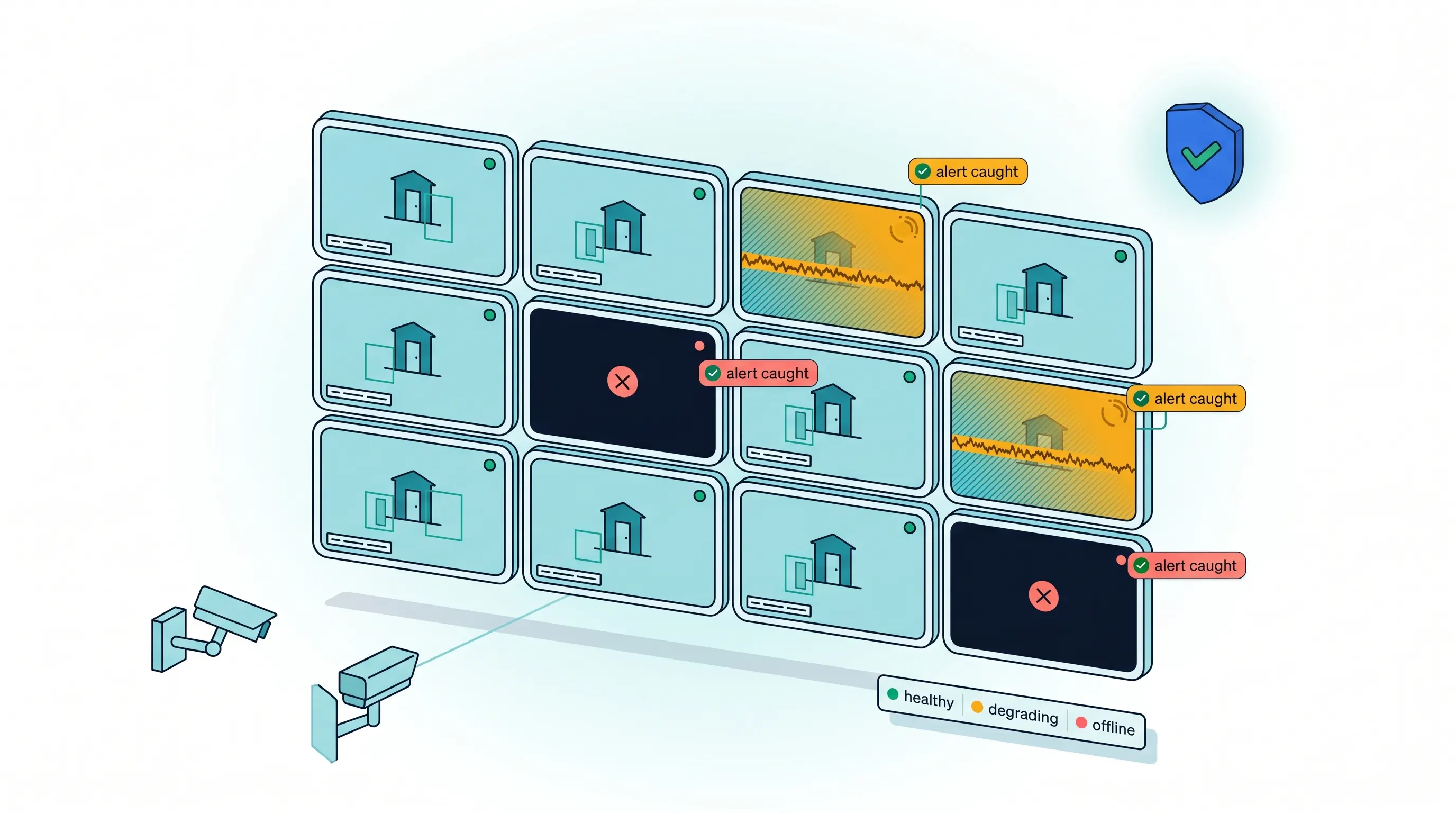
Hero image — Estate uptime dashboard
(SLA-on-target across sites, zero silent failures)
Tentovision CCTV downtime prevention dashboard showing estate-wide uptime SLA on target across distributed sites
Multi-Layer Prevention
SLA Uptime Tracking
Board-Ready Reports
Vendor-Agnostic
VAPT Aligned
The Stakes

The Real Cost of CCTV Downtime

Downtime is rarely a line item on a repair invoice — the real cost lands in a courtroom, an audit, an IT budget, or a boardroom. (Figures below are illustrative industry estimates, not Tentosoft-measured numbers.)

Footage Loss — Legal & Compliance Exposure

A retail chain finds shoplifting at Store 47 — but the NVR's drive failed three weeks ago. No footage, no case. In banking, healthcare, and data centres, missing footage isn't an inconvenience — it's a compliance violation with penalties.

Security Blind Spots — Operational Risk

In a typical unmonitored multi-site estate, industry analyses cite that roughly 15% of cameras are offline at any moment. In a 500-camera network, that's dozens dark right now — each an unmonitored entrance, an unrecorded incident waiting to happen.

Reactive Maintenance — Wasted Resources

Without proactive monitoring, IT teams burn most of their CCTV maintenance budget on emergencies — emergency site visits, in-person diagnosis of remotely-detectable faults, drives replaced months too late. Reactive work is widely cited as 3–5× the cost of planned maintenance.

Reputation & Boardroom Risk

When an incident occurs and there's no footage, the question stops being technical. "Why weren't the cameras working?" travels straight to the board — and the CISO, VP Operations, or facility head answers for it.

Definition

What is CCTV Downtime Prevention?

CCTV downtime prevention is a proactive surveillance-management framework that continuously monitors every component of a CCTV estate — cameras, NVRs, hard drives, network, and power — to detect potential failures before they cause recording gaps, and provides automated alerts, escalation workflows, and maintenance scheduling to ensure near-zero surveillance downtime.

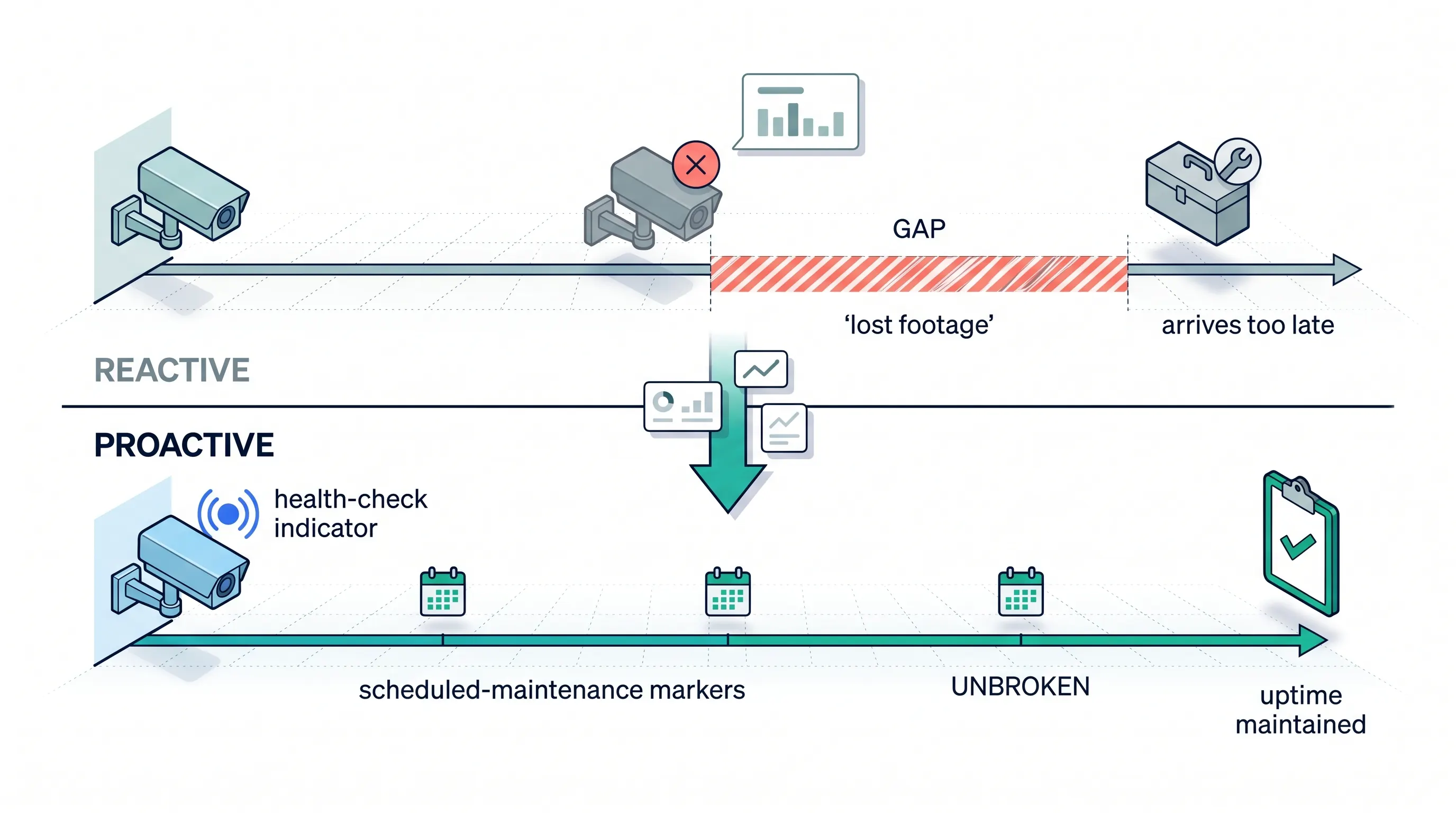
The defining shift is reactive to proactive. Reactive maintenance discovers problems after footage is lost — a camera found dark during an investigation. Proactive prevention detects the warning signs first — a camera going intermittent, a recorder running hot, a drive with rising bad sectors — and acts before the failure becomes an outage.

Why "multi-layer" is the whole point

It works because it is multi-layer: camera, recorder, storage, and network/power health each catch failures the others can't see. A camera can be online while the recorder is overloaded. A recorder can be healthy while its drive is dying. The drive can be fine while the network drops packets. Unifying all four into a single managed outcome — instead of four separate blind spots — is the strategy layer above the individual monitors.

What this is, vs the component pages

The siblings under Camera Health Monitoring each cover one layer in depth: Remote CCTV Health for cameras, NVR Health for recorders, HDD Failure Monitoring for storage. This page is the outcome layer above them — the framework that ties all four into a single uptime KPI you can defend to the board.

Honest framing of "uptime"

Uptime here is a target you engineer toward and monitor against — not a contractual guarantee. Cloud-locked surveillance platforms publish very high SLA numbers (e.g. 99.982%), but those are typically measured against US data centres and lock you into a single hardware ecosystem. Tentovision is vendor-agnostic across your mixed-brand estate, with data residency in Microsoft Azure India regions (Mumbai & Pune), and frames uptime as a managed outcome rather than a marketing number.

The 7 root causes, addressed by 4 layers

There are seven recurring failure modes — camera offline, recorder stopped, drive failed, storage full, network down, power lost, configuration drift — and the four monitoring layers address them collectively. Each cause is named, each is monitored, each has an escalation path. None should reach the buyer as a surprise.

Diagram — Proactive vs Reactive timeline
(failure detected before recording gap)
Proactive versus reactive CCTV maintenance timeline showing prevention before recording gap
Capabilities

Six Downtime-Prevention Capabilities

Six capabilities turn the framework into a managed, board-reportable outcome — at the strategy layer, above any single component monitor.

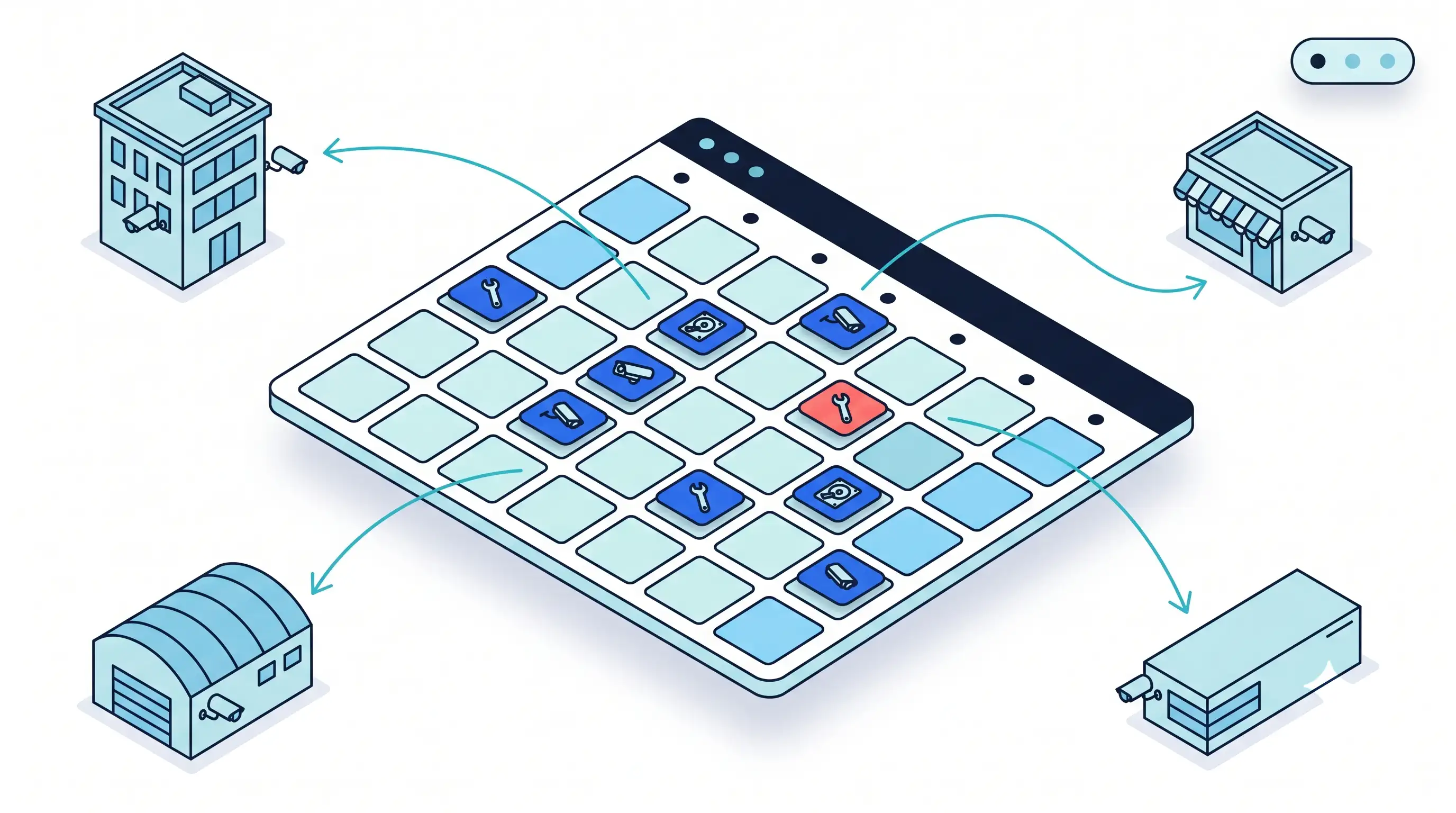
Maintenance calendar
Scheduled work orders across sites
Automated proactive maintenance scheduling calendar across surveillance sites
Strategy · 01

Automated Proactive Maintenance Scheduling

Proactive CCTV maintenance replaces the ad-hoc "something broke, go fix it" cycle with planned, scheduled care. Health scans run automatically across every camera, recorder, and drive. Maintenance windows are sequenced by device age, health score, and accumulated usage. The system auto-generates work orders for devices nearing thresholds, and a single calendar view shows every site's upcoming maintenance — turning a stream of crises into a managed flow.

Camera Health
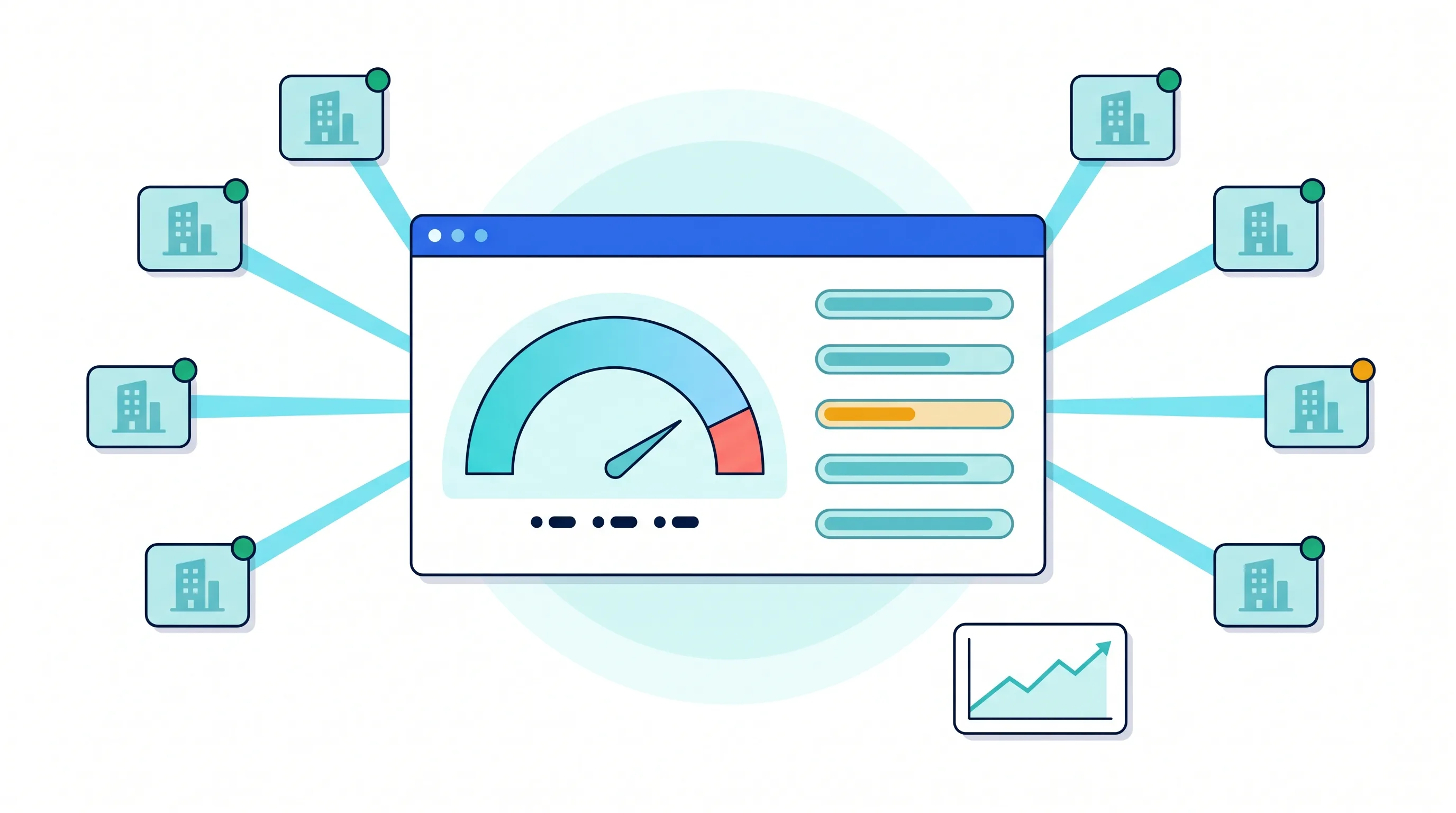
SLA dashboard
On-target vs at-risk sites
SLA-based surveillance uptime dashboard showing sites on target and at risk
Strategy · 02

SLA-Based Surveillance Uptime Monitoring

Surveillance uptime SLA monitoring turns "are the cameras working?" into a measured number you can defend. Define uptime SLAs per site, per camera group, or per recorder — the real-time dashboard shows which sites meet target and which are at risk, with SLA-breach alerts firing before the target is missed. Monthly and quarterly SLA-compliance reports export for auditors and the board; pairs with multi-site monitoring.

Multi-site Monitoring
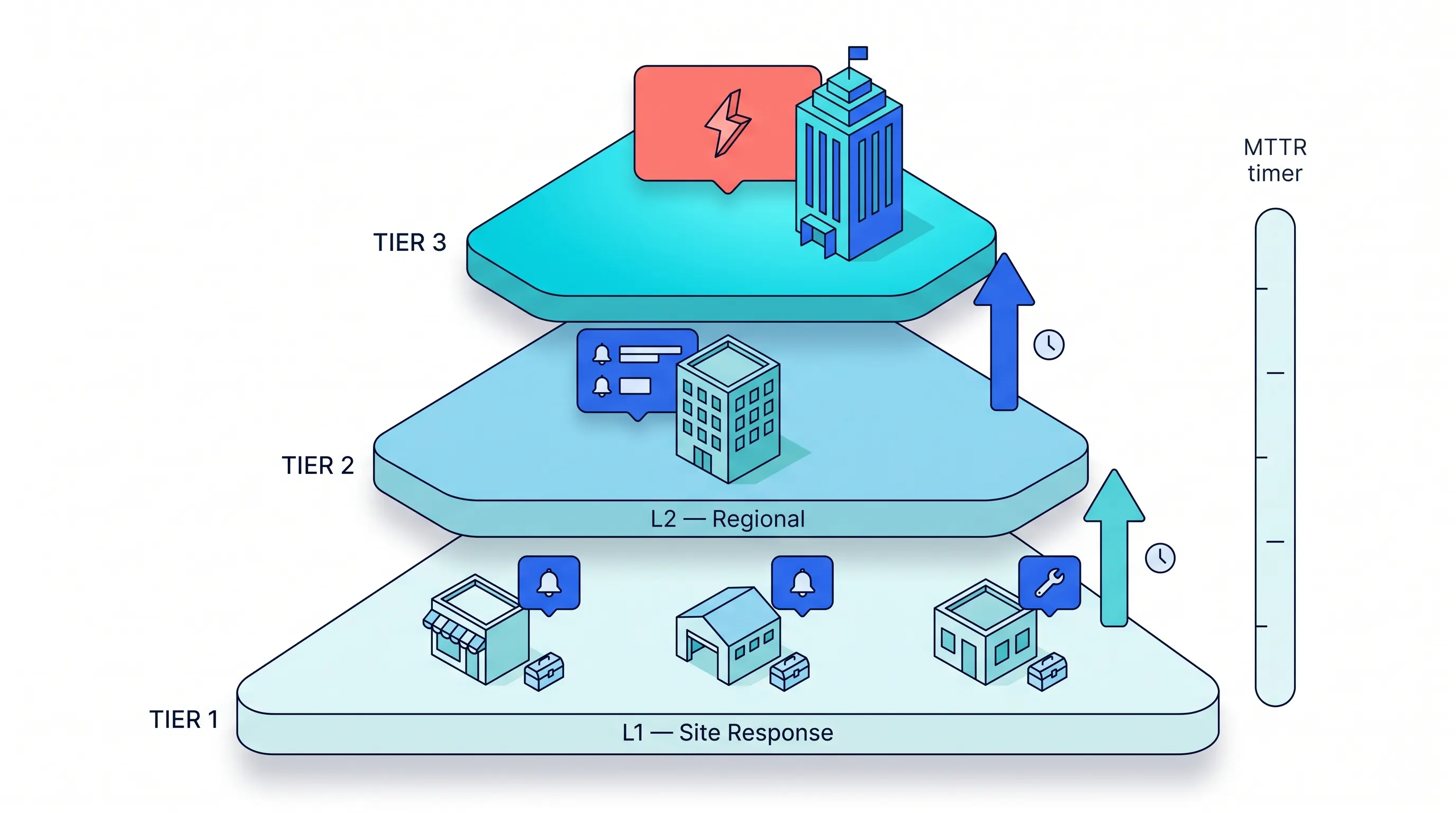
Escalation tiers
L1 → L2 → L3 with MTTR tracking
Tiered escalation workflow from site technician to CISO with MTTR analytics
Strategy · 03

Tiered Escalation Workflows & MTTR Tracking

Escalation converts an alert into a guaranteed response — the difference between monitoring and prevention. L1 sends an automated alert to the site technician; L2 escalates to the regional IT manager if unresolved within SLA; L3 escalates to the CISO or VP Ops for critical events. MTTR analytics per site, per issue type, and per technician reveal where response is slowest. Routes into the command centre for unified action.

Command Center
Failover map
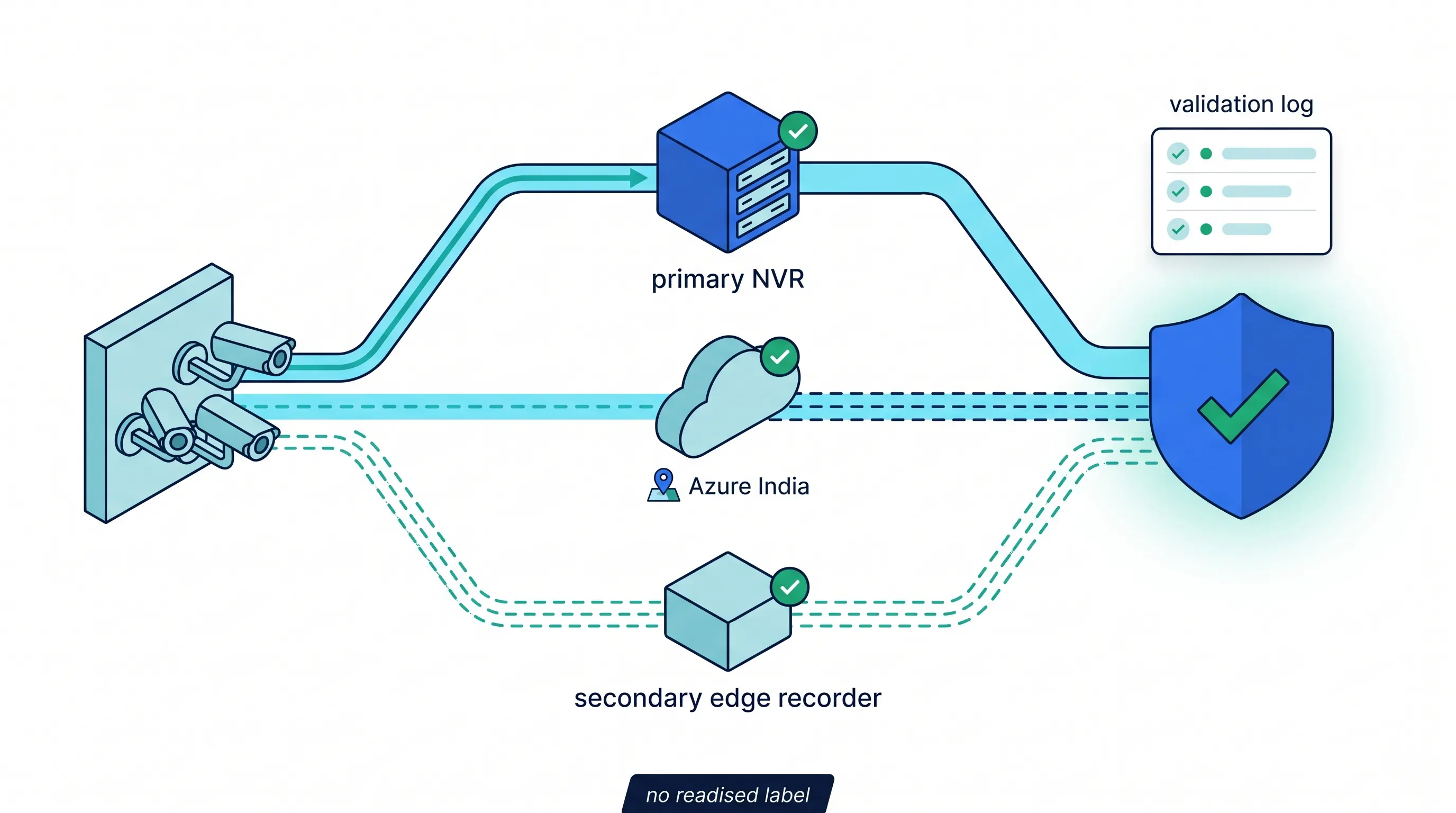
Edge · cloud · secondary recorder
Surveillance redundancy and failover map with validated backup recording paths
Operations · 04

Surveillance Redundancy & Failover Validation

High availability only works if someone is watching the backup — so the framework monitors the redundancy itself. Backup paths are continuously validated: edge storage, cloud backup to Microsoft Azure India, secondary recorder. Alerts fire when primary fails and failover activates, and — critically — the system regularly validates that failover is actually working, not just configured. A failover that nobody has tested is no failover at all.

Cloud Adapter
Compliance report PDF
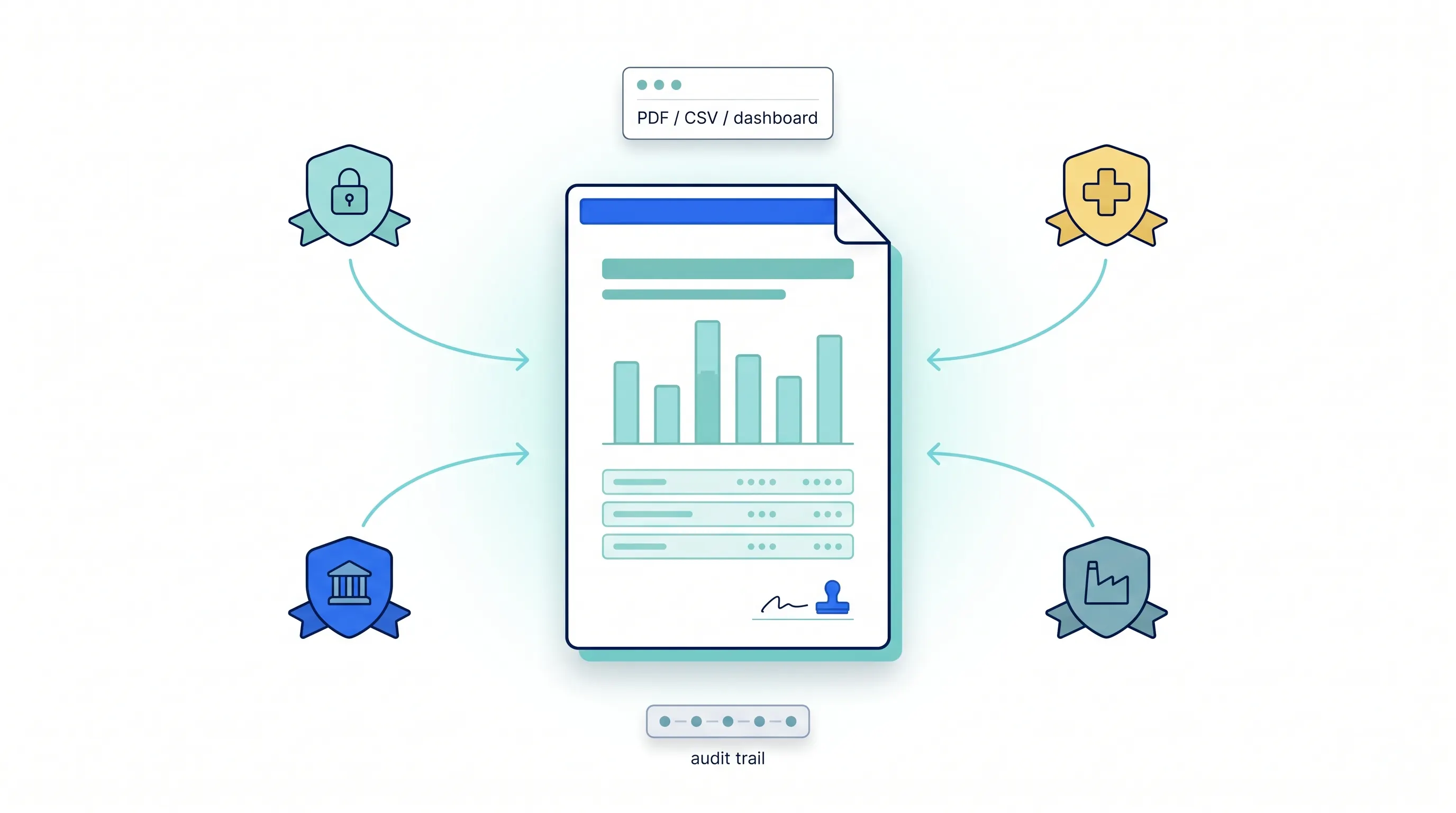
Per-site uptime, audit trail
Compliance-ready surveillance uptime report with per-site statistics and timestamped audit trail
Operations · 05

Compliance-Ready Uptime Reports

The reporting layer makes uptime auditable — provable, not just claimed. Automated PDF reports show uptime percentages, downtime incidents, and root-cause breakdowns; per-camera, per-site, and per-region statistics; a timestamped audit trail of every alert, response, and resolution. Templates align with banking (RBI), healthcare (NABH), and manufacturing requirements; DPDP Act 2023 documentation supports surveillance-data governance. (Aligned with, not certified by.)

Enterprise VMS
Estate dashboard
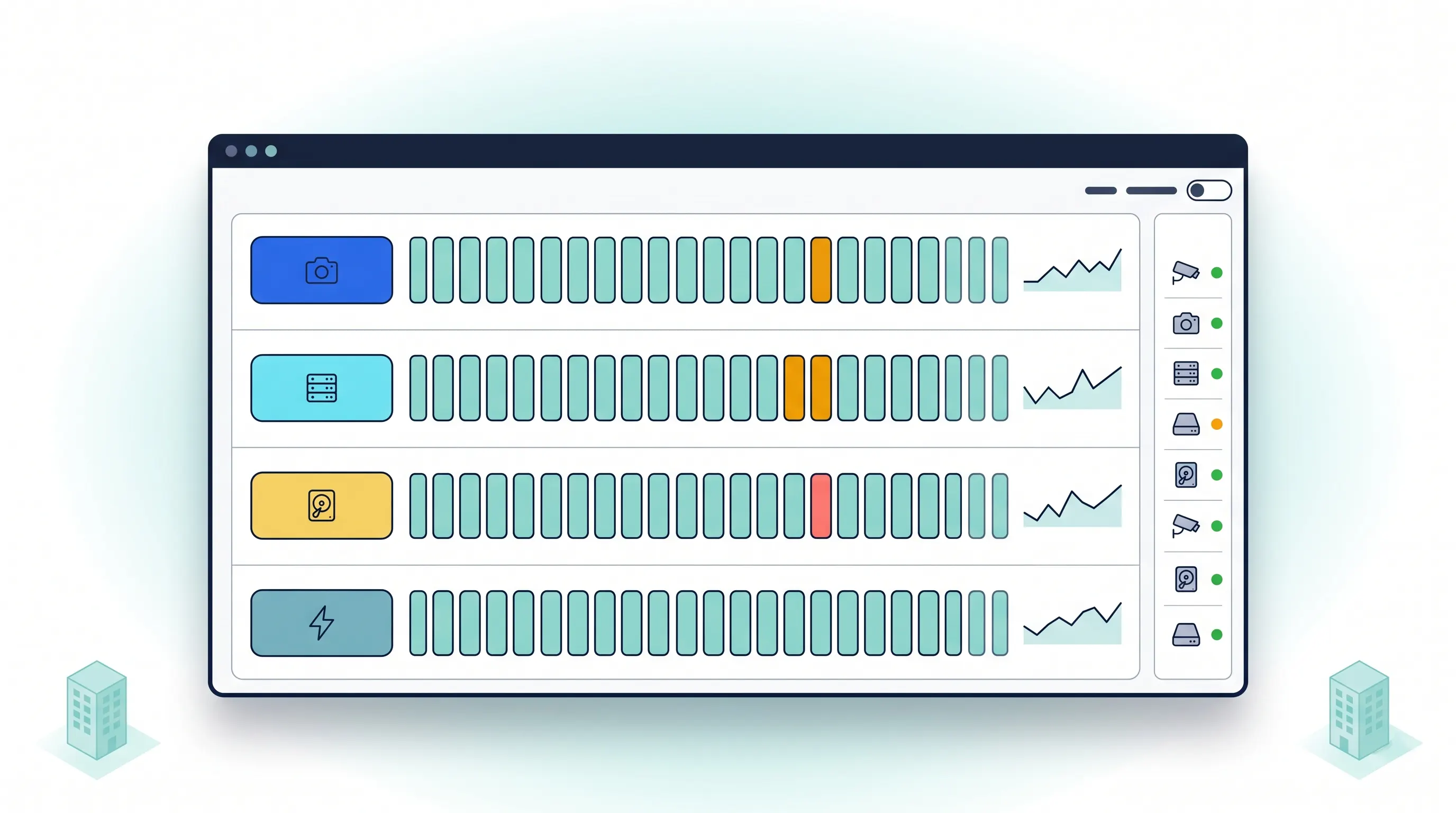
All 4 layers, every site, one screen
Estate-wide uptime dashboard showing all monitoring layers across distributed surveillance sites
Operations · 06

Estate-Wide Uptime Dashboard

The unifying visual layer above the framework — every camera, every recorder, every drive, every site on one screen. Layer 1 (camera), Layer 2 (recorder), Layer 3 (storage), Layer 4 (network/power) each colour-coded by health. Drill from estate view to region to site to device. Year-over-year uptime trending, downtime-by-cause breakdowns, executive summary card for the next board meeting. The dashboard the buyer can actually live in.

Enterprise VMS
All six capabilities run on the same platform — and on the surveillance estate you already operate. Start with an uptime assessment of one region, then scale across the estate.
Vendor-Agnostic Across Your Estate

100+ camera brands, NVRs of every flavour, drives of every make

Tentovision is vendor-agnostic over ONVIF, RTSP, and standard storage APIs — preventing downtime across your mixed-brand estate on the cameras you already own. No rip-and-replace. No locked single-vendor ecosystem.

HikvisionWorld #1Hikvision CCTV brand — works with Tentovision
DahuaGlobal Top 2Dahua CCTV brand — works with Tentovision
CP PlusIndian LeaderCP Plus CCTV brand — works with Tentovision
UniviewTier-1 ChinaUniview CCTV brand — works with Tentovision
Sparsh CCTVIndian OEMSparsh CCTV brand — works with Tentovision
HiFocusIndian BrandHiFocus CCTV brand — works with Tentovision
HikvisionWorld #1Hikvision CCTV brand — works with Tentovision
DahuaGlobal Top 2Dahua CCTV brand — works with Tentovision
CP PlusIndian LeaderCP Plus CCTV brand — works with Tentovision
UniviewTier-1 ChinaUniview CCTV brand — works with Tentovision
Sparsh CCTVIndian OEMSparsh CCTV brand — works with Tentovision
HiFocusIndian BrandHiFocus CCTV brand — works with Tentovision
AxisSwedishAxis CCTV brand — works with Tentovision
VivotekTaiwaneseVivotek CCTV brand — works with Tentovision
BoschGermanBosch CCTV brand — works with Tentovision
PelcoAmericanPelco CCTV brand — works with Tentovision
HoneywellAmericanHoneywell CCTV brand — works with Tentovision
TiandyChineseTiandy CCTV brand — works with Tentovision
AxisSwedishAxis CCTV brand — works with Tentovision
VivotekTaiwaneseVivotek CCTV brand — works with Tentovision
BoschGermanBosch CCTV brand — works with Tentovision
PelcoAmericanPelco CCTV brand — works with Tentovision
HoneywellAmericanHoneywell CCTV brand — works with Tentovision
TiandyChineseTiandy CCTV brand — works with Tentovision
The Architecture

Four Layers, One Managed Outcome

Each layer prevents a different class of failure — because each catches what the others miss.

The 4-Layer Framework

Camera · Recorder · Storage · Network & Power — all four, or you have blind spots

A camera can be online while the recorder is overloaded. A recorder can be healthy while its drive is dying. The drive can be fine while the network drops packets. Only monitoring all four layers together prevents downtime.

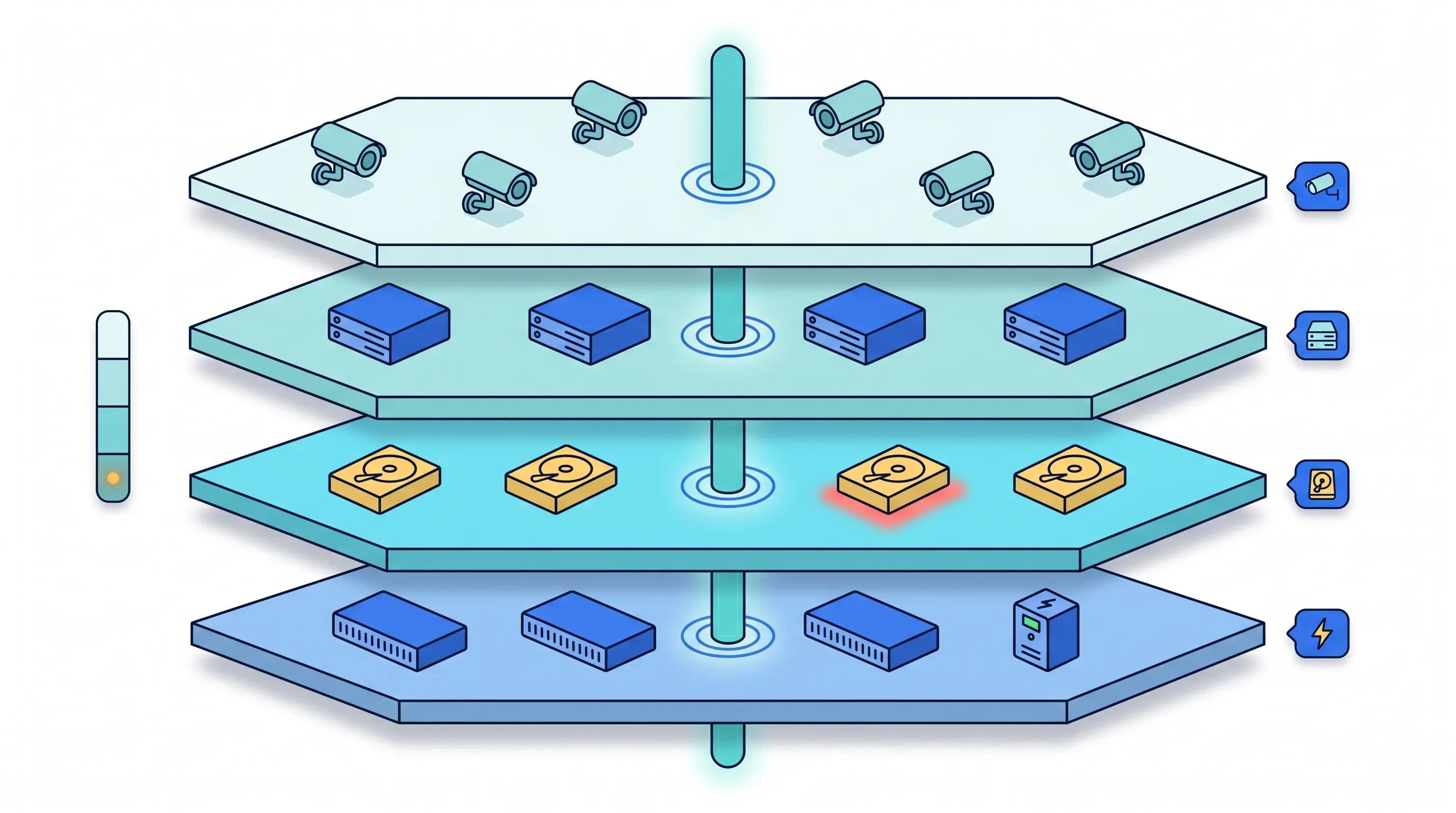
  • Layer 1 — Camera Health: continuous online/offline monitoring, video-loss detection, tamper alerts. Powered by Remote CCTV Health Monitoring.
  • Layer 2 — Recorder Health: NVR/DVR status, resource load, firmware integrity, recording-integrity validation. Powered by NVR Health Monitoring.
  • Layer 3 — Storage Health: predictive disk diagnostics — drive health, bad-sector growth, RAID, temperature, lifespan. Powered by HDD Failure Monitoring.
  • Layer 4 — Network & Power: bandwidth and switch health, UPS status, power-failure detection. Resilient connectivity via the Cloud Adapter to Microsoft Azure India.

Each layer has a dedicated page for depth. This page is the strategy that connects all four into one reportable uptime KPI — the outcome layer above the components.

Feature image — Stacked 4-layer architecture
(Camera → Recorder → Storage → Network)
Tentovision four-layer CCTV downtime prevention architecture — camera, recorder, storage, and network/power monitoring
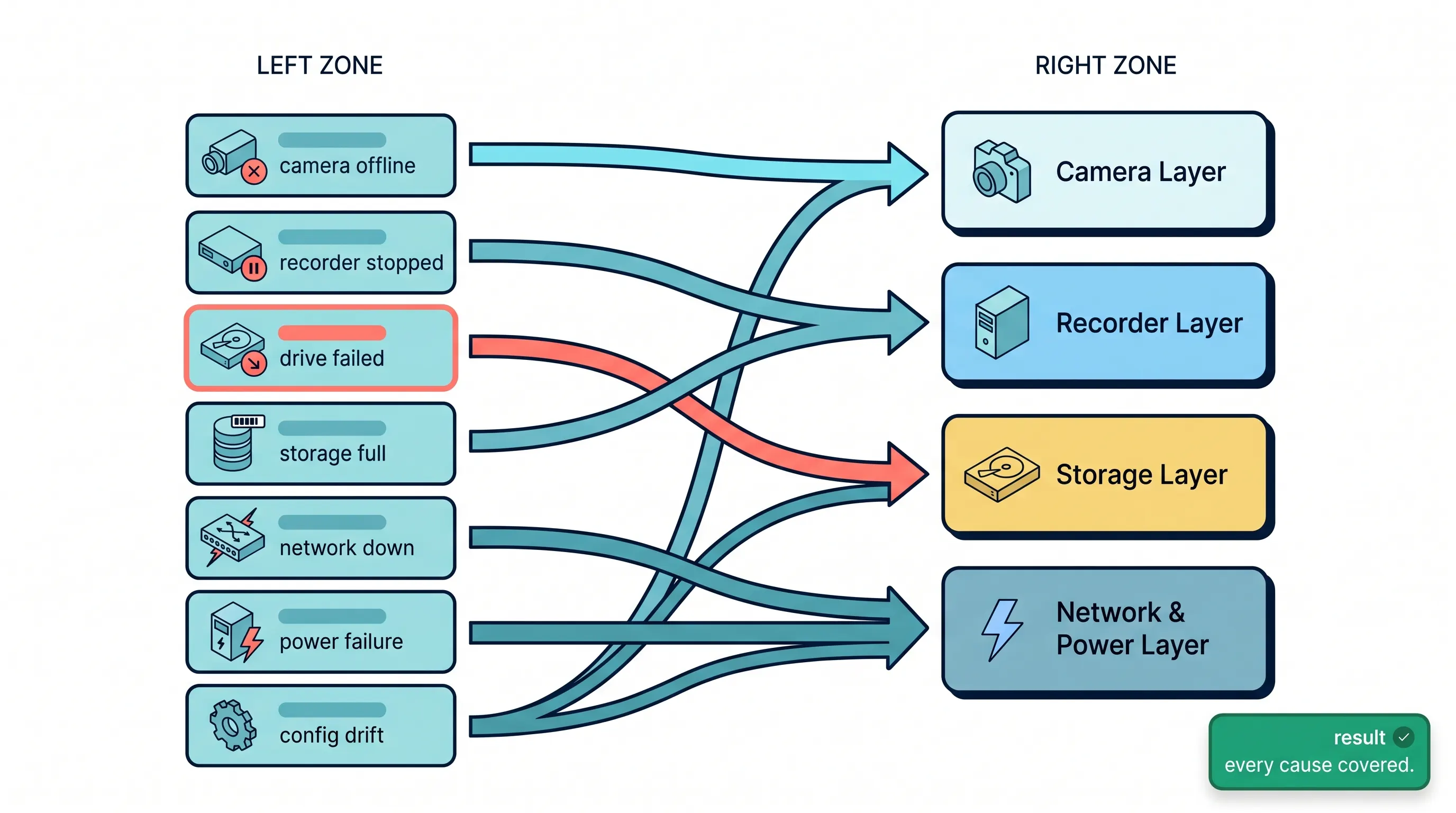
Cause-to-Layer Mapping

Seven Recurring Causes of CCTV Downtime — each routed to the layer that prevents it

Downtime has a finite set of causes. Name every one, route each to the layer that eliminates it, and the system has no untracked failure modes.

  • 1. Camera offline — network disconnect, PoE failure, tampering, hardware fault → Layer 1: Remote CCTV Health
  • 2. Recorder stops recording — crash, firmware bug, reboot without auto-resume → Layer 2: NVR Health
  • 3. Hard drive fails silently — disk degradation, bad sectors, thermal damage → Layer 3: HDD Failure Monitoring
  • 4. Storage fills up — capacity exceeded, retention rule failed → Layer 3 capacity forecasting
  • 5. Network instability — bandwidth saturation, failed switch, degraded cabling → Layer 4 network monitoring
  • 6. Power failure — UPS exhaustion, mains outage, no backup at remote site → Layer 4 power monitoring + edge battery backup
  • 7. Configuration drift — someone changes recorder settings, disables a schedule, alters retention → cross-layer audit trail + RBAC

Indian deployments compound several of these — heat, dust, and power fluctuations make causes 3, 4, 5, and 6 more frequent. India-aware alert thresholds catch them earlier.

Feature image — Cause-to-layer routing diagram
(7 causes ↔ 4 layers)
Cause-to-layer routing diagram mapping the seven recurring CCTV downtime causes to the four monitoring layers that prevent them
Self-Assessment

10-Point CCTV Downtime Prevention Checklist

Score your own surveillance operation honestly — it's the fastest way to find your blind spots before they find you.

01

Are all cameras monitored for online/offline status 24/7 across every site?

02

Do you get an alert when a recorder stops recording — within minutes, not days?

03

Is hard-drive health tracked predictively, before drives fail?

04

Are RAID arrays monitored with rebuild alerts and degraded-array notifications?

05

Do you have tiered escalation workflows for different severities (L1 → L2 → L3)?

06

Is there a proactive maintenance schedule, not just reactive repair tickets?

07

Do you track surveillance uptime against measurable SLAs, per site?

08

Are backup and failover recording paths validated regularly — not just configured?

09

Can you generate compliance-ready uptime reports on demand, by site or region?

10

Can you prove recording continuity for any camera on any date, to an auditor or the board?

If you answered "no" to more than three, your surveillance estate is at real risk of undetected downtime. A 30-minute uptime assessment shows you the gaps — and which ones can be closed without replacing hardware.

Score your estate — Book an Uptime Assessment
Why Tentosoft

Why CISOs and VP Operations Choose Tentovision

Uptime treated as a managed outcome rather than a marketing number — vendor-agnostic, Indian-built, and engineered for mixed-brand estates the buyer already operates.

Multi-Layer Architecture

Camera + Recorder + Storage + Network/Power in one platform. Component-only monitoring leaves blind spots between layers — only the unified architecture catches everything.

Vendor-Agnostic Across Mixed Estates

Works on Hikvision, Dahua, CP Plus, Uniview, Axis — all together, on the cameras you already own. Cloud-locked surveillance platforms force a single hardware ecosystem. Tentovision doesn't.

SLA as a Managed Outcome

Most "uptime monitoring" tools track failures. Tentovision tracks SLAs — pre-breach alerts, target enforcement, board-ready compliance reports. Uptime as a number you can defend.

Indian Data Residency · Azure India

Surveillance metadata, telemetry, and recordings stay in Indian jurisdiction by default on Microsoft Azure India regions (Mumbai & Pune). Cloud-locked platforms typically run on US AWS regions — material for DPDP-bound buyers.

Compliance-Aligned Reporting

Report templates aligned with RBI (banking), NABH (healthcare), DPDP Act 2023 (data privacy), and sector-specific manufacturing requirements. Aligned with, not certified by — but documented for auditor review.

Built for Indian Operating Reality

40–48°C ambient, power fluctuations, dust, monsoon. Alert thresholds, lifespan calculations, and failover validation are tuned for Indian conditions — not European data-centre defaults.

The Complete Suite

Camera Health Monitoring — Five Layers, One Suite

Each sibling page addresses one component layer in depth. This page is the strategy that connects them all into one managed outcome.

The component monitors tell you what's wrong. Downtime Prevention is the system that keeps you recording — and lets you prove it.

Industries

Industries Where CCTV Downtime is Unacceptable

Downtime is never just downtime — it's a specific, industry-shaped consequence. (Enterprise references shown with permission for prior deployments; scenarios illustrative.)

Retail Chains

A shoplifting investigation with no footage and an unrecoverable case. Loss-prevention teams need 100% recording continuity across 200+ NVRs. (e.g. City Centre Mall.) See retail.

Manufacturing

A safety incident with no recording is both legal exposure and a regulatory compliance violation. Hot, dusty plants make downtime more frequent — and more dangerous. (e.g. Nippon Paint.) See manufacturing.

Healthcare

A medico-legal footage gap during an incident is both NABH compliance failure and litigation risk. Multi-hospital networks need provable recording continuity. (e.g. Narayana Health.) See healthcare.

Banking & Financial Services

RBI-mandated continuous recording at every branch and ATM. A recording gap fails the audit. Tentovision's compliance reports are templated for RBI documentation requirements.

Logistics & Warehousing

Missing dispatch-verification footage means a disputed shipment with no proof. Drives under constant write load from 20–60 camera feeds need proactive replacement. (e.g. YNT Supply Chain, Emerson.)

Data Centres

Client SLA breach if surveillance recording lapses — physical-security uptime is contractually mandated. Surveillance health needs to match data-centre standards. (e.g. STT GDC India.)

Education Campuses

Multi-block campus safety with limited IT staff to watch each NVR. Recording must hold through exam season, hostel night-time, and incidents requiring forensic review. Centralised uptime monitoring is the only practical answer. (e.g. NIFT Chennai.)

Comparison

Why Multi-Layer Prevention Beats Every Alternative

Every approach catches something. Only one combines multi-layer monitoring, vendor-agnostic estate coverage, SLA tracking, compliance reports, and Indian data residency in a single platform.

Approach Multi-Layer Vendor-Agnostic SLA Tracking Compliance Reports Indian Data Residency
Reactive — no monitoring No No No
Component-only monitoring (single layer) Single layer Yes No Limited Self-hosted
Cloud-locked surveillance platform Yes Single ecosystem only Yes Yes Typically US-hosted
Generic IT monitoring (Zabbix/Nagios) Limited Yes Generic, not surveillance-tuned Manual Self-hosted
Tentovision Multi-Layer Prevention Yes (4 layers) Yes (mixed-brand) Yes (SLA-driven) Yes (RBI/NABH/DPDP aligned) Yes (Azure India)

Reactive monitoring finds problems after footage is lost. Component-only monitoring leaves blind spots between layers. Cloud-locked surveillance platforms force a single hardware ecosystem and typically host data outside India. Generic IT monitoring lacks surveillance-specific tuning and SLA workflows. Tentovision is the only approach that combines all five attributes — built specifically for distributed Indian enterprise estates running mixed-brand cameras on Azure India.

Proven · Verify Numbers

Uptime Prevention at Enterprise Scale

The health-monitoring engine behind this framework runs across hundreds of enterprise sites — uptime framed honestly. (500+ deployments and 99.7% figures shown verify-before-publish; "uptime target" not "uptime guarantee".)

Multi-hospital footage continuity

500+ cameras across Narayana Health locations require guaranteed recording continuity for medico-legal evidence. The same engine that watches the camera fleet also enforces SLA targets for downtime prevention.

— Narayana Health, centralized VMS (verified with permission)

24/7 manufacturing surveillance at Nippon Paint

Hot plants where ambient heat and dust drive higher hardware failure rates. The same predictive framework runs uptime SLAs alongside fire-detection analytics.

— Nippon Paint India, manufacturing (verified with permission)

Data-centre-grade physical security at STT GDC

Construction-site edge AI plus surveillance uptime for client-SLA-bound physical security. Uptime metrics rolled up to a client-facing dashboard.

— STT GDC India, data centre (verified with permission)

Mixed-brand estate uptime monitoring

Enterprise deployments across 100+ camera brands — Hikvision, Dahua, CP Plus, Uniview, Axis, mixed in real-world estates — under one uptime SLA target.

— Verified across enterprise deployments

Start with an uptime assessment. Tentovision pulls health telemetry from one region of your estate, runs the four-layer audit, and produces a baseline report: current uptime, primary downtime causes, MTTR estimate, and the gaps that need closing first. You see real data on your real estate before committing to fleet-wide rollout.

99.7%(illustrative)
Target uptime
4-Layer
Prevention architecture
7 Causes
Mapped & addressed
SLA-Driven
Response workflows
Board-Ready
Compliance reports
India
Based support
Compliance

Surveillance Uptime Governance

Recording continuity is itself a compliance artefact — Tentovision's controls and reports are mapped to the frameworks that govern surveillance data and physical security in India.

DPDP Act 2023

Data privacy & governance compliant for surveillance metadata and uptime telemetry.

ISO 27001 Aligned

Information-security practices mapped to ISO/IEC 27001 controls.

SOC 2 Aligned

Operational controls mapped to SOC 2 Type II principles.

VAPT Aligned

Internal vulnerability assessment and penetration testing programme.

RBI Alignment

Uptime-report templates aligned with RBI surveillance documentation for banking deployments.

NABH Alignment

Templates aligned with NABH accreditation requirements for healthcare CCTV.

Microsoft Azure India

Mumbai & Pune regions for data residency. AES-256 encryption at rest.

Per-Project Attestation

Formal certification and audit documents issued per deployment on request.

FAQ

Frequently Asked Questions

Common questions from CISOs, VP Operations, and security directors evaluating a downtime-prevention framework.

What is CCTV downtime prevention?

CCTV downtime prevention is a proactive strategy and system that keeps a surveillance network recording continuously by detecting and resolving the causes of failure across cameras, recorders, storage, network, and power before they cause an outage. Rather than reacting after footage is lost, it monitors uptime as a measurable KPI, enforces SLA targets, and triggers escalation so issues are fixed within a defined window. The goal is near-zero downtime and provable recording continuity across every site.

What are the main causes of CCTV system downtime?

There are seven recurring causes: a camera going offline (see Remote CCTV Health Monitoring), a recorder that stops recording (see NVR Health Monitoring), a hard drive failing silently (see HDD Failure Monitoring), storage filling up, network instability, power failure, and configuration drift. In India, heat, dust, and power fluctuations make several of these worse. Each cause needs proactive monitoring because almost all of them are invisible until someone needs footage.

How does proactive maintenance differ from reactive maintenance?

Reactive maintenance fixes a camera or recorder after it has failed, which means footage was already lost in the gap before anyone noticed. Proactive maintenance continuously watches system health, predicts failures from early warning signs, and resolves them before recording is interrupted, supported by scheduled preventive work. For an executive, the difference is whether you learn about a problem from a dashboard today or from missing footage during an investigation next month, and proactive prevention is consistently cheaper than emergency repair.

What is surveillance SLA monitoring?

Surveillance SLA monitoring tracks your estate's recording uptime against a defined service-level target, such as a percentage of cameras recording over a period, and reports compliance against it. It converts the question "are the cameras working?" into a measured, auditable number, with alerts when uptime drifts below target and evidence you can present to auditors or the board. It is the difference between hoping the system was up and proving it was.

How can I calculate the cost of CCTV downtime?

Estimate it from three inputs: the value of footage-dependent events such as investigations, claims, and compliance evidence you could lose; the operational cost of reactive versus planned maintenance; and the regulatory or reputational exposure of a recording gap. Industry estimates put general system downtime in the thousands of dollars per hour, but for surveillance the larger risk is a single uninsurable incident with no footage. Calculating your own figure almost always shows that prevention costs a fraction of one serious gap.

Does Tentovision monitor cameras, NVRs, and hard drives together?

Yes, and that unification is the entire point. The framework monitors all four layers — camera, recorder, storage, and network/power — on one platform and one dashboard, because each layer catches failures the others cannot. A camera can be online while the recorder is overloaded, or a recorder healthy while its drive is dying, so monitoring them together is what actually prevents downtime. Each layer also has a dedicated page for depth, linked throughout this one.

How is CCTV downtime prevention different from camera health monitoring?

Camera health monitoring tracks individual component health. CCTV downtime prevention is the unified framework that monitors all components together and adds SLA management, escalation workflows, maintenance scheduling, and compliance reporting — ensuring the outcome of zero downtime rather than just the input of component monitoring. In short, the monitors tell you what is wrong; downtime prevention is the system that keeps you recording and lets you prove it to the board.

Can I get automated uptime compliance reports?

Yes. The framework generates compliance-ready reports showing uptime percentages, downtime incidents, root-cause breakdowns, and a timestamped audit trail of every alert and resolution, exportable per camera, site, or region. Templates align with sector requirements such as banking, healthcare, and manufacturing, and DPDP Act 2023 documentation supports surveillance-data governance. When an auditor asks you to prove recording continuity for a period, the report is already there.

Book a CCTV Downtime Prevention Demo

Turn surveillance uptime from luck into a managed outcome.

If you own the uptime KPI, you know the cost of finding out about downtime too late. Tentovision monitors every layer of your surveillance infrastructure, predicts failures before they become outages, binds every alert to an SLA-driven response, and gives you board-ready proof that your cameras were recording.

1

30-minute uptime assessment call

We baseline current uptime, identify your top three downtime causes, and quantify the gap.

2

Single-region pilot

Connect Tentovision to one region of your estate. Watch the 4-layer framework on real cameras, recorders, and drives — no rip-and-replace.

3

Compliance & SLA report walkthrough

See the exact uptime PDF you'd send to auditors and the board, generated from your pilot data.

4

Fleet-wide rollout plan

Per-region scaling, integration with existing ticketing, SLA targets agreed with your team — quoted to estate size, not per-seat.

Tentosoft Solutions Private Limited
7th Floor, 4/293, RAR Technopolis, OMR, Perungudi, Chennai 600096
+91 99620 37023 · info@tentosoft.com

Book Your Free Uptime Assessment

No obligation. Estate-size-aware quote within one business day.

No spam · DPDP-compliant data handling
India-based response within 1 business day
Pilot on one region first · no full-fleet commitment
Trademark, attribution & disclosure notice. Brand names, illustrative figures, and competitive references shown on this page belong to their respective owners and are used for compatibility, contrast, and editorial purposes only.Read more

Competitive references. Generic competitor labels used in the comparison table on this page ("cloud-locked surveillance platform", "generic IT monitoring", etc.) describe categories of competing approaches and are not directed at any single named vendor. Where AWS or US-hosted data residency is mentioned, this reflects the publicly-disclosed default region of major cloud-locked surveillance platforms and is provided for honest contrast with Tentovision's Microsoft Azure India deployment. All third-party brand names, service marks, and product names referenced — including but not limited to AWS, Microsoft Azure, Zabbix, Nagios — are trademarks or registered trademarks of their respective owners.

Camera, recorder & storage brands. Hikvision, Dahua, CP Plus, Uniview, Sparsh CCTV, HiFocus, Axis Communications, Vivotek, Bosch Security Systems, Pelco, Honeywell, and Tiandy are trademarks of their respective owners. References on this page indicate ONVIF / RTSP / standard-API compatibility for monitoring purposes; Tentovision is not affiliated with, endorsed by, or sponsored by these manufacturers. Storage SMART, RAID, and disk health monitoring works with drives from Seagate, Western Digital, Toshiba, and other manufacturers; brand mentions are for compatibility reference only.

Illustrative figures. The "99.7% uptime" reference appears throughout this page marked as illustrative — it represents the target architecture supports and observed performance in typical deployments, not a contractual SLA. The "500+ deployments" figure is marked (verify) and represents combined Tentovision enterprise deployments; the exact verified count should be confirmed before publication. The 15% offline-camera figure, 3–5× reactive maintenance cost ratio, and "three weeks of lost footage" scenarios are industry estimates drawn from common surveillance-industry analyses, not Tentosoft-measured numbers. The "12-day camera offline" example in the hero is a representative scenario, not a single specific incident.

Enterprise references. Customer names — Narayana Health, Nippon Paint, City Centre Mall, YNT Supply Chain, Emerson Electric, STT GDC India, and NIFT Chennai — are reproduced with prior permission for the technology categories shown. Scenarios used on this page are illustrative of the type of deployment and may not represent every detail of each customer's actual configuration; full case-study details for each customer are available on dedicated case-study pages under case studies on request.

Compliance language. Tentovision is "aligned with" the controls and documentation requirements of ISO/IEC 27001, SOC 2, RBI banking-surveillance guidance, NABH healthcare accreditation requirements, and the DPDP Act 2023. "Aligned" indicates that the platform's controls and reporting templates are mapped to these frameworks; it does not constitute certification by the respective bodies. Per-project formal attestation documentation is available on request as part of deployment. "VAPT Aligned" means Tentovision operates an internal vulnerability-assessment and penetration-testing programme; specific test reports are available under NDA.

Trademark. Tentovision™ and Tentosoft® are trademarks of Tentosoft Solutions Private Limited. All product names, logos, and brands are property of their respective owners. Use of these names, logos, and brands does not imply endorsement.