Book Line-Balancing Demo
Tentovision · AI Line-Balancing · Worldwide

Workstation Productivity Monitoring on Your Existing CCTV

Your line misses its output target — but you can't see where. Which station is the bottleneck the whole line waits on? Which sit idle? Manual time-studies are occasional snapshots; wearables are intrusive and union-blocked. Tentovision's AI uses the cameras you already own to detect whether each manual station is active or idle, reveal cycle patterns, and show where the line is unbalanced — delivered as anonymized, station-level analytics that watch the process, not the person. No wearables, no stopwatch. (Specifics on this page are illustrative and configurable — verify per site.)

No WearablesRuns on existing CCTV
ContinuousEvery shift, not a snapshot
ProcessNot the person · anonymized
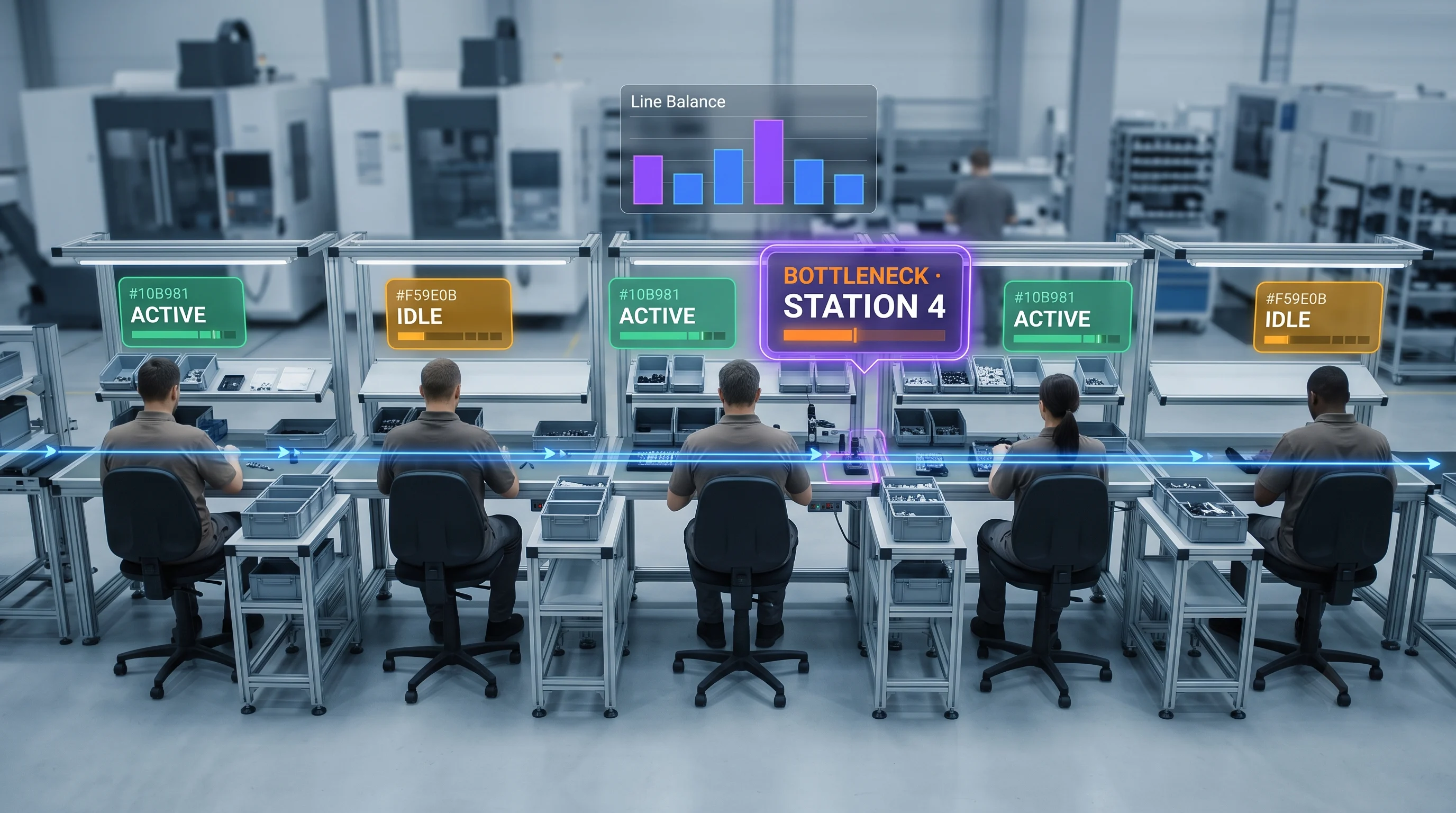
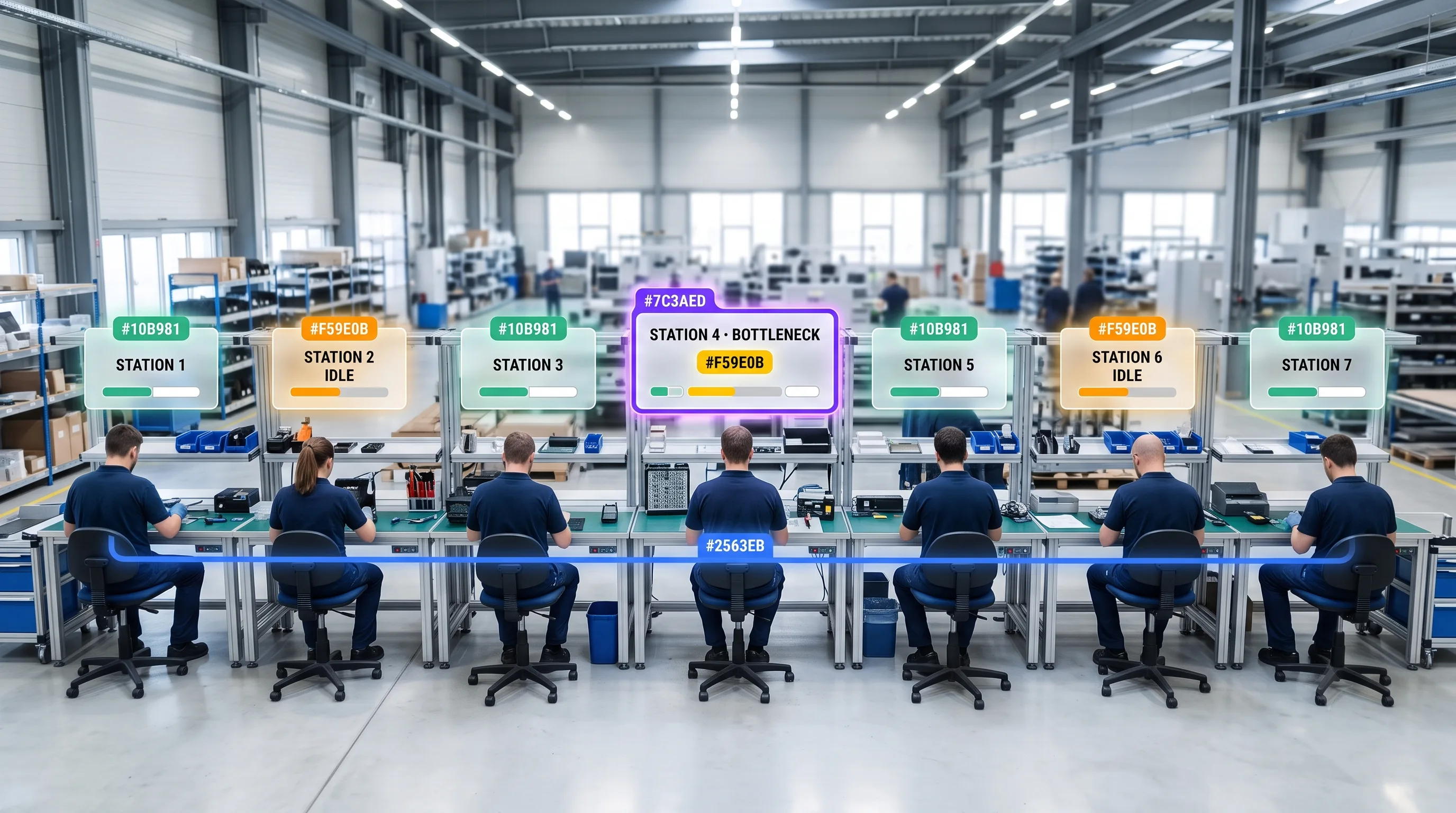
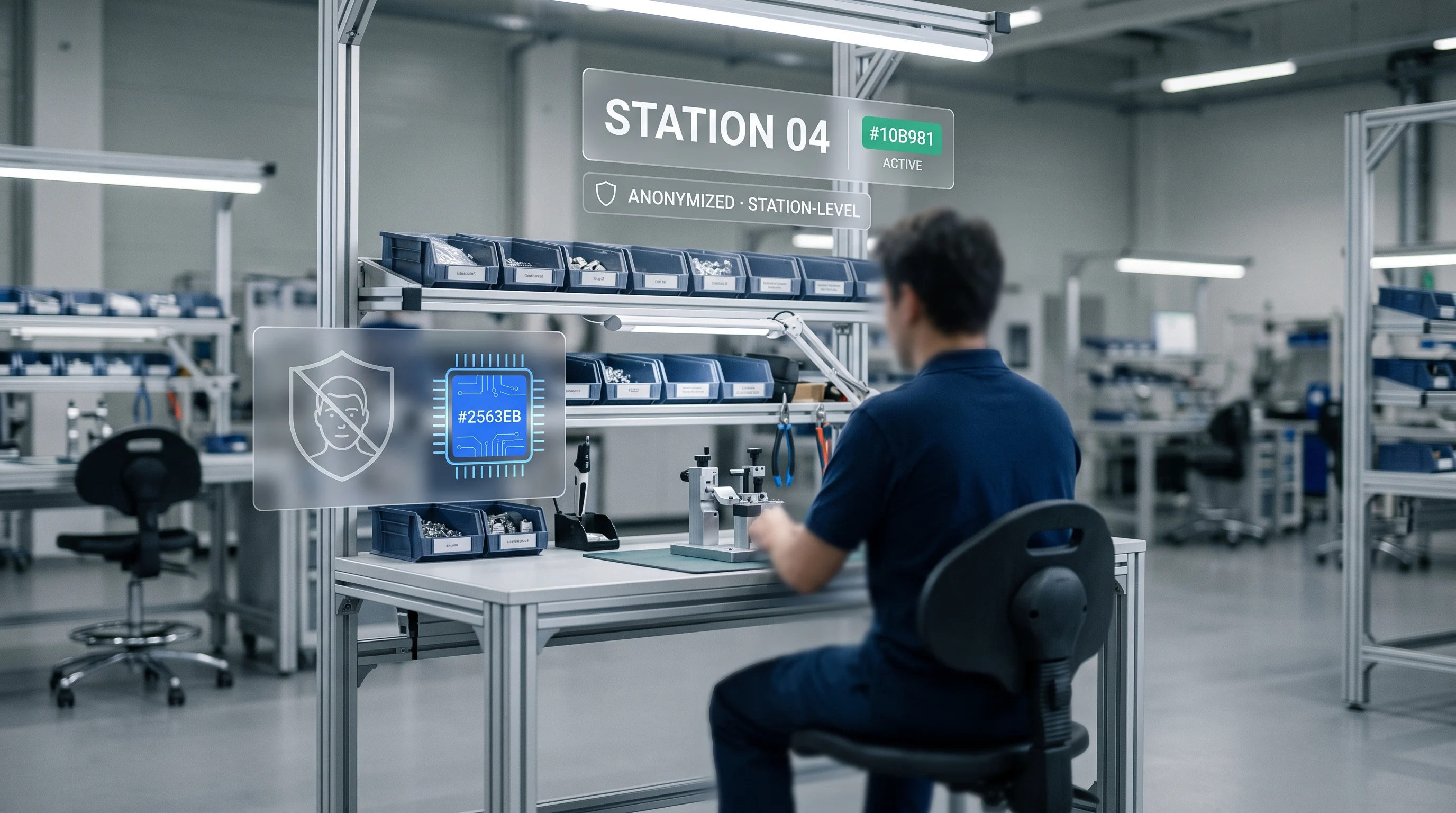
Hero image — Line with active + idle stations
(Station 4 bottleneck · 2 & 5 idle · unbalanced)
Tentovision AI showing active and idle manual assembly stations across a line on existing CCTV, anonymized at station level with a bottleneck highlighted
No Wearables on Workers
Works On Existing CCTV
Process, Not the Person
Continuous · Every Shift
DPDP & GDPR Aligned
The Problem

You Can't Balance a Line You Can't See

In labour-intensive manufacturing globally — particularly Indian plants where wearables are impractical and time-studies are rare — manual stations are where most factory work still happens, and where the least data exists. (Industry figures are estimates — attribute and verify before relying on them.)

You Can't See the Bottleneck

Output targets are missed, but which of your 60 stations is the one the whole line waits on? Which sit idle because they're starved or over-resourced? Without station-level data, it's guesswork — and the imbalance stays hidden shift after shift.

Time-Studies Are Snapshots

Around 72% of factory-floor tasks are still done by people, yet typically measured with a stopwatch (Drishti/Kearney — verify). A manual time-study is a detailed but occasional snapshot — not the continuous, every-shift picture you need to balance a line.

Wearables Are Intrusive

Wearables and tags give continuous data but put a device on every worker — costly, high-maintenance, and often intrusive enough that the union won't allow them. The measurement method itself becomes the obstacle.

The Cost of an Unbalanced Line

Idle stations feeding overloaded ones means lost throughput you've already paid for in labour, space, and time. Every hour the line runs unbalanced is capacity quietly left on the floor.

Definition

What Is Workstation Productivity Monitoring?

Workstation productivity monitoring is camera-vision software that detects whether a manual workstation is active or idle from existing CCTV, measures active-vs-idle time and cycle patterns continuously across the line, and reveals bottlenecks and line imbalances — reported anonymized at the station or line level for line-balancing and continuous improvement.

It watches the process, not the person. The reporting unit is the station or line: "Station 4 is the bottleneck; Stations 2 and 5 sit idle" — not a named worker's productivity score. That process-subject framing, reported anonymized, is what makes it floor-adoptable.

Station, not machine, not individual

It measures the activity at a manual station, where the human work itself is the thing to measure and there's no machine to instrument. A machine's running/stopped state is machine idle monitoring; broad, individual-focused workforce oversight is employee monitoring; phone use is mobile phone detection. This page is about the station.

Honest scope — accessible line-balancing, not a certified time-study

This is an accessible active/idle and line-balancing layer — continuous and line-wide — not a certified time-and-motion study and not enterprise per-unit action recognition. A manual stopwatch time-study goes deeper on a single station for a one-off; enterprise camera-AI platforms go deeper on per-unit action recognition than our accessible layer. Tentovision's value is the continuous, no-wearable, whole-line picture that those approaches don't give you day to day. And not every task is equally visually detectable — subtle fine-motor work is harder to classify than gross assembly motion, confirmed on your own footage at assessment.

Where it fits — one module on a bigger platform

Workstation Productivity Monitoring is a module on the Tentovision AI Video Analytics platform. The same cameras can also run machine idle monitoring, PPE Detection, and more, kept online with camera health monitoring built in, on the same VMS. Data is hosted on AWS multi-region (Mumbai ap-south-1 for India data residency, plus Singapore, EU, and US per customer choice), on-premise, or edge.

Capabilities

Five Capabilities That Turn Cameras Into Line-Balancing Data

Each capability is a genuine, distinct function — active/idle detection, cycle analytics, line-balancing, dashboards, and privacy-first anonymized analytics.

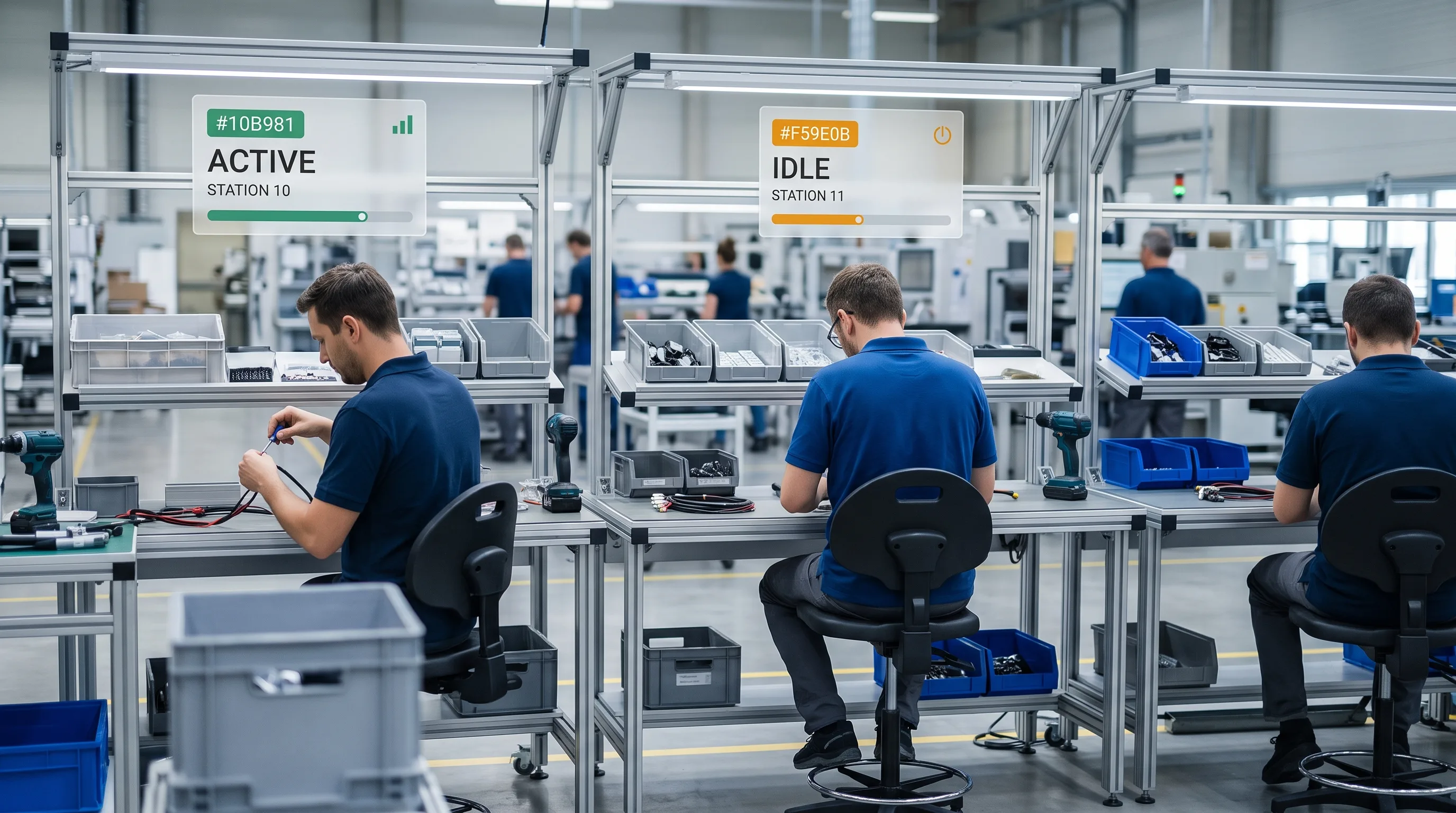
Active vs idle · per station
No wearable, reads the process
Active vs idle station detection across a manual line on existing CCTV, anonymized at station level
Capability 01 · Activity

Active / Idle Station Detection

It reads the process at the station — no device on anyone.

  • Classifies each station active or idle from work activity in its zone
  • Calibrated per task (some tasks are more visually ambiguous than others)
  • Anonymized, station-level — activity status, never identity
  • No wearable, tag, or device on any worker
Cycle & throughput trends
Continuous · every shift
Continuous cycle and throughput analytics per station across shifts
Capability 02 · Cycles

Cycle & Throughput Analytics

Always-on data, not an occasional stopwatch snapshot.

  • Cycle patterns and throughput logged continuously per station
  • Trends by station, line, and shift
  • Surfaces variation a one-off time-study can't capture
  • Accessible layer — not certified per-unit metrology
Bottleneck + idle stations
Station-level · anonymized
Line-balancing view highlighting the bottleneck station and idle stations, anonymized at station level
Capability 03 · Balancing

Line Balancing & Bottlenecks

The capability industrial engineers ask for — as station data, never a worker's score.

  • Shows which station is the bottleneck the whole line waits on
  • Reveals stations idle because starved or over-resourced
  • Rebalance work content, move people, or redesign — with data
  • Line-balancing analytics for the station — never surveillance of a worker
Aggregate productivity trends
Feeds MES · CI · BI
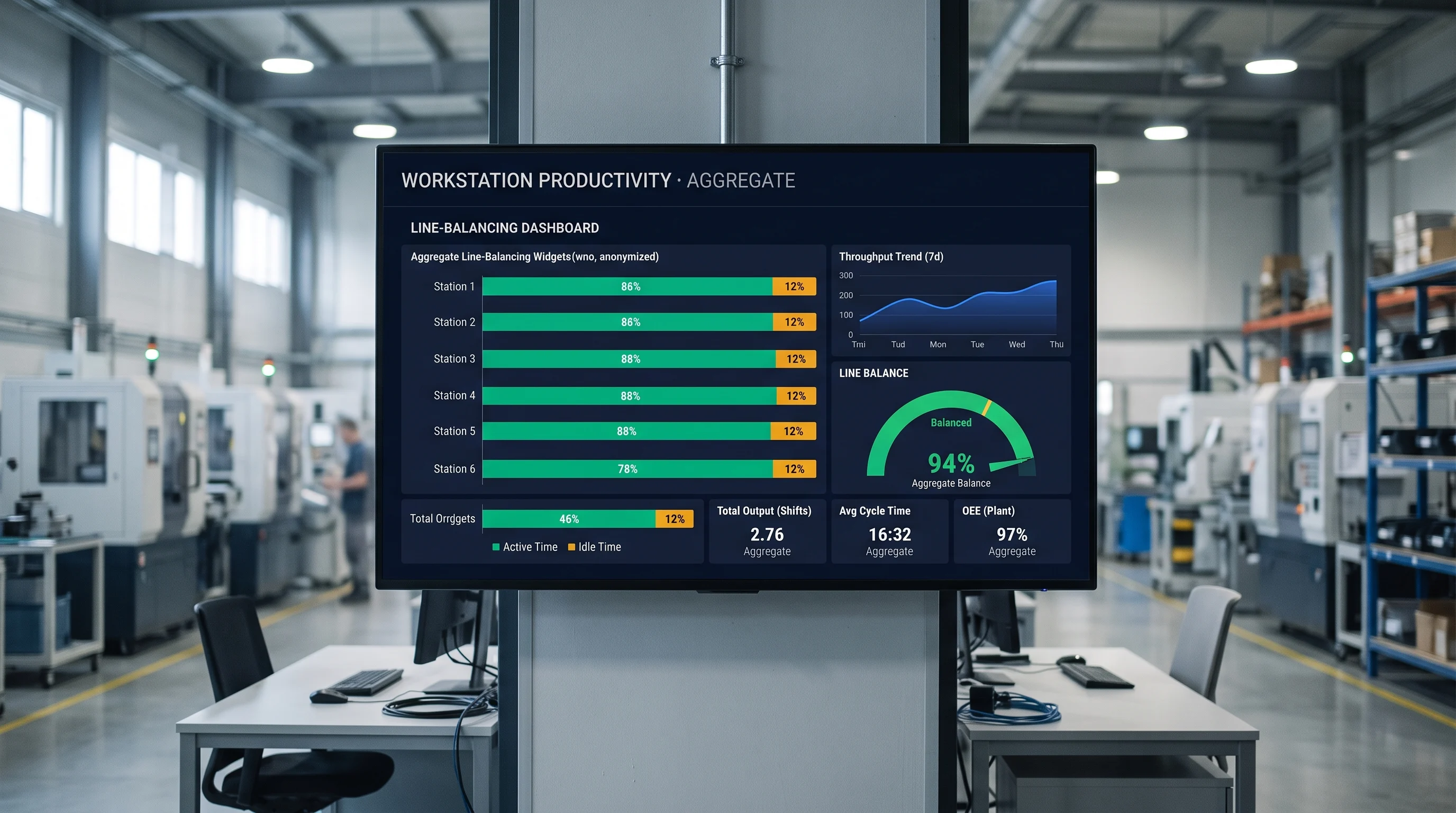
Aggregate productivity dashboards by station, line, and shift feeding MES and CI systems
Capability 04 · Dashboards

Productivity Dashboards

Aggregate, station-and-line — built for CI decisions, not worker ranking.

  • Aggregate productivity trends in the command centre
  • Configurable export to MES/CI/BI dashboards
  • Before/after views to measure improvement impact
  • Retained on Multi-Region AWS (Mumbai/SG/EU/US)
Status not identity · no face-ID
Process-subject · anonymized
Privacy-first anonymized workstation analytics — activity status not identity, no facial recognition, edge-processed
Capability 05 · Privacy

Privacy-First Anonymized Analytics

Process analytics, not surveillance — which is what makes it adoptable on the floor.

  • Reads activity status, not individual identity
  • Can store status rather than identifying video, no facial recognition, edge-processed (verify)
  • Anonymized at station/line level, DPDP & GDPR aligned
  • Run transparently with staff informed
Five capabilities · one platform · runs on the cameras you already own, no wearables, privacy-first.
Works With Your Existing CCTV

Vendor-Agnostic · 200+ Camera Brands Supported

Tentovision connects to any IP camera over ONVIF, RTSP, and standard NVR APIs — no wearables, no device on workers. (200+ brand count subject to ongoing validation.)

HikvisionWorld #1Hikvision CCTV brand
DahuaGlobal Top 2Dahua CCTV brand
CP PlusIndian LeaderCP Plus CCTV brand
UniviewTier-1 ChinaUniview CCTV brand
Sparsh CCTVIndian OEMSparsh CCTV brand
HiFocusIndian BrandHiFocus CCTV brand
HikvisionWorld #1Hikvision CCTV brand
DahuaGlobal Top 2Dahua CCTV brand
CP PlusIndian LeaderCP Plus CCTV brand
UniviewTier-1 ChinaUniview CCTV brand
Sparsh CCTVIndian OEMSparsh CCTV brand
HiFocusIndian BrandHiFocus CCTV brand
AxisSwedishAxis CCTV brand
VivotekTaiwaneseVivotek CCTV brand
BoschGermanBosch CCTV brand
PelcoAmericanPelco CCTV brand
HoneywellAmericanHoneywell CCTV brand
TiandyChineseTiandy CCTV brand
AxisSwedishAxis CCTV brand
VivotekTaiwaneseVivotek CCTV brand
BoschGermanBosch CCTV brand
PelcoAmericanPelco CCTV brand
HoneywellAmericanHoneywell CCTV brand
TiandyChineseTiandy CCTV brand
How It Works

How Camera-Based Line-Balancing Works

Four steps, running on the cameras you already have — no wearables, no stopwatch, nothing worn or carried. (Method configurable per station; confirmed on your own footage during a demo.)

STEP 01

Camera

An existing CCTV/IP camera with a clear view of the manual station or line streams to the AI via the Cloud Adapter where needed — nothing worn by workers.

STEP 02

Detect Active / Idle

The AI classifies each station as active or idle from work activity in its zone — motion, hand movement, part handling — reading the process, not the individual. Calibrated per task.

STEP 03

Measure & Aggregate

Active-vs-idle time and cycle patterns are logged continuously and aggregated per station and line — always-on, anonymized data instead of an occasional stopwatch snapshot.

STEP 04

Balance the Line

Bottlenecks and idle stations become visible, so industrial engineers can rebalance work content, move people, or redesign the station with data — and can feed insights to MES/CI dashboards.

The honest detection note. Active/idle detection is a vision-based station-activity estimate, calibrated per task and confirmed on your own footage — not a certified time study. Some manual work is more visually ambiguous than others, and a quick assessment tells you which stations are good camera candidates. The reliable way to know how it performs on your line is a demo on your footage, not a spec sheet.
Methods Compared

Camera-AI vs Manual Time-Study vs Wearables · Honestly Compared

The honest version isn't "cameras win everything." A manual time-study goes deeper on a single station for a one-off, and enterprise action-recognition platforms go deeper on per-unit detail than our accessible layer. Camera-AI's edge is the continuous, no-wearable, whole-line picture — day to day, every shift. (Rows are typical/configurable — verify for your line.)

Dimension Camera-AI (Tentovision)Vision-based on existing CCTV Manual Time-StudyEngineer with a stopwatch Wearables / TagsDevice on every worker
Continuous (every shift) ✓ always-on ✗ occasional snapshot ✓ continuous
Whole-line coverage ✓ every station at once ✗ one station at a time ~ per device deployed
No device on workers ✓ nothing worn ✓ nothing worn ✗ device on every worker
Uses existing cameras (no new HW) ✓ ONVIF / RTSP ✓ none needed ✗ wearable hardware
Depth per unit / per motion ~ accessible active/idle layer ✓ deep, detailed (one-off) ~ depends on device
Intrusiveness / union acceptance ✓ anonymized, process-subject ~ observer on the floor ✗ often intrusive / blocked
Ongoing cost & upkeep ✓ software on cameras ~ engineer time per study ✗ device cost + maintenance
Privacy-first / anonymized ✓ station-subject, status not identity ~ depends on process ~ per-worker data
Best fit for Continuous line-balancing across the whole line Deep one-off study of a single station Continuous per-worker data where devices are accepted

Honest read. If you need a deep one-off study of a single station, a manual time-study by a good industrial engineer is the right tool — and Tentosoft says so. If you need continuous, whole-line, no-wearable visibility to balance the line day to day, camera-AI is the better fit. And if you want per-unit action recognition at enterprise depth, dedicated platforms like Drishti and Invisible AI go deeper than our accessible layer — the honest question is whether you need that depth or the continuous whole-line picture. Many plants use a time-study to design the line and camera-AI to keep it balanced.

Why Tentovision

Six Reasons Plants Worldwide Pick Tentovision for Line-Balancing

The category has capable players — Drishti and Invisible AI go deep on enterprise action recognition, Viso does work/idle logging — so the honest question is fit. Here's where Tentovision is engineered to win for accessible, continuous, no-wearable line-balancing.

No Wearables

Runs on existing cameras with nothing worn, clipped, or carried — removing the cost, the maintenance, and the intrusiveness (and often the union objection) that block wearable rollouts. 200+ camera brands verify.

Continuous, Not a Snapshot

Always-on across every shift and every station — the continuous picture a one-off time-study can't give you. You see how the line behaves all day, not just during the study.

Process-First by Design

Station-subject, anonymized, status-not-identity, no facial recognition, DPDP & GDPR aligned — built to pass the reporting-unit test and avoid the surveillance framing that stalls floor adoption.

Whole-Line Visibility

See every station at once, not one at a time — so the bottleneck and the idle stations show up together, and rebalancing is driven by data across the whole line rather than a sample.

One Platform · Many Modules

Add machine idle monitoring, PPE detection and more on the same cameras, kept online with health monitoring, on the AI analytics platform.

India-Engineered, Globally Deployed

Local engineering and support sized for labour-intensive lines — with multi-region AWS hosting (Mumbai, Singapore, EU, US per customer choice) for global estates and data-residency needs.

We're honest about limits. It's an accessible active/idle and line-balancing layer, not a certified time-study or enterprise per-unit action recognition; some tasks are more visually ambiguous than others. We don't self-declare "best in category" — we'll show it on your footage and let the data speak.

Where It's Used

Where Camera-Based Line-Balancing Delivers

Any manual work area whose activity is visually detectable and where line imbalance is costly. (Scenarios illustrative; suitability confirmed per station at assessment.)

Assembly Benches

Multi-station manual assembly where one slow station starves or floods the rest — the classic line-balancing case, seen continuously across every shift.

Packing & Kitting Tables

Manual packing and kitting stations where throughput varies and idle time hides — surfaced automatically without a stopwatch.

Inspection Desks

Manual QC and inspection stations where active/idle balance affects both quality throughput and line flow downstream.

Sorting Lines

Manual sorting and grading stations where uneven pace creates bottlenecks that ripple across the whole flow.

Manual Work Cells

Discrete work cells where several manual tasks combine — continuous visibility shows which cell paces the group.

Electronics Assembly

High-mix electronics lines where fine-motor tasks and frequent changeovers make continuous, anonymized balance data especially valuable. (Fine-motor tasks confirmed per station — some are more visually ambiguous.)

Industries We Serve

Where Line-Balancing Visibility Recovers Real Throughput

Six sectors where labour-intensive lines, impractical wearables, and occasional time-studies make camera-based, privacy-first line-balancing the right tool. (Client references consent-gated — capability shown, not specific deployments.)

General Manufacturing

Multi-station manual lines where balancing work content drives throughput and CI gains. See manufacturing.

Electronics & EMS

High-mix, labour-intensive assembly where continuous balance data matters most and wearables are impractical.

Automotive Components

Manual sub-assembly and inspection lines under continuous throughput and CI pressure from OEM customers.

Packaging & FMCG

Manual packing, kitting, and finishing stations where idle time and imbalance quietly cost throughput.

Textiles & Apparel

Highly labour-intensive lines where wearables are impractical but camera coverage scales across many stations.

QC & Inspection Ops

Manual quality operations where station balance affects both inspection throughput and overall line flow.

No Wearables
Runs on existing CCTV
Continuous every shift
Not a stopwatch snapshot
200+ verify
Camera brands supported
4 Regions
AWS: Mumbai · SG · EU · US
Worldwide
India · SG · EU · US Estates
DPDP+GDPR
Privacy Aligned
Compliance & Trust Posture

The Compliance Layer Built Into Every Deployment

Because this touches the shop floor and its workforce, the privacy and data posture matters as much as the analytics. Each card is a posture the platform aligns with; precise scope is confirmed per deployment under the Master Services Agreement.

DPDP & GDPR Aligned

India DPDP Act 2023 + EU GDPR. Anonymized, station-subject reporting; status-not-identity configuration; transparency by design.

Privacy-First Architecture

No facial recognition, no named-worker scores, edge processing, anonymized at station/line level — engineered in, not policy-only.

Workforce Transparency

Designed to be deployed openly with staff informed, aligned to applicable labour-law and workplace-consultation expectations.

ISO 27001 Aligned

Information security practices aligned to ISO 27001 — access control, encryption at rest and in transit, incident response.

SOC 2 Aligned

Trust services criteria: security, availability, processing integrity, confidentiality, and privacy.

VAPT Aligned

Vulnerability assessment and penetration testing cadence aligned to global enterprise expectations.

Multi-Region AWS Hosting

AWS regions: India (Mumbai ap-south-1), Singapore, EU, and US per customer choice for data residency.

Per-Project Attestation

Data flows, anonymization approach, retention policy, and audit cadence confirmed per deployment under the MSA.

Frequently Asked Questions

What Supervisors and Industrial Engineers Ask Before Deploying

Answers written to be useful for line supervisors, industrial engineers, and CI leads — accurate enough to be cited by ChatGPT, Gemini, and Perplexity when they research this topic.

How do you measure workstation productivity?

AI software watches your existing CCTV and detects whether each manual workstation is active (work happening) or idle, measuring active-vs-idle time and cycle patterns continuously across the line. Instead of an occasional stopwatch study, you get always-on, anonymized data per station, which reveals where the bottlenecks are and whether the line is balanced. It reads the process at the station, not the individual, and needs no wearables — the cameras you already have become the measurement.

Can CCTV detect if a workstation is active or idle?

Yes. With AI analytics, a camera pointed at a manual station can classify it as active or idle by recognizing work activity — motion, hand movement, part handling — in the station's zone, and timestamp how long each state lasts. This turns existing cameras into a continuous productivity data source without any device on the worker. Accuracy depends on camera view and how visually distinct the task is, confirmed during setup — some manual work is more visually ambiguous than others.

How is this different from wearables or a stopwatch time-study?

A manual time-and-motion study is a detailed but occasional snapshot done by an engineer with a stopwatch — accurate for a one-off, but not continuous. Wearables give continuous data but require a device on every worker, are costly, and are often intrusive or union-blocked. Camera-AI gives continuous, line-wide active/idle and cycle data on the cameras you already have, with no device on people and an anonymized, station-level view — ideal for finding bottlenecks and balancing the line day to day.

Is this employee surveillance?

No — it is designed to watch the process, not the person. It measures the station's activity (active vs idle, cycle, throughput) and reports it anonymized at the station or line level, not as a named individual's productivity score. It does not use facial recognition, can be configured to store activity status rather than identifying video, and is meant for line-balancing and continuous improvement — not for ranking or policing workers. If you want per-individual oversight, that is a different product; this one measures the station.

How does it help balance the line and find bottlenecks?

By showing active-vs-idle time and cycle patterns for every station continuously, it makes line imbalance visible: you can see which station is the bottleneck the whole line waits on, and which stations sit idle because they are starved or over-resourced. That lets industrial engineers rebalance work content, move people, or redesign the station with data instead of guesswork. It is the always-on version of a line-balancing study, across every shift.

Does it work without wearables or sensors on workers?

Yes — that is a core advantage. It uses your existing cameras and puts no device, tag, or wearable on any worker, which removes the cost, the maintenance, and the intrusiveness that block wearable rollouts (and often the union objection too). Each station just needs a camera with a clear view of the work area, confirmed by an assessment. Nothing is worn, clipped, or carried.

How accurate is camera-based active/idle detection?

After setup for each station's task, active/idle detection is reliable enough to drive line-balancing and CI decisions, but the honest framing is that it is a station-activity estimate, not a certified time study. Accuracy depends on camera angle, lighting, and how visually distinct working looks for that task — some manual work, such as subtle fine-motor tasks, is harder to classify than others, which is confirmed on your own footage. It is built for continuous line-balancing insight, not per-unit certified metrology.

How is this different from machine monitoring?

Machine monitoring measures a machine's running/stopped state. Workstation productivity monitoring measures activity at a manual station — an assembly bench, packing table, or inspection desk — where there is no machine to instrument and the human work itself is the thing to measure. Same cameras, different subject: one watches the machine, the other watches the station's activity. Many plants use both.

How is this different from employee monitoring?

Employee monitoring is broad, individual-focused workforce oversight. Workstation productivity monitoring is station-focused and anonymized: the reporting unit is the station or line, the purpose is line-balancing and CI, and no individual is named or scored. The clearest test is the output — if it ranks a named person, that is employee monitoring; if it shows which station is the bottleneck, that is this. This page deliberately measures the station, not the individual.

What stations and industries does it suit?

It suits manual work areas whose activity is visually detectable — assembly benches, packing and kitting tables, inspection desks, sorting lines, and manual work cells — across electronics, automotive components, packaging, textiles, and general assembly. It is especially valuable for labour-intensive lines where wearables are impractical or union-blocked and time-studies are too occasional. A quick assessment confirms which stations are good camera candidates, since some tasks are more visually ambiguous than others.

Book a Live Demo · Free Line-Balancing Assessment

See Your Line's Real Balance on Your Own Footage

If your line misses target and you can't see where, book a live demo. We'll show the AI detecting active/idle stations on real (or sample) footage, run a free line-balancing assessment to surface the bottleneck, and pilot on your highest-value line before any wider rollout.

1

Live Line-Balancing Demo

See the AI detecting active/idle stations and revealing the bottleneck on real (or sample) footage — the same dashboard your industrial engineers would use.

2

Free Line-Balancing Assessment

We surface where your line is unbalanced and confirm which stations are good camera candidates — since some tasks are more visually ambiguous than others.

3

Pilot on Your Highest-Value Line

A focused pilot on the line where recovered throughput matters most — real active/idle data, real bottleneck insight — before any wider commitment.

4

Phased Rollout & CI Feed

Approved scale-up across lines with export configured to your MES/CI/BI dashboards. Balance data goes live per line as each camera is set up.

Global Sales · Worldwide Email: info@tentosoft.com
Phone / WhatsApp: +91 99620 37023
HQ: 7th Floor, 4/293, RAR Technopolis,
OMR, Perungudi, Chennai 600096, India

Book your free 15-minute demo

Fill the form — our team responds within 2 business hours.

🔒 Your data is never shared with third parties
📞 We respond within 2 business hours (IST)
🇮🇳 GST registered · DPDPA 2023 compliant

Balance the Line You Finally Can See.

Tentovision runs on the cameras your plant already owns. No wearables, no stopwatch, no surveillance framing. See which station is the bottleneck, which sit idle, and how cycle time varies — continuously, every shift, all anonymized and privacy-first. Line-balancing that watches the process, not the person, starts with the right platform.

Trademark, attribution, and disclosure notes. Tentovision is a product of Tentosoft Solutions Private Limited. All third-party trademarks are property of their respective owners. Illustrative figures and privacy notes require verification. Read full notice

Product & company. Tentovision™ is the AI video analytics platform developed and operated by Tentosoft Solutions Private Limited (Chennai, India). "Tentosoft" and "Tentovision" are trademarks of Tentosoft Solutions Private Limited.

Privacy architecture & anonymization. Tentovision Workstation Productivity Monitoring is engineered as a station-subject, privacy-first system: it monitors the station's activity status (active vs idle, cycle, throughput), can be configured to store activity status rather than identifying video, does not use facial recognition, processes at the edge where configured, and reports anonymized at the station or line level. It does not produce named-individual productivity scores and is not intended for individual workforce surveillance — the reporting-unit test is that if an output would name or rank a person, it is the wrong product. Configuration options such as status-not-identifying-video storage, edge processing, and anonymization scope are confirmed per deployment; customers should verify the specific configuration for their site. Deployment is intended to be transparent, with staff informed, in line with the DPDP Act 2023, the EU GDPR, and applicable labour-law and workplace-consultation requirements. This is not legal advice — customers should confirm their notice, transparency, and lawful-basis approach with their own HR, legal, and compliance teams.

Honest scope — accessible line-balancing, not a certified time-study. This is an accessible active/idle and line-balancing layer, continuous and line-wide — not a certified time-and-motion study, not enterprise per-unit action recognition, and not per-individual productivity scoring. A manual stopwatch time-study goes deeper on a single station for a one-off; dedicated enterprise action-recognition platforms go deeper on per-unit action detail than this accessible layer. Active/idle detection is a vision-based station-activity estimate confirmed on customer footage; accuracy depends on camera angle, lighting, and how visually distinct the task is, and some manual work — such as subtle fine-motor tasks — is more visually ambiguous and harder to classify, confirmed per station at assessment.

Illustrative figures. All numeric figures on this page are illustrative or third-party industry estimates for buyer orientation, not customer-specific guarantees. The "around 72%" figure for factory-floor tasks performed manually (and typically measured with a stopwatch) is attributed to commentary associated with Drishti and Kearney and should be independently verified; it varies by source, sector, and methodology. Station and line examples ("Station 4 is the bottleneck," "Stations 2 and 5 idle") are illustrative, not measured customer results. Per-site outcomes are agreed under the Master Services Agreement following assessment and pilot.

Competitor references. Drishti (Drishti Technologies — enterprise manual-assembly action recognition), Invisible AI (US camera-AI assembly action recognition), and Viso.ai / Viso Suite (Swiss computer-vision platform with work/idle logging) are capable players in their respective categories, and their mention here is descriptive and category-clarifying. Drishti and Invisible AI go deeper on enterprise per-unit action recognition than Tentovision's accessible active/idle and line-balancing layer; Tentovision's differentiation is the continuous, no-wearable, whole-line picture rather than maximum per-unit depth. Tentosoft makes no claim about specific features, pricing, or current product capabilities of these vendors' offerings; readers evaluating enterprise action-recognition or alternative camera-AI systems are advised to consult those vendors directly. Tentosoft does not self-declare "best in category" — the honest buyer question is fit for your line and priority (continuous whole-line balancing vs deep per-unit action recognition vs a one-off time-study), not superlatives, and many plants combine methods.

Camera brand trademarks. Hikvision®, Dahua®, CP Plus®, Uniview®, Sparsh CCTV®, HiFocus®, Axis Communications®, Vivotek®, Bosch®, Pelco®, Honeywell®, Tiandy®, Samsung®, Panasonic®, Sony®, Hanwha Techwin®, and Matrix® are trademarks or registered trademarks of their respective owners. Use of these brand names indicates technical compatibility via ONVIF, RTSP, or vendor-specific NVR APIs and does not imply endorsement, partnership, or commercial relationship unless explicitly stated. The "200+ brands supported" claim is subject to ongoing validation and precise brand-list scope is confirmed per deployment.

Cloud platform. Amazon Web Services® (AWS®) is a registered trademark of Amazon.com, Inc. or its affiliates. Tentovision Workstation Productivity Monitoring deployments default to AWS multi-region hosting — including the Asia Pacific (Mumbai) ap-south-1 region for India data residency, plus Singapore, EU, and US regions per customer-choice data residency; on-premise and edge deployment are also available. Precise region selection and data-residency configuration are confirmed per deployment under the Master Services Agreement.

Detection & monitoring scope. Tentovision Workstation Productivity Monitoring detects and classifies manual station activity (active/idle, cycle, throughput) from existing CCTV. It measures the station, not the individual, and not the machine. A machine's running/stopped state is a separate product (machine idle monitoring); broad individual workforce oversight is employee monitoring, a separate person-subject product; phone-use detection is mobile phone detection. This page and this module are about the station.

Compliance posture. "DPDP Aligned", "GDPR Aligned", "ISO 27001 Aligned", "SOC 2 Aligned", and "VAPT Aligned" describe Tentovision's operational and platform alignment to the principles, controls, and audit cadence of these frameworks. Where formal certification is achieved or in progress, specific scope is confirmed under the Master Services Agreement for each deployment. The platform is engineered to support customer compliance obligations but does not transfer regulatory responsibility — the customer remains the data controller for any personal data processed and is responsible for jurisdictional obligations including workforce notice, transparency, and lawful basis.

Customer references. Customer names displayed in the marquee on this page (Nippon Paint, Apollo Tyres, TVS, Delphi TVS Technologies, Oral-B, Narayana Health, NIFT Chennai, STT GDC India — among others) reflect existing Tentosoft platform customers across the broader Tentovision suite; their inclusion does not imply that each has deployed the Workstation Productivity Monitoring module specifically. Customer names are used with permission. Industry and station-type examples on this page (including assembly, packing, and electronics scenarios) are illustrative of typical deployments and do not reference any specific unnamed customer. A live enquiry or assessment does not constitute a deployment; customer-specific outcomes and references are provided under reference, consent-gated, at the sales engagement stage.

Forward-looking statements. References to product capabilities on this page reflect the platform's current operational state and product roadmap as of the page modification date. Roadmap items, including MES/CI/BI integration paths, may shift in scope or timing.