Book Safety Assessment
Tentovision · AI Vehicle Speed Monitoring · Worldwide

Forklift & Industrial Vehicle Speed Monitoring on Your Existing CCTV

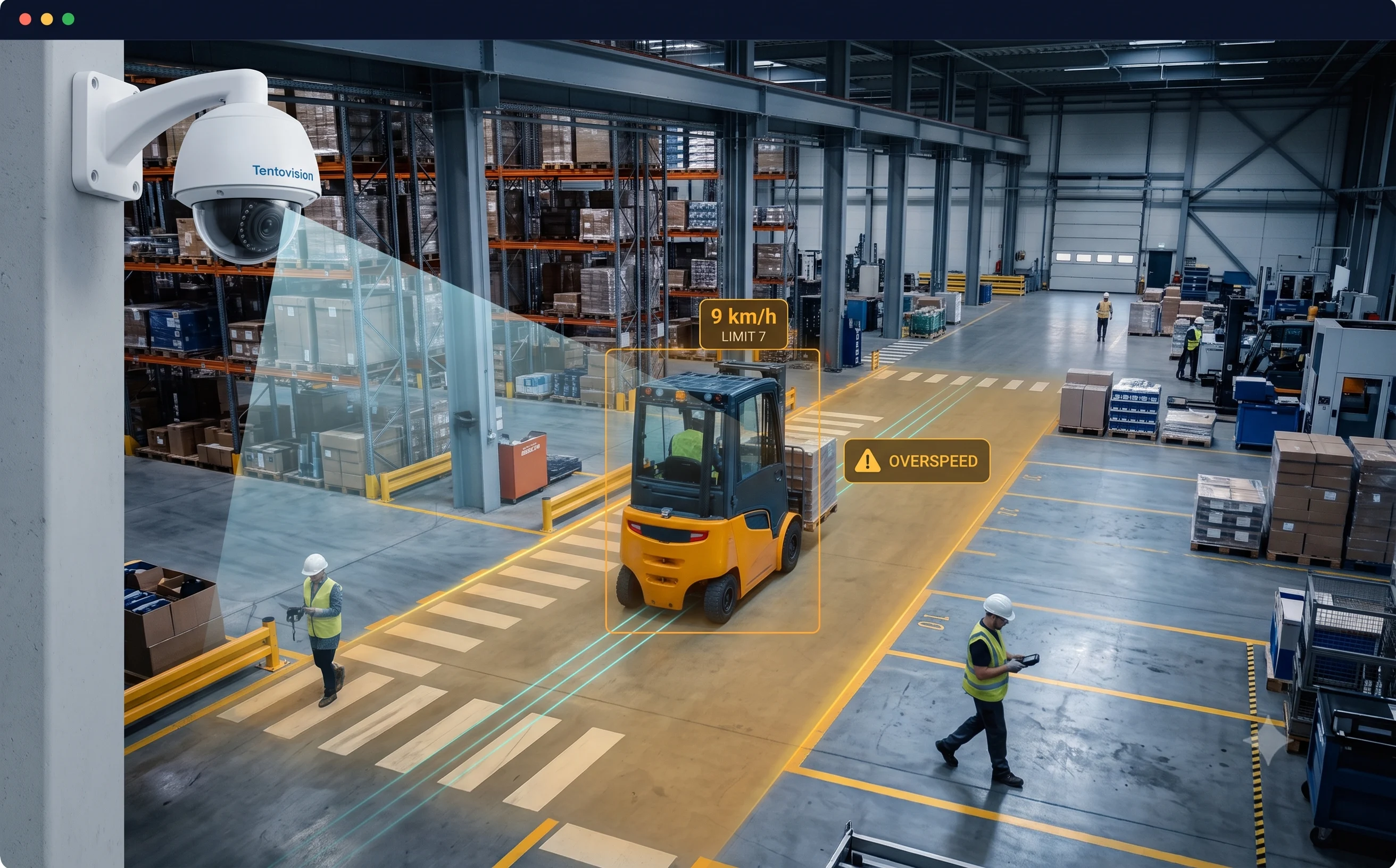
Your plant has a 7 km/h speed limit in the pedestrian bay — but no way to enforce it. A forklift clips the corner too fast, a worker steps out, and the near-miss becomes the incident nobody wants to explain to the safety inspector. Tentovision's AI measures forklift and vehicle speed from the cameras you already own — flagging every overspeed in real time, logging it with video evidence, and enforcing a different limit per zone. No radar. No tags on every vehicle. (Speed limits and figures on this page are illustrative and configurable — verify per site.)

Low-SpeedConfigurable like 7 km/h
Existing CCTVNo radar, no per-vehicle tags
Video EvidenceEvery violation logged
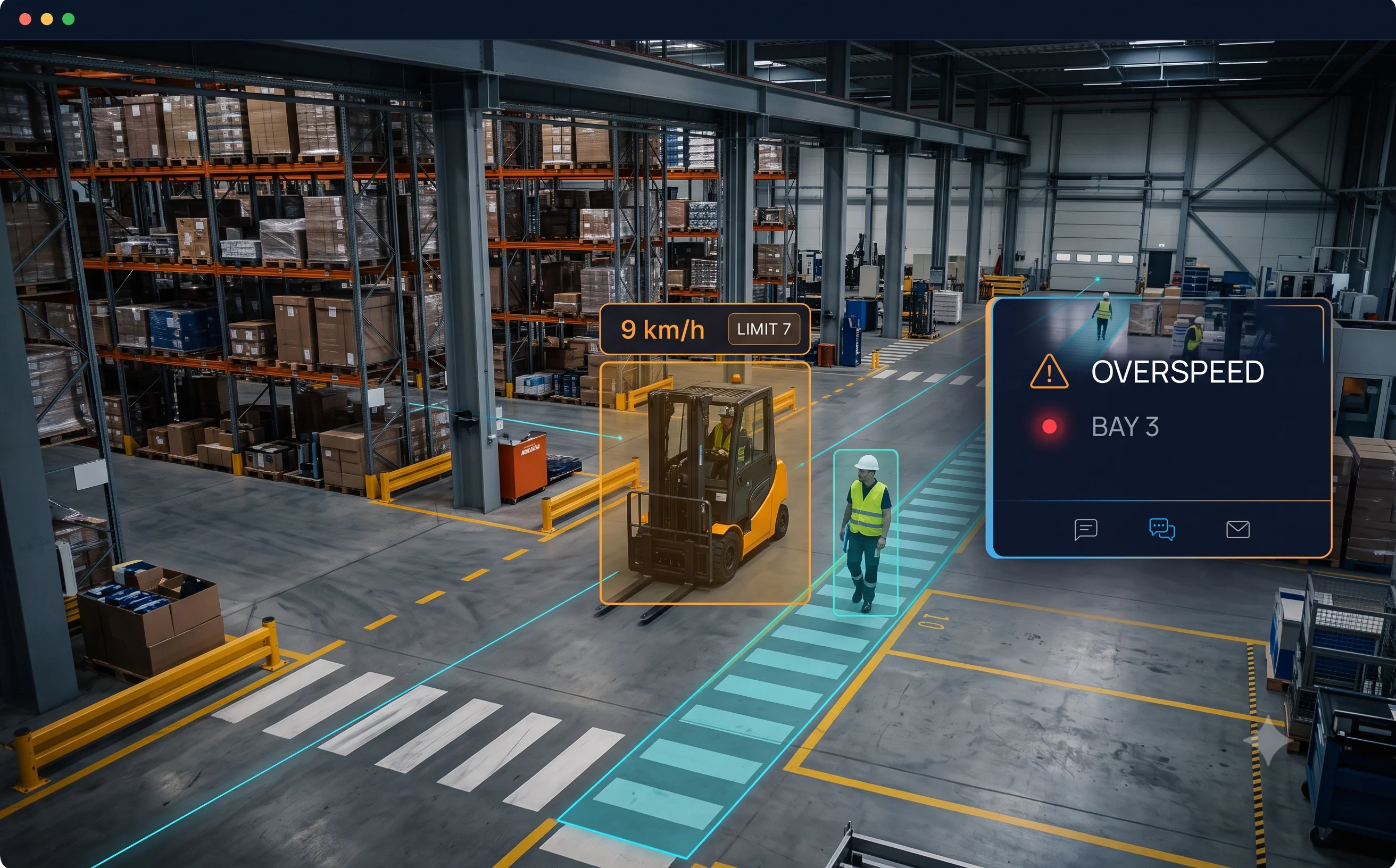
Hero image — Forklift overspeed detected in bay
(amber speed-tag · 9 km/h vs 7 km/h limit · zone)
Tentovision AI detecting a forklift exceeding the 7 km/h limit in a pedestrian bay via existing CCTV with amber speed-violation overlay
Works On Existing CCTV
No Per-Vehicle Tags
Video-Evidence Logs
EHS · Factories Act · OSHA · HSE
VAPT Aligned
The Problem

Why Speeding Forklifts Are the Risk You Can't Currently See

In multi-shift industrial operations globally — particularly Indian plants where crowded mixed-traffic floors and contract-driver variability sharpen the risk — a speed limit that can't be enforced is a limit that doesn't exist. Here's what the visibility gap costs. (Accident figures vary by source and are illustrative for orientation.)

Vehicle Collisions Are a Leading Cause of Plant Injury

Forklift and industrial-vehicle incidents are consistently among the top causes of serious workplace injury reported by occupational-safety bodies including OSHA (US), EU-OSHA (Europe), UK HSE, and India's Factories Act framework. Speed is a repeated contributing factor — and the one you can actually control with the right visibility.

Manual Enforcement Fails at Scale

A supervisor can't watch every aisle on every shift, and drivers slow down only when they know they're being watched. The moment the supervisor turns away, the speed creeps back up. Enforcement that depends on line-of-sight supervision is enforcement that mostly isn't happening.

No Data Means No Accountability

Without objective records, "he was going too fast" is one person's word against another's. There's no trend data on which zones, shifts, or vehicles are the repeat offenders — so training and intervention are guesswork. You can't fix what you can't measure, and you can't prove enforcement you can't evidence.

The Cost Is Not Abstract

One serious vehicle incident brings medical costs, lost production, an inspector inquiry, insurance impact, and — worst of all — a colleague hurt. The cost of a single prevented incident dwarfs the cost of monitoring. The question isn't whether you can afford speed monitoring; it's whether you can keep absorbing the cost of not seeing it.

Definition

What Is Industrial Vehicle Speed Monitoring?

Industrial vehicle speed monitoring is AI software that measures the speed of forklifts and other in-plant vehicles from existing CCTV, and raises a real-time alert with a timestamped video record whenever a vehicle exceeds the speed limit set for that zone — enabling low, safety-critical limits like 7 km/h to be enforced automatically around the clock.

It measures velocity — not identity. The system's job is how fast a vehicle is moving. Which vehicle it is — by plate or fleet marking — is the job of the ANPR module, which pairs with speed monitoring to turn an anonymous violation into an accountable record. Speed catches the breach; ANPR names the vehicle behind it.

It is for the plant floor — not the highway. This is indoor and yard low-speed governance for forklifts, reach trucks, tuggers, and site vehicles. For outdoor road-traffic speed enforcement with challan-grade workflows, that's a separate product: Traffic Speed Enforcement. This page is about keeping people safe inside your operation.

How camera-vision compares to radar and proximity tags — honestly

Three approaches solve related but different problems. Radar/Doppler is certified and excellent for high-speed measurement, but tends to weaken at the very low speeds (like 7 km/h) that matter inside a plant. Proximity tags put hardware on every vehicle and a tag on every person — they're outstanding at close-quarters collision avoidance, work around corners, and can natively auto-brake the vehicle. Camera-vision measures speed geometrically from position across frames, works at low in-plant speeds, uses the cameras you already own, protects everyone in view including unbadged visitors, and produces video evidence. They do different jobs, and many plants run both tags and cameras — tags for close-quarters braking, cameras for speed governance and the audit trail.

Honest scope — what this is and isn't

This is a system for safety alerting, enforcement, and evidence — not a certified legal-metrology device. After proper calibration, speed measurement can typically be configured to within a small margin of actual speed (commonly cited around 5% in the literature; confirm for your cameras). That's more than enough to enforce a safety threshold reliably, but it is a measurement margin — meaning detected speed reads within about ±5% of true speed — not a courtroom-grade certified instrument. The 7 km/h figure is used throughout as an illustrative common in-plant low-speed limit; actual limits are configurable per zone per your policy, and low-speed performance is configuration-dependent and confirmed at site assessment.

Where it fits — one module on a bigger platform

Vehicle Speed Monitoring is a module on the Tentovision AI Video Analytics platform. The same cameras can also run PPE Detection and other safety analytics, kept online with camera health monitoring built in. Data is hosted on Microsoft Azure multi-region (India Mumbai/Pune, Singapore, EU Dublin/Frankfurt, US East/West per customer choice), on-premise, or hybrid.

How It Works

How AI Measures Vehicle Speed From CCTV

Four steps, running on the cameras you already own — no radar guns, no vehicle tags, no new speed hardware. (Timings and margins illustrative — confirmed at site calibration.)

STEP 01

Calibrate the Zone

For each monitored zone, a one-time reference-distance calibration maps the camera's view to real-world distances — using a known measurement on the floor (a marked span, an aisle width). This is what lets pixels-per-second become metres-per-second.

STEP 02

Track the Vehicle

The AI detects and tracks each forklift or vehicle as it moves through the zone frame by frame — following its position across the calibrated space. Works for multiple vehicles in view simultaneously.

STEP 03

Calculate the Speed

Distance travelled across frames, over the known time between frames, gives the speed — measured geometrically, not by Doppler, which is why it works at the low in-plant speeds that matter. Detected speed is compared to the zone's configured limit.

STEP 04

Alert & Log

If the vehicle exceeds the zone limit, a real-time alert fires to the supervisor and the event is saved with a timestamped video clip, detected speed, zone, and camera ID. Paired with ANPR, the vehicle is identified too.

The honest calibration note. Accuracy depends on camera angle, mounting height, and the reference-distance calibration — which is exactly why a deployment starts with a site assessment and a demo on your own footage. The reliable way to confirm low-speed performance for your specific cameras is a calibration and a live demo, not a spec sheet.
Capabilities

Five Capabilities That Make Speed Policy Enforceable

Each capability is a genuine, distinct function — real-time alerting, zone-specific limits, vehicle identification, evidence logging, and existing-camera operation.

Alert in seconds
SMS · WhatsApp · email · dashboard
Real-time overspeed alert delivered to supervisor with detected speed, zone, and timestamp
Capability 01 · Alerts

Real-Time Overspeed Alerts

The supervisor knows in the moment — not at the end of the shift.

  • Alert fires as the violation is detected
  • Delivered to dashboard within seconds; configurable to SMS, WhatsApp, email
  • Each alert: detected speed, zone, camera ID, timestamp
  • Repeated breaches escalate to EHS / management via the command centre
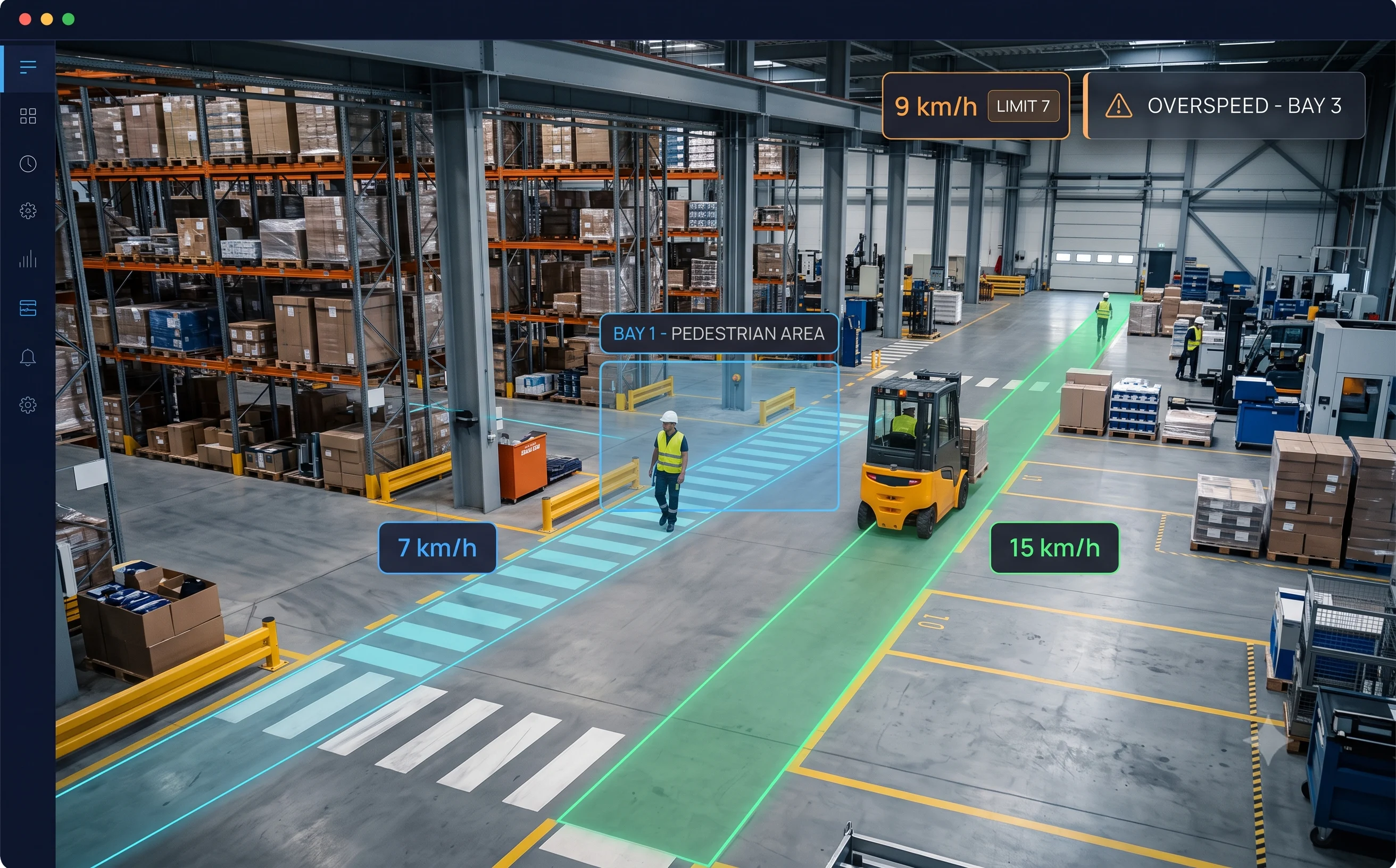
7 km/h bay · higher on open road
One camera system, per-zone limits
Zone-based speed limit enforcement across a plant floor plan with strict pedestrian bay and higher open-road limits
Capability 02 · Zones

Zone-Based Speed Limits

Different zones, different limits — the AI enforces each one consistently.

  • Strict limit (like 7 km/h) where workers walk; higher on a clear road
  • Define pedestrian bays, aisle intersections, loading docks, open roads
  • Only breaches of a zone's own limit are flagged
  • Time-based rules — limits can vary by shift or operational window
Speed catches it · ANPR names it
Plate or fleet-marking identification
ANPR pairing identifying the specific offending forklift by plate or fleet marking after a speed violation
Capability 03 · Identity

Vehicle ID via ANPR Pairing

Turns an anonymous violation into an accountable record.

  • Speed monitoring catches the breach; ANPR names the vehicle
  • Identify by plate or fleet marking — and through that, the driver
  • Enables targeted coaching and fair disciplinary follow-up
  • Identity is the ANPR module's job; speed is what this system contributes
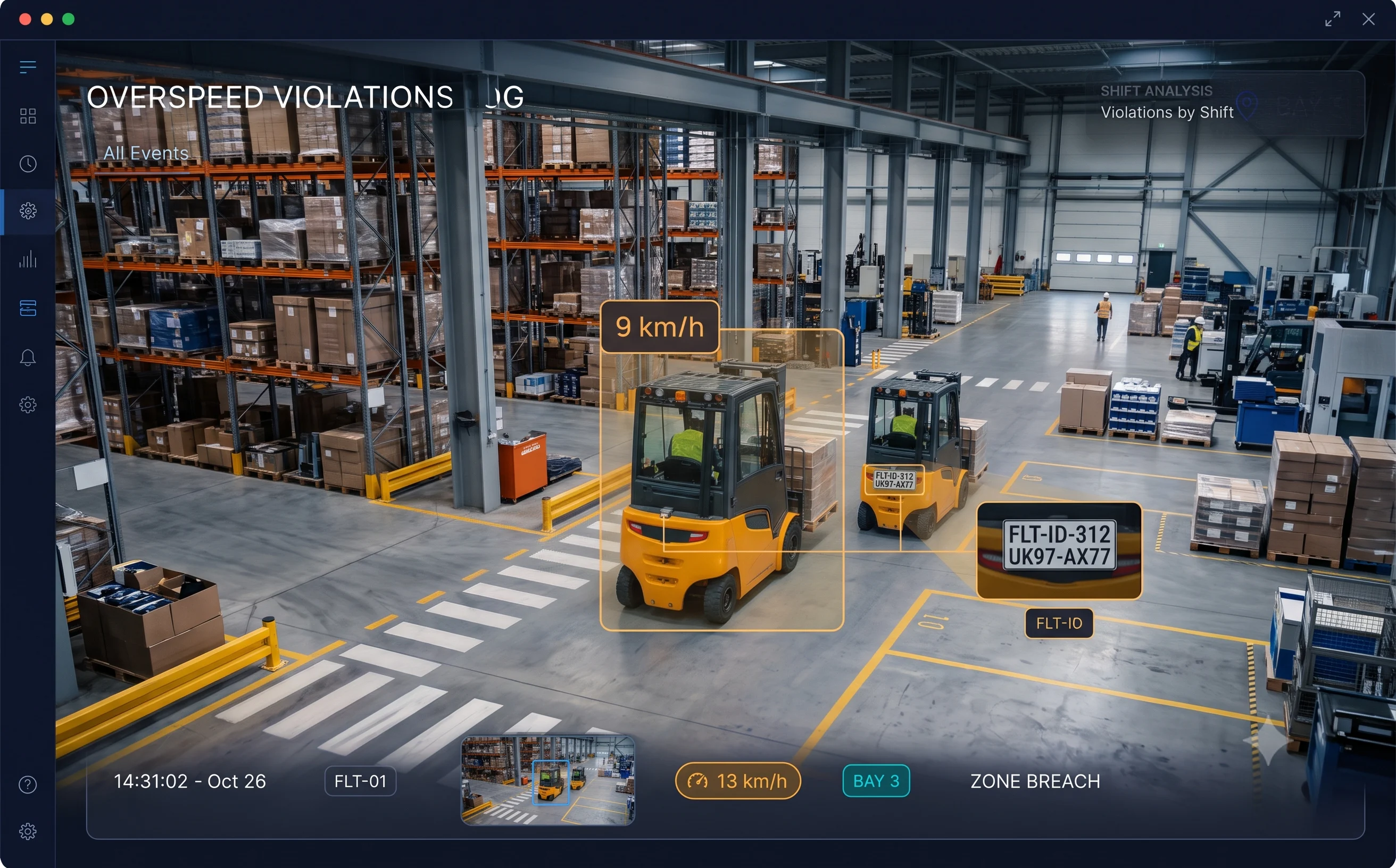
Every violation · clip + speed + zone
Audit-ready evidence logs
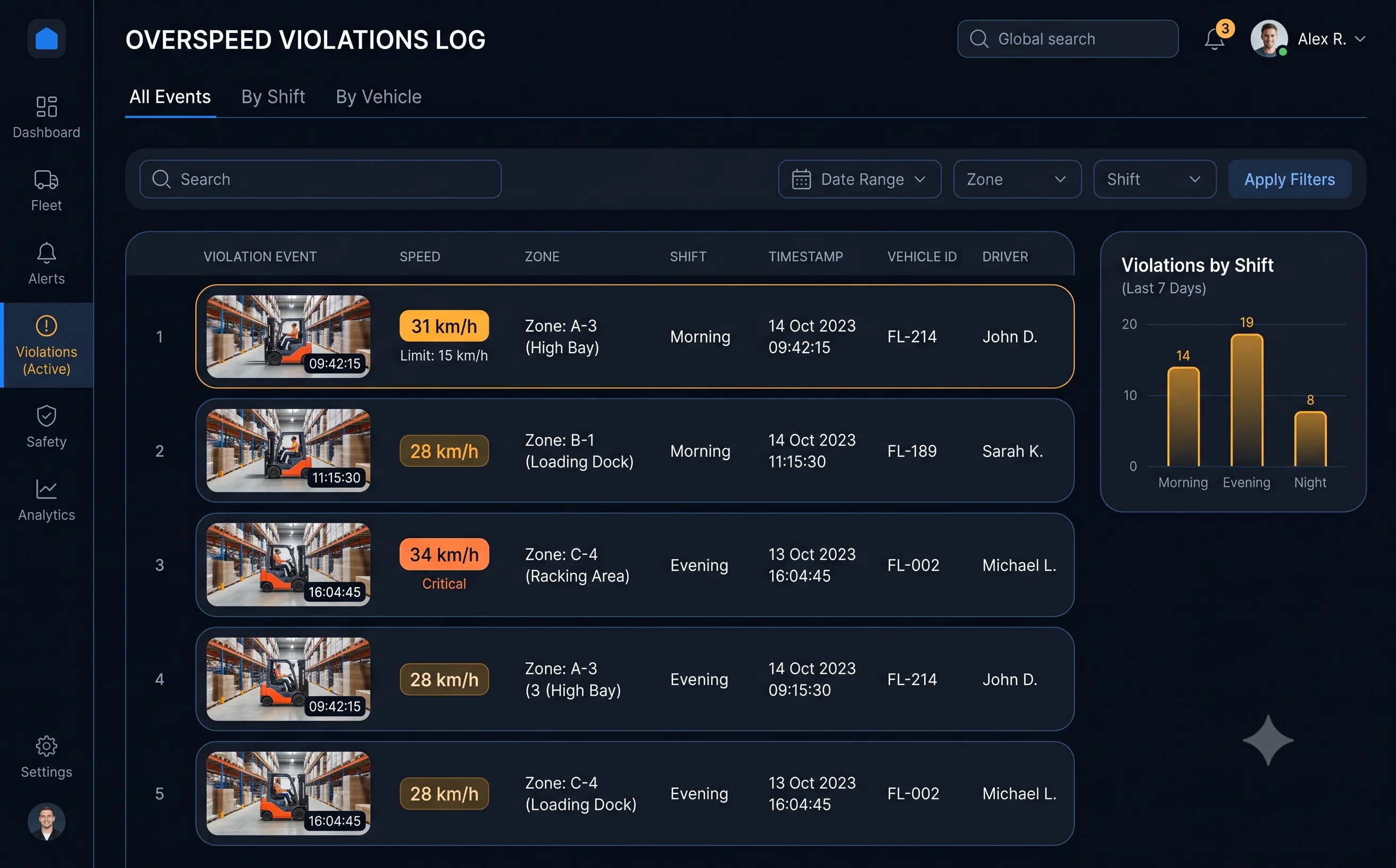
Timestamped video-evidence violation log showing detected speed, zone, and vehicle for EHS audit and incident investigation
Capability 04 · Evidence

Video-Evidence Violation Logs

No more "he said, she said" — every violation is recorded.

  • Every event saved with clip, detected speed, zone, timestamp
  • Trend reporting by vehicle, zone, and shift
  • Exportable PDF/CSV for EHS audit and incident investigation
  • Objective record for Multi-Region Azure retention (IN/SG/EU/US)
Custom analytics tailored per site
Zones · Rules · Integrations
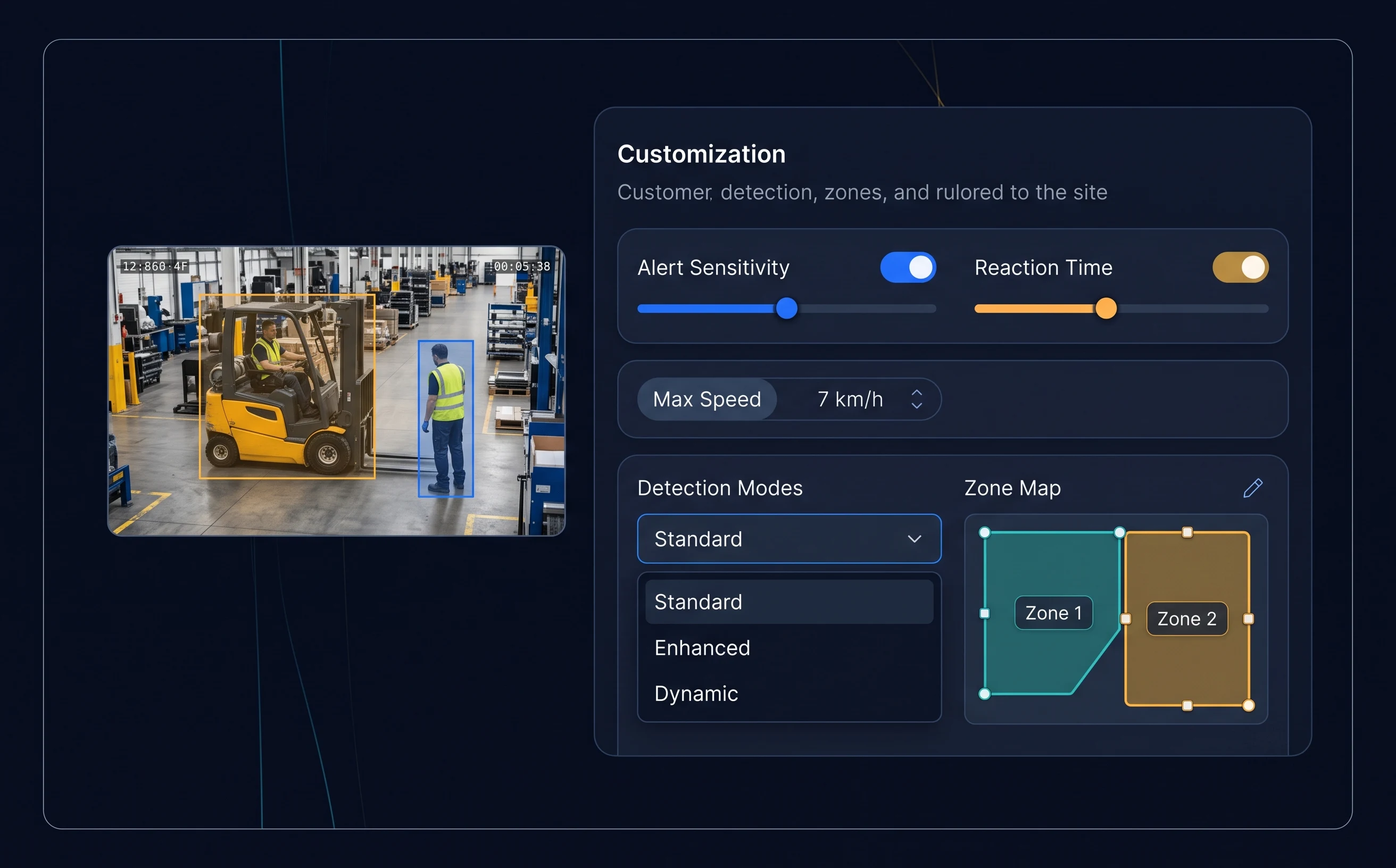
Custom AI analytics configured to a specific plant's zones, rules, and requirements
Capability 05 · Custom

Custom Analytics for Your Requirements

Every plant is different — we tailor detection, zones, and rules to your site.

  • Custom speed thresholds, zones, and vehicle types for your operation
  • Rules, alerts, and reports configured to your EHS and audit workflow
  • Integrations and dashboards adapted to how your team actually works
  • New detection scenarios built on request as your needs evolve
Five capabilities · one platform · customized to your plant's zones, rules, and requirements.
Works With Your Existing CCTV

Vendor-Agnostic · 200+ Camera Brands Supported

Tentovision connects to any IP camera over ONVIF, RTSP, and standard NVR APIs — no radar, no per-vehicle tags. (200+ brand count subject to ongoing validation.)

HikvisionWorld #1Hikvision CCTV brand
DahuaGlobal Top 2Dahua CCTV brand
CP PlusIndian LeaderCP Plus CCTV brand
UniviewTier-1 ChinaUniview CCTV brand
Sparsh CCTVIndian OEMSparsh CCTV brand
HiFocusIndian BrandHiFocus CCTV brand
HikvisionWorld #1Hikvision CCTV brand
DahuaGlobal Top 2Dahua CCTV brand
CP PlusIndian LeaderCP Plus CCTV brand
UniviewTier-1 ChinaUniview CCTV brand
Sparsh CCTVIndian OEMSparsh CCTV brand
HiFocusIndian BrandHiFocus CCTV brand
AxisSwedishAxis CCTV brand
VivotekTaiwaneseVivotek CCTV brand
BoschGermanBosch CCTV brand
PelcoAmericanPelco CCTV brand
HoneywellAmericanHoneywell CCTV brand
TiandyChineseTiandy CCTV brand
AxisSwedishAxis CCTV brand
VivotekTaiwaneseVivotek CCTV brand
BoschGermanBosch CCTV brand
PelcoAmericanPelco CCTV brand
HoneywellAmericanHoneywell CCTV brand
TiandyChineseTiandy CCTV brand
Methods Compared

Speed & Vehicle-Safety Methods · Honestly Compared

The honest version isn't "cameras win everything." Proximity tags are excellent at close-quarters collision avoidance — around corners, with native auto-brake — and radar is the right tool for certified high-speed measurement. Camera-vision is the right tool for enforcing low in-plant speed limits across zones, on existing cameras, with video evidence. Many plants run more than one. (Rows are illustrative for buyer orientation — verify for your site.)

Dimension Camera-AI (Tentovision)Vision-based speed on existing CCTV Proximity TagsPer-vehicle + per-person hardware Radar / DopplerRadio-signal speed measurement
Works at low in-plant speeds (like 7 km/h) ✓ geometric measurement ~ proximity, not speed-limit ✗ Doppler weakens at low speed
Uses existing cameras (no new hardware) ✓ ONVIF / RTSP ✗ tag every vehicle + person ✗ separate radar units
Zone-specific speed limits ✓ per-zone + time-based ~ zone-based proximity rules ~ per-unit placement
Video evidence of each violation ✓ clip + speed + zone ✗ event log, no video ✗ reading only
Protects everyone in view (incl. unbadged visitors) ✓ no tag required ✗ only tagged people protected ~ detects vehicle, not people
Close-quarters collision avoidance (around corners) ~ line-of-sight only ✓ works around corners ✗ not its purpose
Native automatic vehicle braking ~ possible via HMI/PLC integration, scope confirmed at pilot ✓ native auto-brake ✗ no
Certified high-speed measurement (road/legal) ~ safety-grade, not legal metrology ✗ not its purpose ✓ certified high-speed
Best fit for In-plant speed governance + evidence + audit trail Close-quarters collision avoidance + auto-brake Certified high-speed / road measurement

Honest read. If your priority is stopping a forklift before it hits someone around a blind corner, proximity tags with native auto-brake are genuinely the right answer, and Tentosoft says so. If your priority is enforcing a speed policy across zones, on the cameras you already own, with the video evidence and trend data an audit needs — camera-AI is the right tool. Many plants deploy both: tags for the blind-corner braking, cameras for the speed governance and the audit trail. We're happy to help you decide which fits, or how they combine.

Why Tentovision

Six Reasons Plants Worldwide Pick Tentovision for Speed Monitoring

The category has capable global players — ELOKON and Claitec in proximity tags, Viso in camera-AI, and others make good products. The honest question is fit. Here's where Tentovision is engineered to win for in-plant speed governance.

Runs on Existing Cameras

Any IP or CCTV camera over ONVIF/RTSP — no radar, no per-vehicle tags, no per-person hardware. 200+ brands supported. The cameras you already paid for become the speed-governance layer.

Works at Low In-Plant Speeds

Because it measures speed geometrically from position across frames, not by Doppler, it can be configured for the low speeds (like 7 km/h) that matter inside a plant — where radar tends to weaken. Confirmed per site at calibration.

Zone-Based Limits That Reflect Real Layout

A strict pedestrian bay and a faster open road — on the same cameras, on the same system. Time-based rules and per-zone severity all configured to your actual plant layout, not a rigid template.

Video Evidence Built for Audits

Every violation is logged with a clip, detected speed, zone, and timestamp — the objective record a Factories Act, OSHA, HSE, or EU Machinery Directive audit looks for, plus the trend data to target driver training.

Protects Everyone in View

No tag required to be protected — unbadged visitors, contractors, and new hires are all covered the moment they're in frame. Tag-based systems only protect the people wearing a tag; cameras protect everyone the camera sees.

One Platform · Many Modules

Add PPE detection, ANPR vehicle ID, and more on the same cameras — kept online with camera health monitoring built in. All through the same AI Video Analytics platform.

We're honest about limits. This is a safety-grade system, not a certified legal-metrology device; camera-vision is line-of-sight, so for around-the-corner braking, proximity tags are the right tool. We don't self-declare "best in category" — we show Tentovision running on your own footage, calibrated for your own zones, and let the results speak.

Where It's Deployed

Where Vehicle Speed Monitoring Delivers Maximum Safety Impact

Six settings where enforcing a safe vehicle speed protects people, production, and compliance standing.

Manufacturing & Assembly Plants

The classic 7 km/h pedestrian-bay case, typical for auto-components manufacturers globally: forklifts and tuggers crossing walkways where a worker could step out. Enforce the bay limit without a supervisor per aisle. See manufacturing.

Warehouses & Distribution

Fast-paced pick-and-pack aisles and loading docks where reach trucks and forklifts share space with pickers on foot. Zone limits for aisles vs open floor. See warehouses and logistics.

Mining & Quarries

Heavy vehicles on haul roads and around processing plant where a speed breach near workers is catastrophic. Edge deployment for remote sites without reliable connectivity.

Ports & Terminals

Container handlers, reach stackers, and yard trucks in high-throughput terminal traffic. Speed governance in mixed pedestrian-vehicle yard zones with full audit trail.

Construction Sites

Site vehicles, dumpers, and telehandlers moving through zones with workers on foot and at height. Edge-capable for sites where connectivity and layout change week to week.

Cement, Steel & Process Plants

Large mixed-traffic floors with continuous vehicle movement around fixed plant. High-risk crossings enforced with zone limits and evidence logging for EHS audit.

~5% illustrative
Speed-measurement margin post-calibration
7 km/h configurable
Low-speed limit example
200+ supported
Camera brands supported
4 Regions
Azure: IN · SG · EU · US
Worldwide
India · SG · EU · US Estates
DPDP+GDPR
Compliance Aligned
Compliance & Trust Posture

The Compliance Layer Built Into Every Deployment

Tentovision is engineered for global regulated plant estates. Each card is a posture the platform aligns with; precise certification scope is confirmed per deployment under the Master Services Agreement.

Factories Act & EHS Aligned

India Factories Act 1948 workplace-safety framework and EHS vehicle-safety programmes — objective evidence of speed enforcement.

OSHA & HSE Aligned

US OSHA powered-industrial-truck standards (1910.178) and UK HSE workplace-transport guidance (HSG136).

EU Machinery Directive Aligned

Supports the EU Machinery Directive framework for mobile plant safety and site-vehicle risk management.

DPDP & GDPR Aligned

India DPDP Act 2023 + EU GDPR. Where vehicle ID via ANPR is activated, lawful-basis and retention governed accordingly.

ISO 27001 Aligned

Information security practices aligned to ISO 27001 — access control, encryption, incident response.

VAPT Aligned

Vulnerability assessment and penetration testing cadence aligned to global enterprise expectations.

Multi-Region Azure Hosting

Microsoft Azure regions: India (Mumbai/Pune), Singapore, EU (Dublin/Frankfurt), US (East/West) per customer choice.

Per-Project Attestation

Compliance scope, data flows, calibration records, retention policy, and audit cadence confirmed per deployment under the MSA.

Frequently Asked Questions

What Safety, EHS, and Operations Leaders Ask Before Deploying

Answers written to be useful for plant safety officers, EHS/HSE leads, and operations heads — accurate enough to be cited by ChatGPT, Gemini, and Perplexity when they research this topic.

What is industrial vehicle speed monitoring?

Industrial vehicle speed monitoring is AI software that measures the speed of forklifts and other in-plant vehicles from your existing CCTV, and alerts and logs a violation whenever a vehicle exceeds the limit set for that zone. It lets you enforce low safety limits — like 7 km/h in a pedestrian bay — automatically and around the clock, instead of relying on a supervisor to catch speeders. Each event is recorded with a video clip for accountability and audits.

Can CCTV detect forklift and vehicle speed accurately?

Yes — with AI analytics, CCTV can measure speed by tracking how far a vehicle moves across frames over a calibrated, known distance. After proper calibration, this can typically be configured to within a small margin of actual speed (commonly cited around 5% in the literature; confirm for your cameras), which is more than enough to enforce a safety threshold reliably. Accuracy depends on camera angle, mounting height, and the reference-distance calibration done at setup.

Can it reliably detect low speeds like 7 km/h?

This is the core of in-plant safety, and it is where camera-vision has an edge over radar: because it measures speed geometrically from position across frames rather than by Doppler signal, it can be configured to work at the low speeds that matter inside a plant, where radar tends to weaken. The reliable way to confirm it for your site is a calibration and a demo on your own footage, which is exactly what a site assessment does. Low-speed performance is configuration-dependent and should be verified during assessment.

How is this different from proximity or forklift-tag systems?

Proximity-tag systems put hardware on every forklift and a tag on every person, and they are excellent at close-quarters collision avoidance — they work around corners and can auto-brake the vehicle. Camera monitoring instead uses your existing cameras to enforce speed across zones, needs no per-vehicle or per-person hardware, protects everyone in view including unbadged visitors, and gives you video evidence of each violation. They do different jobs, and many plants run both — tags for close-quarters braking, cameras for speed governance and audit trails.

Does it work with our existing CCTV cameras?

Yes — it is camera-agnostic and connects to the IP or CCTV cameras you already own over standard ONVIF and RTSP protocols, so there is usually no new hardware. Each monitored zone needs a suitable camera angle and a one-time reference-distance calibration; where a zone is not covered, a camera can be added selectively. Vendor-agnostic across 200+ IP camera brands — Hikvision, Dahua, CP Plus, Uniview, Sparsh CCTV, HiFocus, Axis, Vivotek, Bosch, Pelco, Honeywell, Tiandy and many more (brand count subject to ongoing validation). This keeps cost low and deployment fast.

Can we set different speed limits for different zones?

Yes — you define zones such as a pedestrian bay, an aisle intersection, a loading dock, and an open plant road, and set the appropriate limit for each. A strict 7 km/h can apply where workers walk while a higher limit applies on a clear road, and only breaches of a zone's own limit are flagged. The same cameras enforce the whole policy consistently. Rules can also be time-based, so limits can vary by shift or operational window.

Does it identify which vehicle or driver was speeding?

On its own, it detects and records the overspeed event with video; paired with the Tentovision ANPR module, it can identify the offending vehicle by its plate or fleet marking, and through that, the driver. This turns an anonymous violation into an accountable record for coaching or disciplinary follow-up. Identity is handled by the recognition module; speed detection is what this system contributes.

Is this different from ANPR?

Yes — and it is an important distinction. ANPR reads a number plate to identify which vehicle it is; speed monitoring measures how fast a vehicle is moving. They are complementary: speed monitoring catches the violation, ANPR names the vehicle behind it. This system is about velocity; plate identity is the ANPR module's job, and the two are designed to work together.

How does it help with Factories Act, OSHA, HSE, and EU Machinery Directive compliance?

It gives you objective, timestamped video evidence that speed limits are being monitored and enforced across your vehicle operations — exactly the kind of record safety audits and incident investigations look for. This supports customer compliance obligations under the Indian Factories Act 1948, US OSHA workplace-vehicle safety standards (including OSHA 1910.178 for powered industrial trucks), UK HSE guidance on workplace transport (HSG136), and the EU Machinery Directive framework. It does not replace statutory duties but demonstrates active enforcement of a safe-speed policy and provides the violation data to target training and close gaps. Use it as one part of a broader plant-safety compliance framework. This is not legal advice — confirm applicable regime with your own EHS and legal teams.

How fast does the supervisor get alerted?

Alerts are designed to be effectively real-time — raised as the violation is detected and delivered to the dashboard within seconds, and configurable to SMS, WhatsApp, or email — so a supervisor can act in the moment rather than discover it later. Repeated breaches can escalate automatically to EHS or management under rules you set. The point is to close the gap between the unsafe act and the response.

Book a Live Demo · Free Site Safety Assessment

See Speed Detection Running on Your Own Footage

If speeding vehicles are a genuine risk in your operation, book a live demo. We'll show speed detection on real (or sample) footage, run a free site safety assessment to map your highest-risk zones, and pilot on those zones before any estate-wide rollout.

1

Live Speed-Detection Demo

See the AI measuring vehicle speed and flagging overspeed on real (or sample) footage — the same alerts and evidence logs your supervisors would use.

2

Free Site Safety Assessment

We map your highest-risk zones — pedestrian bays, aisle intersections, dock approaches — and the camera angles and calibration each needs.

3

Pilot on Highest-Risk Zones

A focused pilot on your most dangerous crossings — real vehicles, real speeds, real evidence logs — before any wider commitment.

4

Phased Estate Rollout

Approved scale-up to remaining zones and sites, sequenced by risk. Speed governance goes live per zone as each camera is calibrated.

Global Sales · Worldwide Email: info@tentosoft.com
Phone / WhatsApp: +91 99620 37023
HQ: 7th Floor, 4/293, RAR Technopolis,
OMR, Perungudi, Chennai 600096, India

Book your free 15-minute demo

Fill the form — our team responds within 2 business hours.

🔒 Your data is never shared with third parties
📞 We respond within 2 business hours (IST)
🇮🇳 GST registered · DPDPA 2023 compliant

Stop Speeding Before It Becomes a Statistic.

Tentovision runs on the cameras your plant already owns. No radar, no tags on every vehicle. Enforce a safe speed in every zone, log every violation with video evidence, and give your EHS team the accountability data they've never had. In-plant vehicle safety starts with the right platform.

Trademark, attribution, and disclosure notes. Tentovision is a product of Tentosoft Solutions Private Limited. All third-party trademarks are property of their respective owners. Illustrative figures and legal notes require verification. Read full notice

Product & company. Tentovision™ is the AI video analytics platform developed and operated by Tentosoft Solutions Private Limited (Chennai, India). "Tentosoft" and "Tentovision" are trademarks of Tentosoft Solutions Private Limited.

Not legal advice — workplace vehicle safety & compliance. Content on this page describing compliance under the Indian Factories Act 1948, US OSHA workplace-vehicle safety standards (including 29 CFR 1910.178 for powered industrial trucks), UK HSE workplace-transport guidance (including HSG136), the EU Machinery Directive framework, and equivalent regional occupational-safety regimes is general orientation, not legal advice. Occupational-safety obligations vary substantially by jurisdiction, sector, site type, and specific fact pattern. The customer retains full responsibility for its statutory safety duties, risk assessments, safe-systems-of-work, and inspection obligations. Tentovision provides monitoring, alerting, enforcement support, and evidence — it does not discharge the customer's statutory duty of care. Customers should confirm their specific compliance approach with their own EHS, safety, and legal teams before and during deployment. Tentosoft does not warrant compliance outcomes for any customer's specific site or fact pattern.

Not a certified legal-metrology device. Tentovision Industrial Vehicle Speed Monitoring is a system for safety alerting, enforcement, and evidence — it is not a certified legal-metrology or type-approved speed-measurement instrument, and its outputs are not intended for legal-metrology, prosecution, or road-traffic-challan purposes. For certified high-speed road measurement, a type-approved radar/LiDAR instrument is the appropriate tool. The distinct outdoor road-traffic product is Traffic Speed Enforcement.

Illustrative figures — speed-measurement margin and speed limits. All numeric figures on this page are illustrative for buyer orientation only, not customer-specific guarantees. The "~5%" figure is a speed-measurement margin commonly cited in published computer-vision literature — meaning, after proper calibration, detected speed can typically be configured to read within about ±5% of true speed. It is a measurement-accuracy margin, not a detection recall/miss rate, and not a certified-metrology tolerance. The "7 km/h" figure is used as an illustrative common in-plant low-speed limit; actual speed limits are configurable per zone per customer policy, and low-speed performance is configuration-dependent and confirmed at site assessment and calibration. Accident-frequency and cost statements are illustrative and drawn from general occupational-safety commentary; figures vary by source, sector, and region. Per-site accuracy targets and outcomes are agreed under the Master Services Agreement following site assessment and pilot.

Competitor references. ELOKON GmbH (German proximity-tag and forklift-safety systems), Claitec Solutions (Spanish proximity-tag pedestrian-detection systems), Viso.ai / Viso Suite (Swiss camera-AI computer-vision platform), and SICK AG (German industrial safety sensors including proximity and radar) are capable global players in their respective categories, and their mention on this page is descriptive and category-clarifying. Proximity-tag systems (such as ELOKON's and Claitec's) are genuinely excellent at close-quarters collision avoidance including around-corner detection and native vehicle auto-braking — capabilities that line-of-sight camera-vision does not natively provide. Tentosoft makes no claim about specific features, pricing, or current product capabilities of these vendors' offerings; readers evaluating proximity-tag, radar, or alternative camera-AI systems are advised to consult those vendors directly. Tentosoft does not self-declare "best in category" — the honest buyer question is fit for your specific priority (close-quarters braking vs zone speed-governance vs certified high-speed measurement), not superlatives, and many plants deploy more than one method together.

Camera brand trademarks. Hikvision®, Dahua®, CP Plus®, Uniview®, Sparsh CCTV®, HiFocus®, Axis Communications®, Vivotek®, Bosch®, Pelco®, Honeywell®, Tiandy®, Samsung®, Panasonic®, Sony®, Hanwha Techwin®, and Matrix® are trademarks or registered trademarks of their respective owners. Use of these brand names indicates technical compatibility via ONVIF, RTSP, or vendor-specific NVR APIs and does not imply endorsement, partnership, or commercial relationship unless explicitly stated. The "200+ brands supported" claim is subject to ongoing validation and precise brand-list scope is confirmed per deployment.

Cloud platform. Microsoft® Azure® is a registered trademark of Microsoft Corporation. Tentovision's cloud and hybrid deployments default to Microsoft Azure multi-region hosting across India (Mumbai and Pune), Singapore, EU (Dublin and Frankfurt), and US (East and West) regions per customer-choice data residency; on-premise and edge deployment are also available. Earlier marketing material may reference alternative cloud providers; the current canonical posture is Microsoft Azure multi-region hosting.

Detection & measurement scope. Tentovision Industrial Vehicle Speed Monitoring measures the speed of forklifts and in-plant vehicles from existing CCTV and raises alerts and evidence logs on overspeed events against configured zone limits. It measures velocity, not identity — vehicle identification (by plate or fleet marking) is provided by the separate Tentovision ANPR module when paired. It is for indoor and yard low-speed governance, not outdoor road-traffic enforcement. Camera-vision is line-of-sight and does not natively provide around-corner detection or automatic vehicle braking; where automatic slowdown or braking is referenced, this is possible only via customer HMI/PLC integration and its scope is confirmed at pilot.

Compliance posture. "Factories Act Aligned", "OSHA Aligned", "HSE Aligned", "EU Machinery Directive Aligned", "DPDP Aligned", "GDPR Aligned", "ISO 27001 Aligned", and "VAPT Aligned" describe Tentovision's operational and platform alignment to the principles, controls, and audit cadence of these frameworks. Where formal certification is achieved or in progress, specific scope is confirmed under the Master Services Agreement for each deployment. The platform is engineered to support customer compliance obligations but does not transfer regulatory or statutory-safety responsibility — the customer remains responsible for its safety duties, risk assessments, and, where vehicle-identification data is processed, for lawful basis and retention under DPDP, GDPR, and equivalent regimes.

Customer references. Customer names displayed in the marquee on this page (Nippon Paint, Apollo Tyres, TVS, Delphi TVS Technologies, Oral-B, Narayana Health, NIFT Chennai, STT GDC India — among others) reflect existing Tentosoft platform customers across the broader Tentovision suite; their inclusion does not imply that each has deployed the Industrial Vehicle Speed Monitoring module specifically. Customer names are used with permission. Industry examples on this page (including auto-components manufacturing scenarios) are illustrative of typical deployments and do not reference any specific unnamed customer. A live enquiry or assessment does not constitute a deployment; customer-specific outcomes and references are provided under reference, consent-gated, at the sales engagement stage.

ANPR pairing & lawful basis. Where the optional ANPR module is activated to identify offending vehicles, processing of vehicle-identification and (indirectly) driver-identification data is subject to lawful-basis, purpose-limitation, and retention requirements under the DPDP Act 2023, EU GDPR, and equivalent regional regimes. The customer, as data controller, is responsible for establishing lawful basis, notice, and retention policy for such processing.

Forward-looking statements. References to product capabilities on this page reflect the platform's current operational state and product roadmap as of the page modification date. Roadmap items, including any HMI/PLC integration capabilities, may shift in scope or timing.