Know Exactly When Every Machine Is Running, Stopped, or Idle — On Existing Cameras
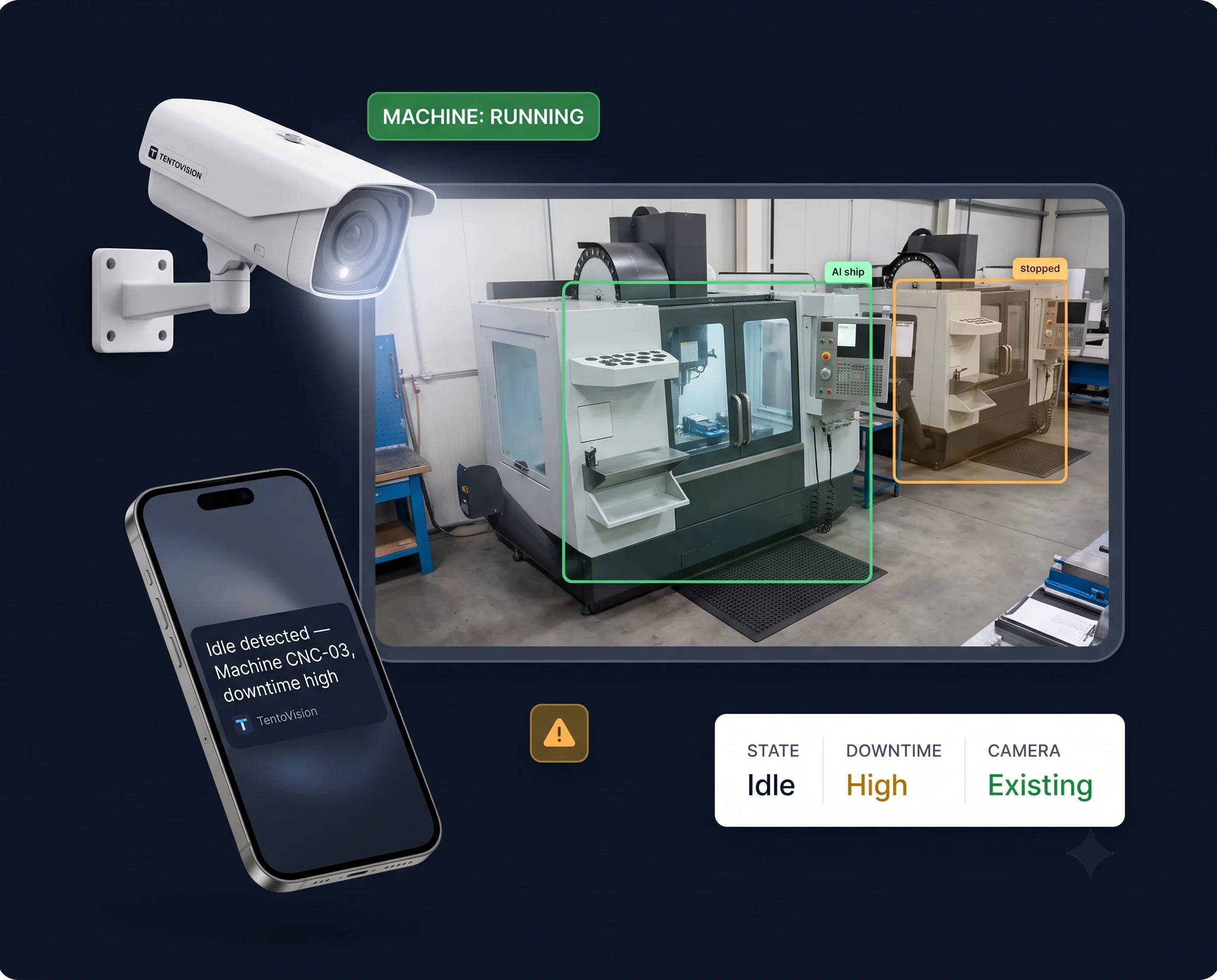
Your OEE report says 85%, but the shop floor tells a different story — machines sit idle mid-shift, "cleaning" stops stretch far longer than they should, and nobody has real numbers. Retrofitting IoT sensors on 40 mixed-age machines is expensive and slow. Tentosoft's machine utilization monitoring uses your existing cameras — across plants in India and worldwide — to detect machine state, measure downtime, and, during a stop, tell whether the operator is cleaning or idle, as anonymized productivity data, not employee surveillance.
"Manufacturers lose an estimated 18–23% of available OEE to causes that are invisible without machine-level data — micro-stoppages, idle time between shifts, and undocumented changeovers that never trigger an alarm — a pattern seen on shop floors from India to Europe and North America."— Context: CII & NASSCOM (India) and global manufacturing productivity estimates
On paper, utilization looks healthy. On the floor, capacity quietly leaks away in ways that manual logs never capture and paper OEE never admits. For a plant running high-value machines around the clock, every hidden idle hour is lost output you've already paid for — and it's exactly what proper machine utilization monitoring is meant to expose.
Manually calculated OEE almost always overstates the truth, because idle time, micro-stoppages, and stretched stops go uncaptured. A line reported at 85% availability may really be running far less — but without machine-level data, nobody can prove it or fix it.
A machine scheduled to stop 2 hours a day for cleaning may actually be down longer — part genuine cleaning, part idle. Is it 2 hours of cleaning, or 1 hour of cleaning and 1 hour of idle? Without visibility, the difference is invisible — and expensive.
Handwritten downtime registers depend on operators recording their own stops. They miss short interruptions, are filled in from memory at shift end, and can be gamed. The data that reaches your continuous-improvement reviews is incomplete before it even arrives.
Wiring PLC connectivity or clip-on sensors onto a fleet of mixed-age, multi-brand machines is expensive, disruptive, and often impossible on older equipment with no exposed controller. On a shop floor of 40 machines, the retrofit bill alone stalls the project.
Five core capabilities that turn passive shop-floor cameras into an accurate, always-on record of how your machines are actually used.
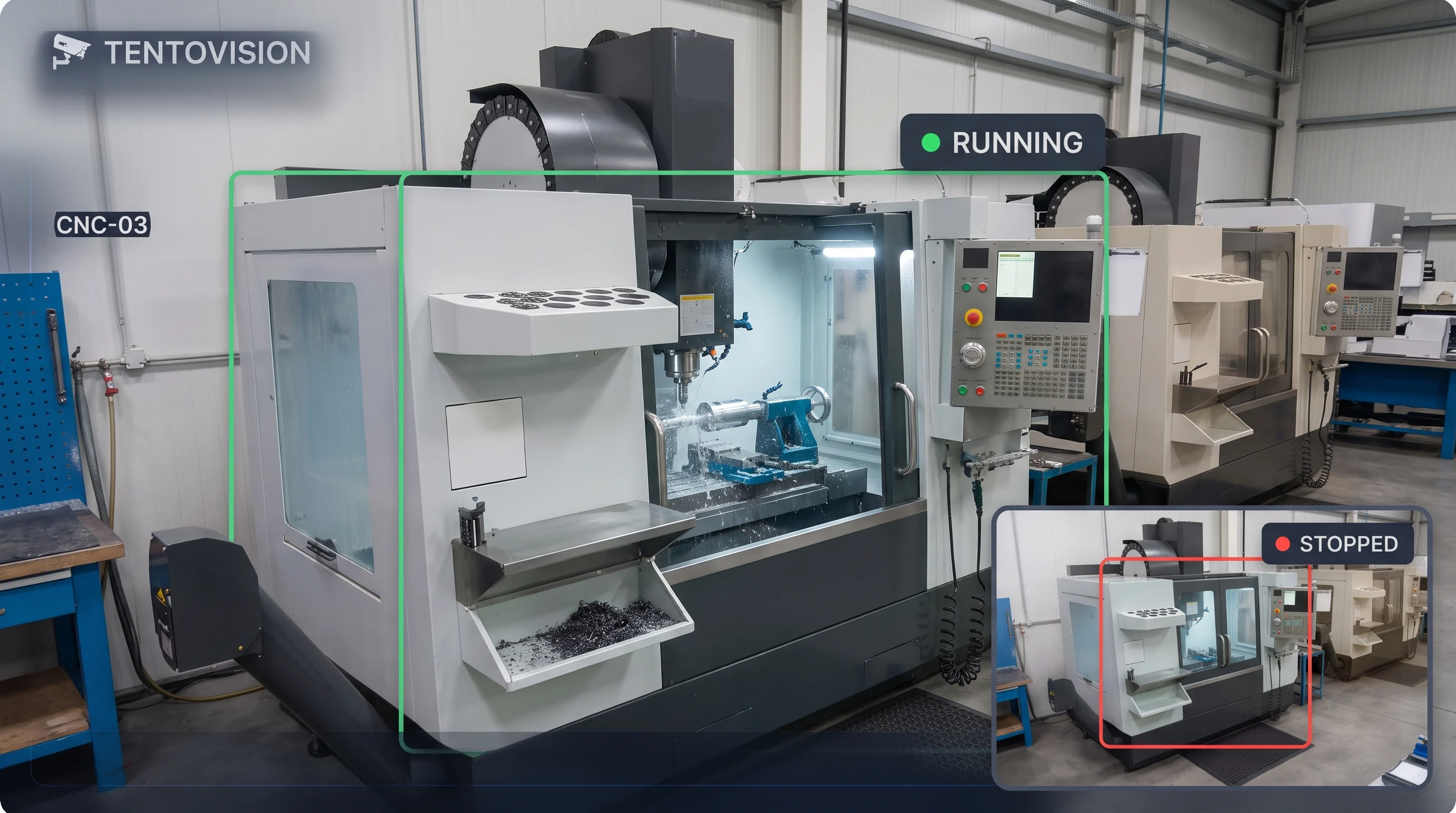
The foundation every other metric is built on. The AI can be configured to classify each machine as running, stopped, or idle — per machine, continuously, 24×7 — from visual cues such as moving parts, spindle motion, output on the line, indicator lights, and operator interaction. No PLC or controller access is required, so it works even on machines that have no data port at all.
Every stop is captured automatically with its start time, duration, and frequency — building an honest, gaming-resistant downtime record. Micro-stoppages that manual logs miss are counted, so your unplanned downtime detection reflects what really happened, not what was remembered at shift end. Stops can be tagged planned or unplanned and rolled up by machine and shift.
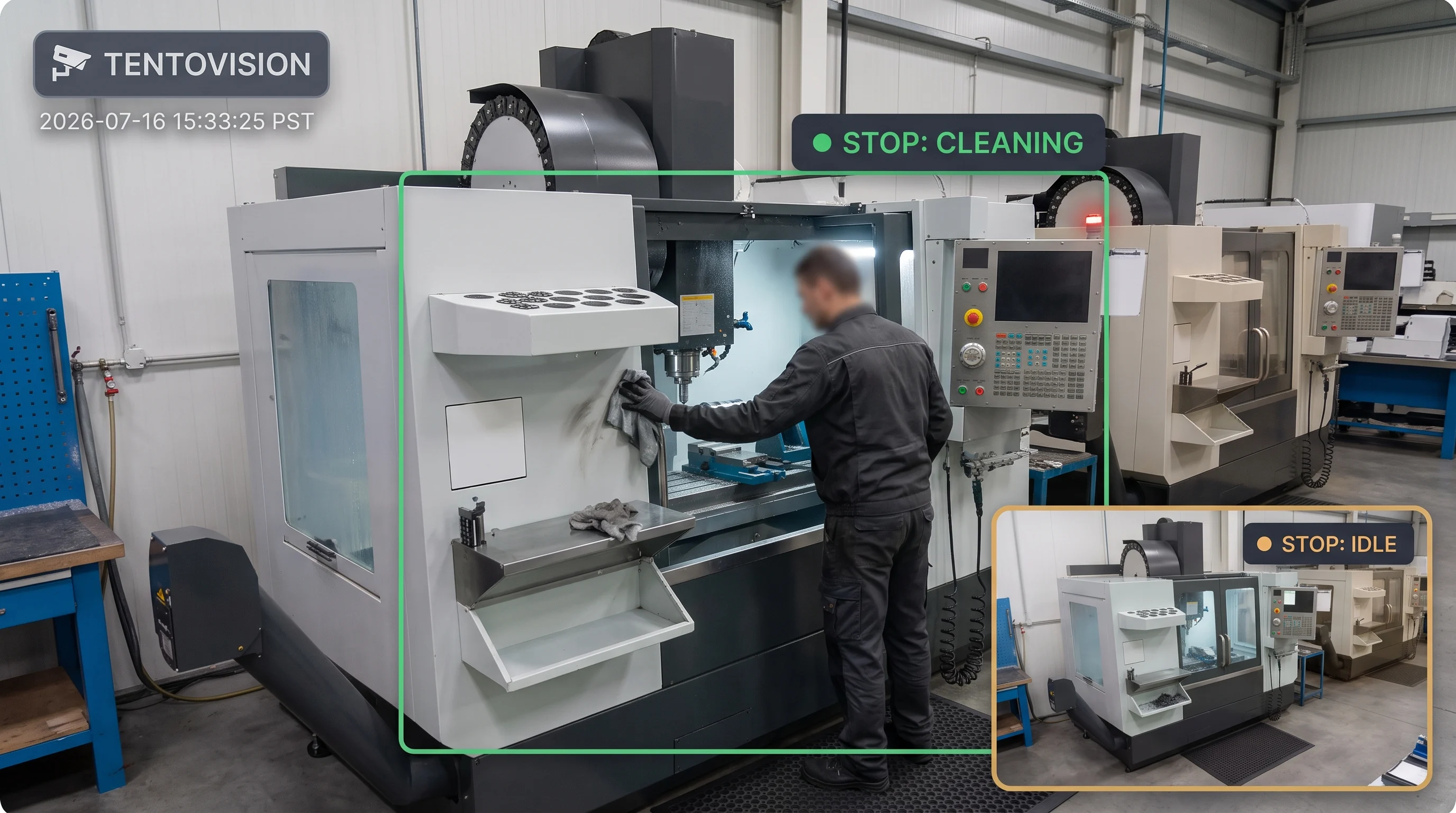
The capability that makes the difference. When a machine stops, the system can be configured to tell whether the stoppage is productive — a legitimate cleaning or changeover task — or unproductive idle. So a two-hour stop can be reported as "1h cleaning, 1h idle," turning a blind spot into a number you can act on. It is reported anonymously, at the machine level, as an activity type — never as a judgment of a named worker.
State and downtime data roll up into utilization trends by machine, shift, and line. This feeds the availability and downtime side of OEE and can typically be exported to your MES, SCADA, or OEE platform — so your effectiveness numbers finally reflect reality instead of optimistic manual estimates. Compare machines, spot the worst idle offenders, and track improvement over time.
TentoVision is built to measure machines, not people. It can be configured to log only machine state and anonymized activity type — never identity, never faces, never stored personal video — with edge or secure storage and aggregate machine-, line-, and shift-level reporting, designed to align with data-privacy regulations such as India's DPDPA 2023 and the EU's GDPR. That is what makes it deployable on labour-sensitive shop floors. For broad person-level oversight, see our separate employee monitoring solution.
Tentosoft's machine monitoring connects to any IP camera using RTSP or ONVIF protocol. No PLC integration, no clip-on sensors, no controller access, no rip-and-replace. Point a camera at the machine zone and go live within days.
From an ordinary shop-floor camera to a logged, classified downtime event — here is the end-to-end flow of camera-based machine utilization monitoring, calibrated once per machine.
An existing camera views the machine zone. Each machine is calibrated once so the AI learns its running and stopped signatures.
The AI classifies running, stopped, or idle from motion, output, indicator lights, and operator interaction — continuously, per machine.
When it stops, duration is measured and the stop is classified — cleaning, changeover, or idle — as anonymized activity, not identity.
Every event is logged and rolled up into utilization and downtime trends that can feed your OEE, MES, or ERP dashboards.
Each approach has a place. Here's an honest comparison — including where IoT sensors have the edge — so you can see why camera-based machine utilization monitoring is often the fastest way to get real data on a mixed fleet.
| Factor | Camera-AI (TentoVision) | IoT / PLC sensors | Manual logs |
|---|---|---|---|
| Retrofit needed | None — existing CCTV | Sensor / controller per machine | None |
| Works on existing cameras | Yes | N/A | N/A |
| Sees operator activity (cleaning vs idle) | Yes — unique | Blind to it | Only if written down |
| Legacy / mixed-age machines | Works — no controller needed | Often can't connect | Works |
| Setup cost & time | Low — live in days | High CapEx, slow rollout | Low, but ongoing labour |
| Gaming-resistant data | Automatic & objective | Automatic & objective | Easily gamed / forgotten |
| Direct machine-signal precision | Inferred visually | Exact from controller | None |
| Feeds OEE / downtime data | Availability & downtime side | Full machine signals | Partial, delayed |
Any machine whose activity is visible to a camera can be monitored. The same machine utilization monitoring approach adapts to each machine type's run and stop signatures.
The classic case: high-value CNC machines meant to run around the clock. See true spindle-up time, catch extended cleaning stops, and separate real changeover from idle.
Track press uptime and stroke activity, log every stop, and surface the micro-stoppages that quietly erode a shift's output on high-volume lines.
Monitor packaging and labelling machines for stalls and slow-downs, and quantify changeover time between SKUs to rebalance the line.
Measure loom and knitting-machine utilization across large halls, flag idle machines during a shift, and log stoppages for maintenance planning.
Track utilization and downtime on filling, blistering, and inspection lines where changeover and cleaning stops are frequent — with anonymized activity data.
Monitor moulding-machine cycle activity and assembly-station uptime, and identify equipment sitting idle during expected operating hours.
Equipment utilization monitoring tuned to the machines, stops, and shift patterns of each sector — deployed for manufacturers in India and globally.
Machining, forming, and assembly lines running to tight OEM schedules.
High-value machines where every idle hour is measurable lost output.
High-speed lines where micro-stoppages and changeovers add up fast.
Large machine halls where floor-wide utilization visibility is hard.
Frequent cleaning and changeover cycles that need honest downtime data.
A machine-utilization layer inside a complete video-analytics platform — not a single-purpose sensor box.
Runs on existing CCTV. No PLC wiring, no clip-on sensors, no controller access — ideal for mixed-age fleets.
Sees what sensors can't: whether a stopped machine is being cleaned, changed over, or is simply idle.
Anonymized, machine-centric analytics designed to align with DPDPA 2023 and GDPR — deployable on labour-sensitive floors.
Part of Tentosoft's AI Video Analytics on our video management software — run machine monitoring alongside PPE detection and fire & smoke detection on one fleet. See pricing.
Microsoft Azure hosting with India-region options, India-based implementation, and remote onboarding for sites worldwide.
Bundled CCTV health monitoring flags offline or degraded cameras so your machine-monitoring coverage never goes dark unnoticed. Scale across sites with multi-site monitoring.
The questions plant managers, production heads, and CI leads ask most when evaluating camera-based machine monitoring — answered directly and honestly.
In 15 minutes, our India-based team shows how Tentosoft detects machine state from a sample feed, measures downtime, and separates cleaning from idle — on existing cameras, no sensor retrofit, no slide deck.
We run detection on a real machine feed so you see running/stopped/idle classification live.
See how a stoppage is classified as a productive task or idle — the number you're missing today.
We'll walk through the anonymized, machine-centric design and how it aligns with DPDPA 2023.
Microsoft Azure hosting with India-region options and an India-based team supporting deployments worldwide.
Fill the form — our team responds within 2 business hours.