Why Kitchen Compliance Is Impossible to Enforce Manually
Food safety fails in the gaps — the moments between audits, in the kitchen nobody happened to be watching. (Regulatory and industry figures are estimates or subject to change.)
Multiple Risks, All at Once
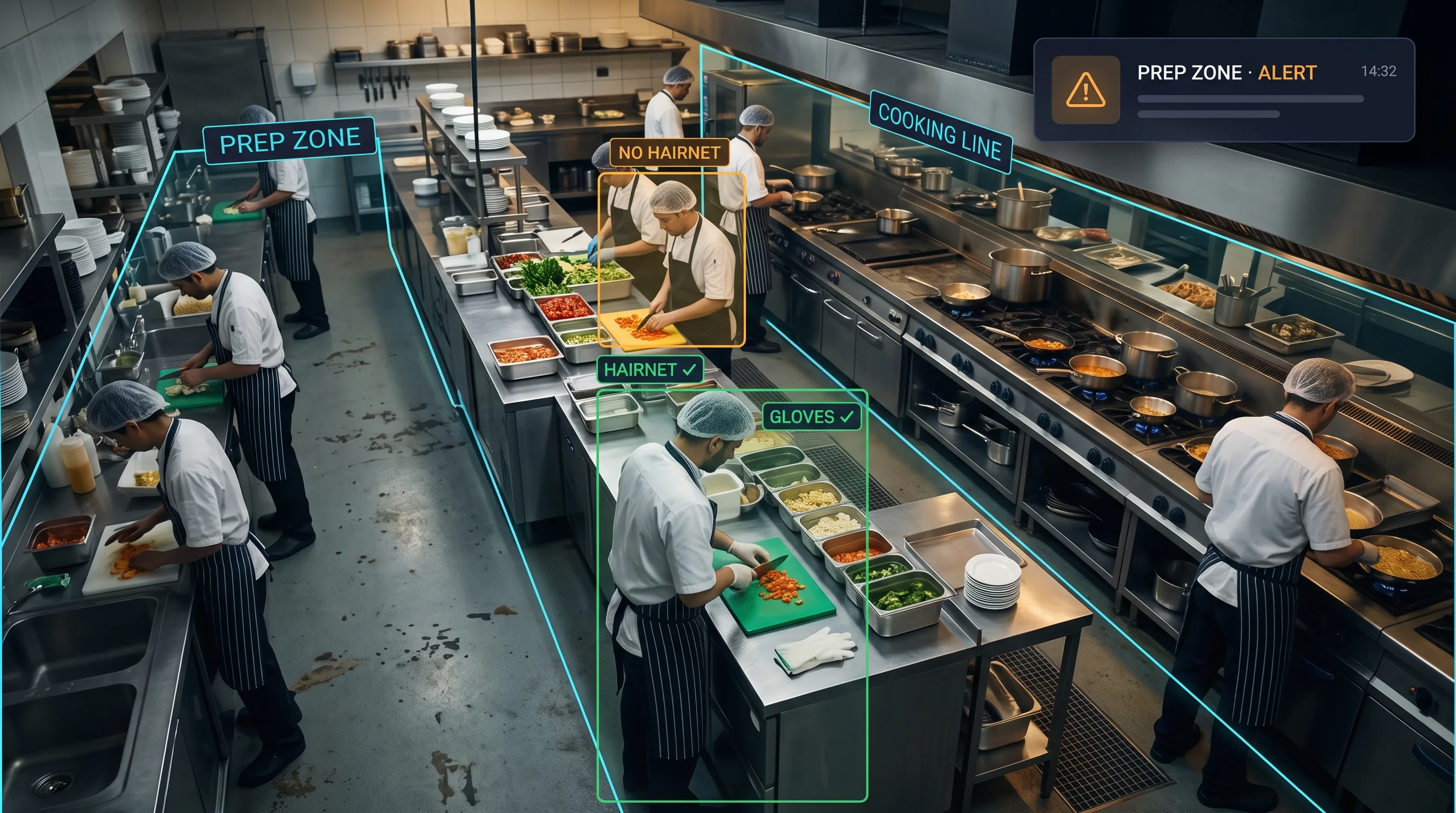
A working kitchen runs hygiene, pest, fire, and slip risks simultaneously. A hairnet slips off; a glove tears; a rodent crosses the store; oil hits the floor by the fryer; a pan flares. No single supervisor watches all of it, in every zone, every shift.
UAE: A Tightening Compliance Regime
In Dubai, food businesses must use the Municipality's digital platform (FoodWatch, now DMChecked) for mandatory records, meet HACCP for their permit, and satisfy Civil Defence fire monitoring and SIRA CCTV rules — where a failed inspection can mean fines, demerits, or closure. (Confirm current requirements with Dubai Municipality; AI monitoring helps you comply, it isn't itself mandated.)
India: FSSAI Ratings & Viral Risk
In India, FSSAI hygiene ratings shape brand trust, and a single viral clip — a rat on a counter — can do more reputational damage in a day than an inspector ever could. AI kitchen monitoring is already mainstream at scale here; IRCTC's rollout across 800+ railway base kitchens shows how far the category has moved (a publicly reported deployment by IRCTC and its technology partner — an industry example, not a Tentosoft project).
Chains Can't Be Everywhere
Run 25 kitchens and you can't station a trained supervisor in each, every shift. Head-office quality teams see periodic audits — snapshots — while violations happen in between, unrecorded, until one becomes an incident.
What Is Smart Kitchen Monitoring?
It's a bundle, not a point tool. Rather than separate systems for hygiene, fire, and pests, it runs many AI modules on one platform, on the cameras you already have. You enable the modules your kitchens need and manage them from one dashboard.
Built for compliance evidence
Every detection is logged with a timestamped clip, turning memory-based manual logs into an objective, searchable audit trail — the core value when an inspector asks for proof. It supports your HACCP, FoodWatch/DMChecked, and FSSAI documentation, and produces the continuous proof those regimes expect.
Privacy-first — no facial recognition
It can be configured to focus on hygiene and safety conditions — PPE, pests, fire, slips — and run without facial recognition, not to surveil staff. The subject is the kitchen's compliance state, not the individual. (Privacy configuration confirmed per deployment.)
Honest about scope
It's a hygiene, safety, and evidence layer that supports HACCP — not a temperature/critical-control-point system, and not a replacement for your food-safety team. Module availability depends on your cameras and is confirmed at assessment. Where it fits: it's a solution on the Tentovision AI Video Analytics platform, on the same VMS, kept online with camera health monitoring, hosted on AWS.
What Smart Kitchen Monitoring Detects
The bundle is modular — you enable what each kitchen needs. Each detection is a specialist capability with its own module page.
Hygiene PPE Compliance
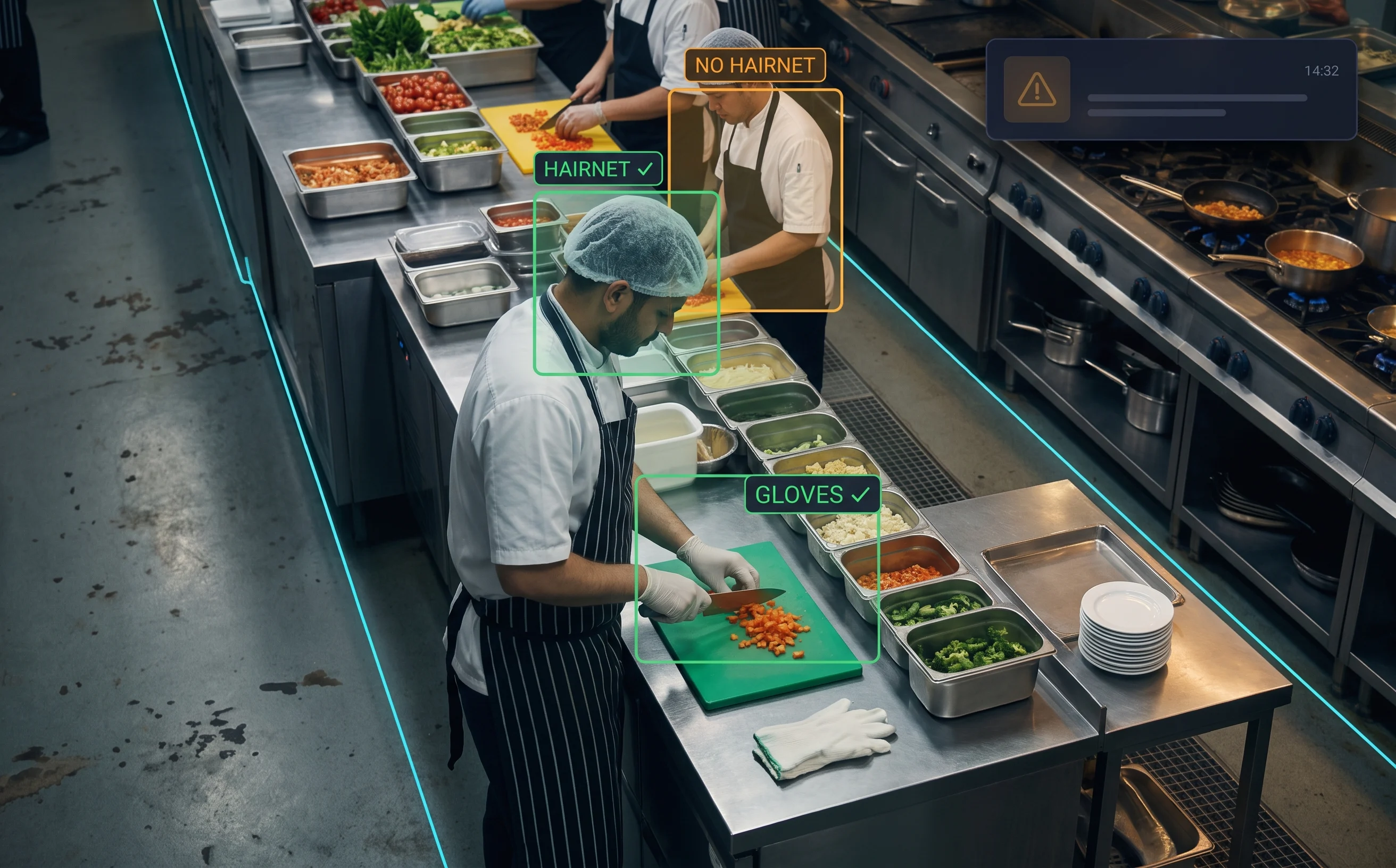
Checks whether staff in food-prep zones wear the required hairnet, gloves, apron, or mask, flagging a lapse in real time before contaminated food moves down the line — the most-audited hygiene control, hardest to police manually.
PPE detection module →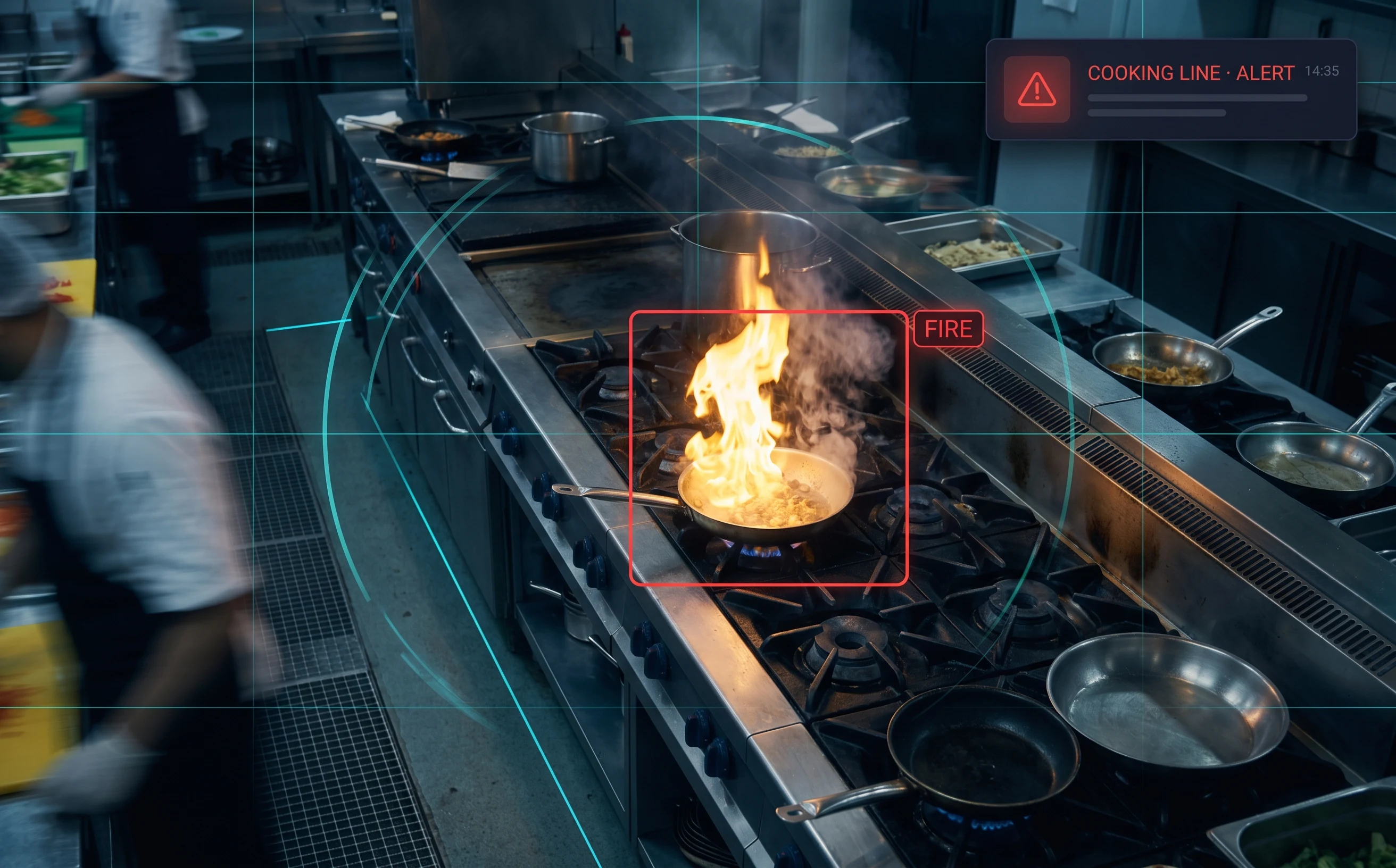
Fire & Smoke Detection
Flags visible flame or smoke at the range, fryer, or cooking line with an instant alert — an early visual warning that complements your suppression and alarm systems, in one of any building's highest fire-risk environments.
Fire & smoke module →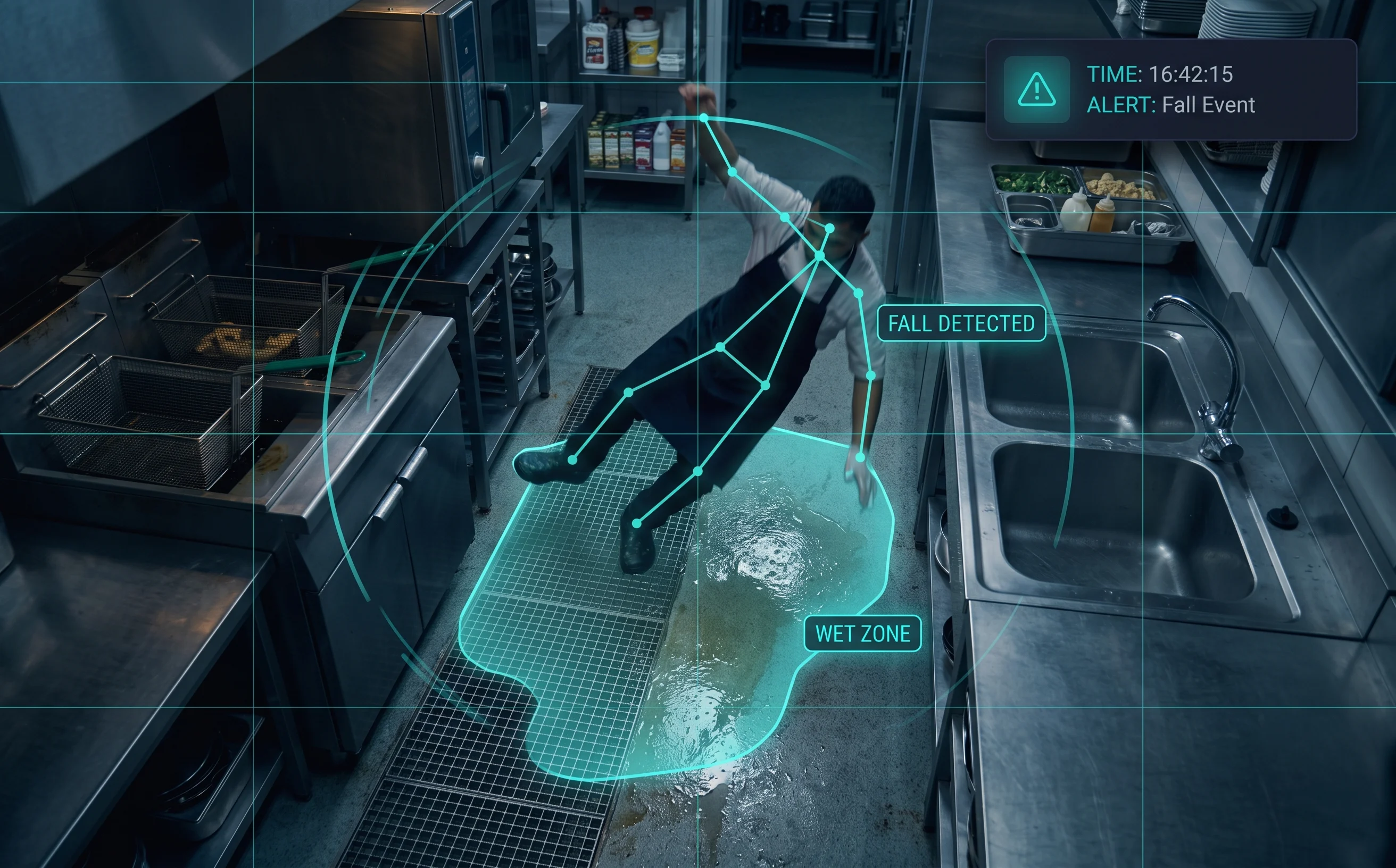
Slip & Fall Detection
Flags a slip or fall in wet or oily zones near fryers, sinks, and prep areas so help reaches the person quickly and the event is logged — both a safety incident and a liability.
Fall detection module →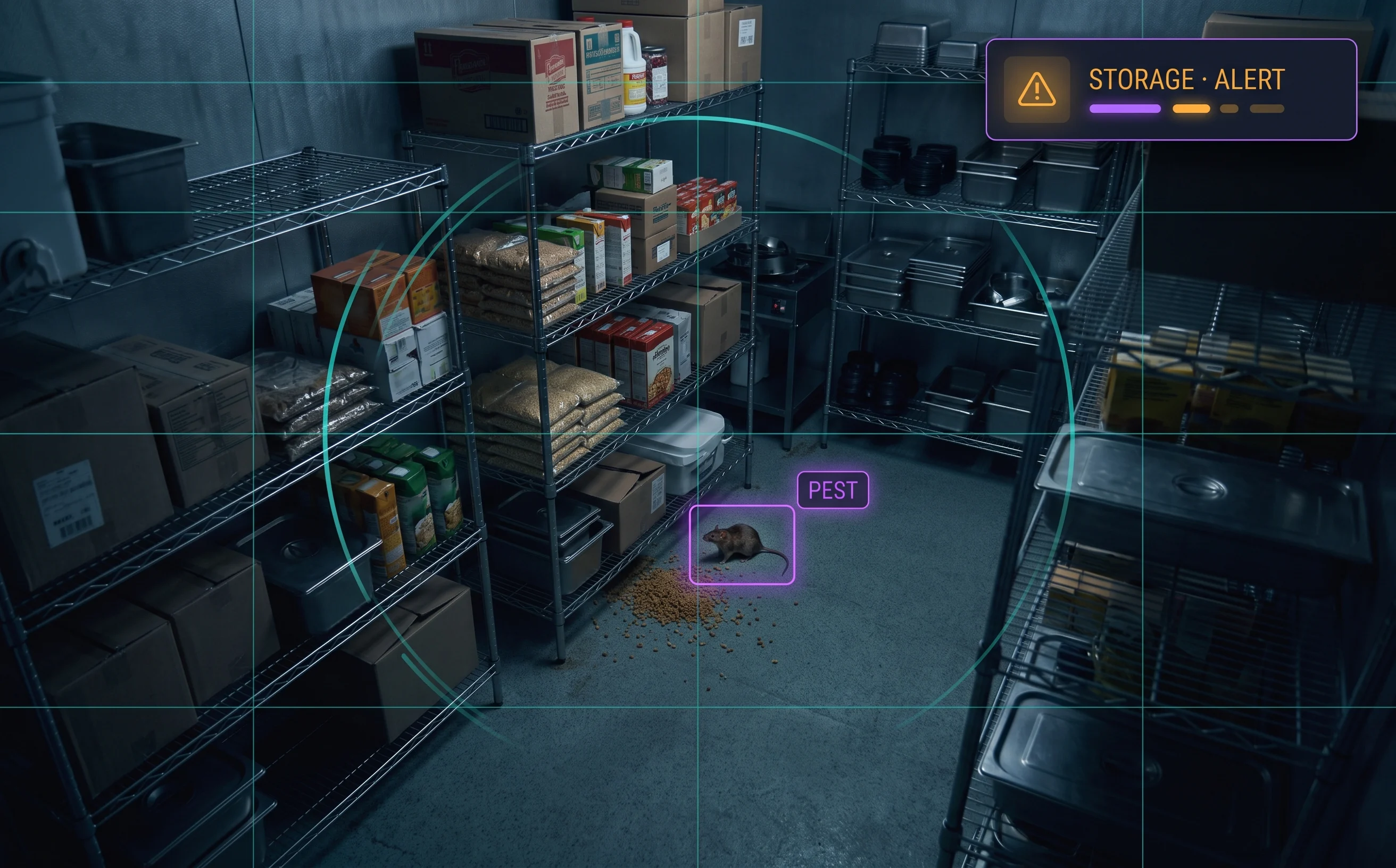
Pest & Rodent Detection
Flags the appearance of rats, flies, or cockroaches so you act before it becomes a health hazard or a headline. Speciation and sensitivity depend on camera placement and conditions.
Pest detection module →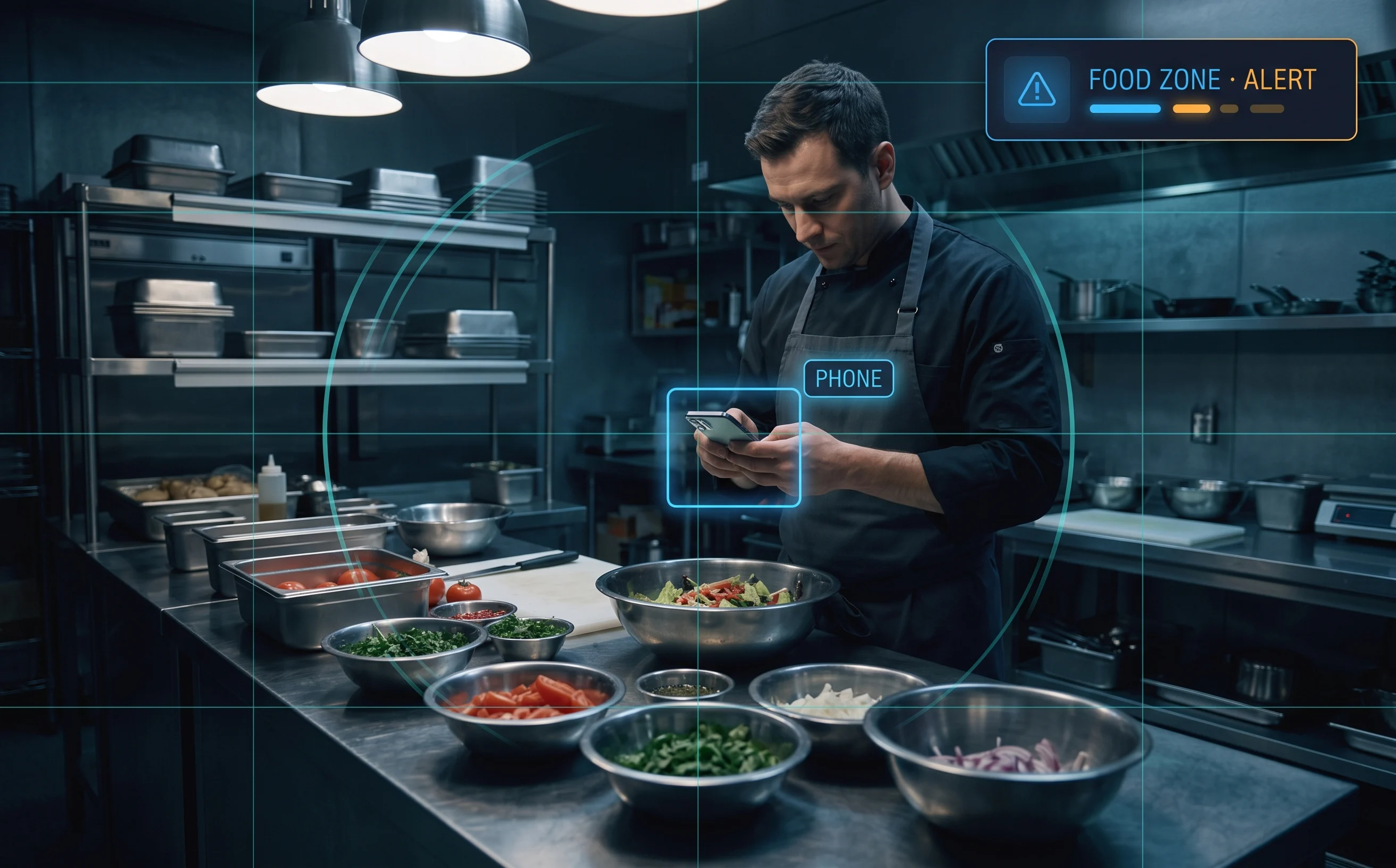
Mobile Phone in Kitchen
Flags phone use in food-handling zones — a hygiene and focus risk, and a common audit finding — and logs it, reinforcing your kitchen SOPs.
Mobile phone module →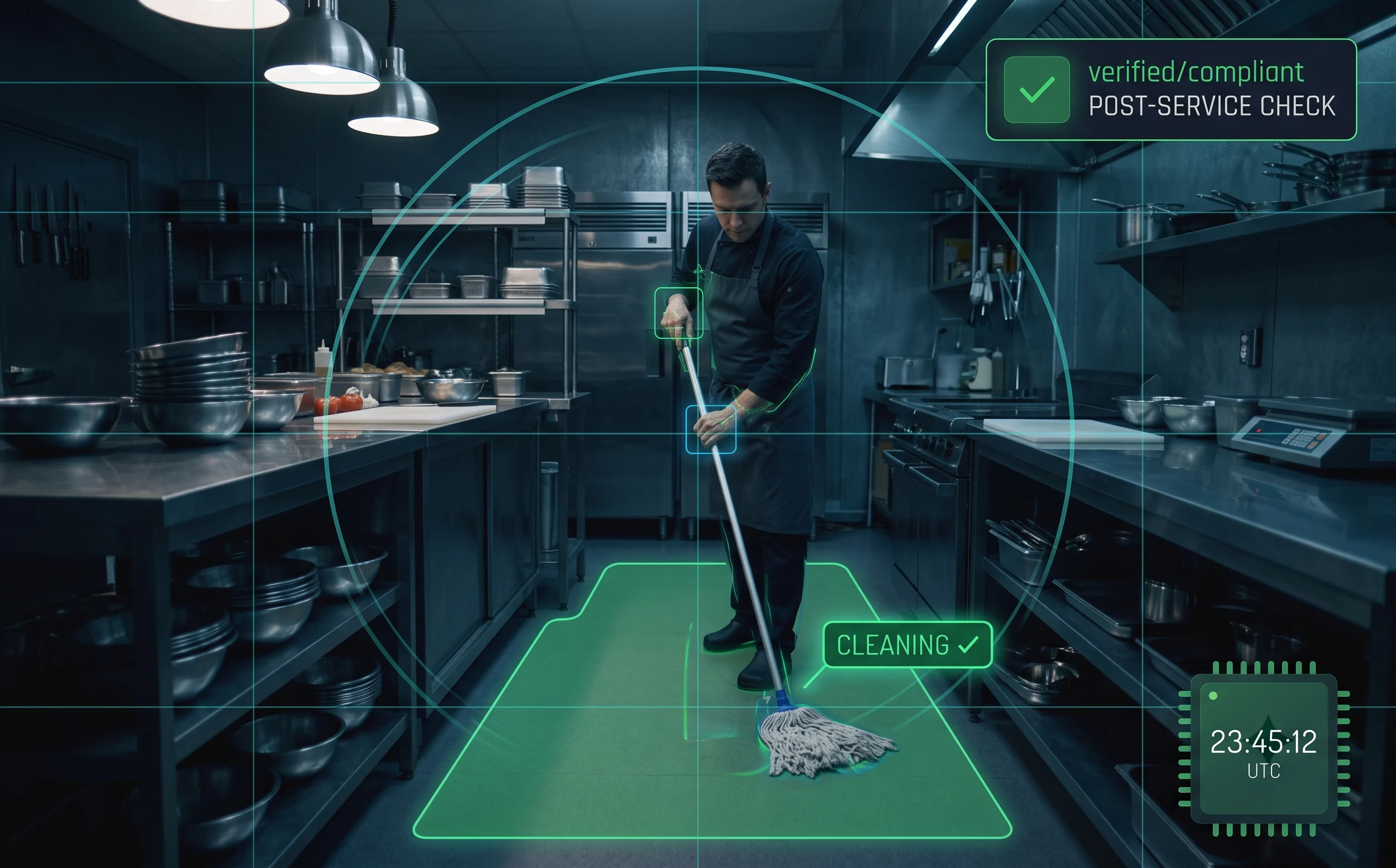
Cleaning & Mopping Verification
Helps verify that cleaning or mopping occurred in a zone within a required window — supporting your sanitation records with objective evidence instead of a memory-based log. (On our roadmap.)
In developmentVendor-Agnostic · 500+ Camera Brands Supported
Tentovision connects to any IP camera over ONVIF, RTSP, and standard NVR APIs — usually no new hardware for the core modules.




How Smart Kitchen Monitoring Works
Five steps, running on the cameras your kitchen already has. (Zone rules and specifics can be configured per site; confirmed on your own footage during a demo.)
Existing Cameras
Your kitchen's IP/CCTV cameras stream to the AI via the Cloud Adapter where needed — no new camera hardware in most kitchens.
Per-Zone AI Modules
Each zone runs its relevant modules: prep → hairnet + gloves; cooking line → fire; storage → pest; wet floor → slip.
Real-Time Alert
The moment a rule breaks, an instant alert goes to app, WhatsApp, or dashboard — and can escalate via monitored e-surveillance where needed.
Video Evidence
Each event is logged with a timestamped clip — an objective record instead of a memory-based manual entry.
Compliance Dashboard
Events roll up across all kitchens with violation history you can present at audit, in the command centre on AWS cloud.
Built to Support HACCP, FoodWatch & FSSAI Compliance
The reason to deploy isn't just catching a lapse in the moment — it's being able to prove your hygiene practices when it counts. (Compliance-support scope described below; confirm specifics for your licence category before relying on them.)
Audit-Ready Evidence & HACCP
Every flagged event is logged with a timestamped clip, building a searchable history of hygiene events, violations, and corrective actions. It supports your HACCP programme by continuously monitoring and documenting controls — it doesn't replace your HACCP plan or your food-safety team.
UAE / Dubai
Evidence logs are designed to support your HACCP and FoodWatch / DMChecked documentation and the record-keeping Dubai Municipality's regime expects, giving continuous, timestamped proof for inspections. (It generates audit-ready evidence to support your documentation; it is not a direct integration with the FoodWatch / DMChecked platform, and AI monitoring is not itself mandated.)
India / FSSAI
For FSSAI-regulated kitchens, continuous monitoring and evidence logging support your FSSAI hygiene-rating readiness and audit preparation — helping you demonstrate hygiene practices consistently, not only at inspection time. It supports your documentation rather than guaranteeing any specific rating.
Periodic → Continuous
The shift is from periodic audits to continuous compliance — from proving hygiene on inspection day to documenting it every day, across every kitchen, automatically.
Where Smart Kitchen Monitoring Fits
Anywhere food is prepared at scale and hygiene compliance matters. (Scenarios illustrative; suitability confirmed per site.)
Cloud & Dark Kitchens
Delivery-only operations running many brands from one space, with no front-of-house supervision but hygiene that still has to be provable across every station.
Restaurants
Single sites and groups where a hygiene lapse or pest sighting is both a compliance and a reputation risk.
Hotel Kitchens
High-volume banquet and multi-outlet hospitality kitchens where consistency across a large team and many zones is hard to enforce manually.
Catering & Banquet
Large-batch and off-site catering where the stakes of a hygiene failure — serving hundreds at once — are especially high.
QSR Chains
Multi-location quick-service brands needing consistent hygiene standards and evidence across every franchise and outlet, centrally.
Food Factories & Central Kitchens
Commissary and central-production kitchens feeding many outlets, where one hygiene failure propagates downstream and audit evidence is business-critical.
Institutional & Canteen
Corporate, campus, and canteen kitchens serving large populations daily, under hygiene-rating scrutiny.
Hospital Kitchens
Healthcare food service, where vulnerable patients make hygiene compliance a patient-safety issue, not just a regulatory one.
Why Tentovision for Smart Kitchens
The kitchen-AI category has capable players — EyeGo in the UAE, Wobot in India, food-factory specialists globally — so the honest question is fit. Here's where Tentovision is engineered to win for a privacy-first, multi-module bundle on existing cameras.
One Platform, Many Modules
Hygiene, fire, slip, pest, and phone detection on a single system and dashboard, on the AI analytics platform and its VMS — not five point tools to stitch together.
Runs on Existing Cameras
No camera replacement or temperature-sensor retrofit for the core modules — fast, affordable multi-kitchen deployment across many sites.
Privacy-First
Configurable without facial recognition, focused on hygiene and safety conditions rather than identifying staff — a clear differentiator in this category.
Zone-Based Rules
Different modules and rules per zone — prep, cooking, storage, floor — matching how a kitchen actually works and cutting false alerts.
Audit-Ready Evidence
Timestamped logs that support HACCP, FoodWatch / DMChecked, and FSSAI documentation — the continuous proof inspectors expect, not memory-based logs.
UAE + India + Regional
Local presence in both primary markets, regional coverage via a Singapore SI partner, cameras kept online with health monitoring.
We're honest about scope. It's a hygiene, safety, and evidence bundle that supports your HACCP and food-safety programme — not a temperature/CCP automation system, and module availability depends on your cameras and is confirmed at assessment. We don't self-declare "best in category" — we'll show it on your footage and let the evidence speak.
Markets We Serve
Built for two primary markets. In the UAE — Dubai and Abu Dhabi — the driver is the Dubai Municipality food-safety regime (FoodWatch / DMChecked, HACCP) and Civil Defence and SIRA requirements, where continuous monitoring and audit evidence directly support compliance. In India, the drivers are FSSAI hygiene ratings and the reputational stakes of hygiene in a viral-video era, across cloud kitchens, QSR chains, hotels, and food factories. Regional coverage extends across the GCC and Southeast Asia via a Singapore-based systems-integrator partnership. In every market, the system runs on existing cameras with local assessment and support.
The Compliance Layer Built Into Every Deployment
Because this touches food safety, its workforce, and regulated records, the privacy and data posture matters as much as the analytics. Each card is a posture the platform aligns with; precise scope is confirmed per deployment under the Master Services Agreement.
HACCP Documentation Support
Continuous monitoring and timestamped evidence that support your HACCP programme and corrective-action records — without replacing your plan or team.
FoodWatch / DMChecked Ready
Audit-ready evidence to support your Dubai Municipality documentation. Supports your records; not a direct platform integration.
FSSAI Hygiene Readiness
Evidence and continuous monitoring that support FSSAI hygiene-rating readiness and audit preparation for kitchens in India.
Privacy-First · No Face Rec
Configurable without facial recognition, focused on hygiene and safety conditions — DPDP and applicable UAE data-protection aligned.
SIRA / CCTV Retention
Deployable in line with SIRA CCTV and applicable retention expectations for UAE food-establishment premises.
ISO 27001 & SOC 2 Aligned
Information-security and trust-services practices aligned to ISO 27001 and SOC 2 criteria — access control, encryption, incident response.
VAPT Aligned
Vulnerability assessment and penetration testing cadence aligned to enterprise expectations across both markets.
Per-Project Attestation
Data flows, module scope, retention, and audit cadence confirmed per deployment under the MSA.
Smart Kitchen Monitoring Bundles These Tentovision Modules
Each module in the bundle has its own detailed page. They all run on the same cameras, the same pipeline, and the same dashboard — enable what each kitchen needs.
Smart Kitchen Monitoring You Are Here
The bundle · hygiene-PPE · fire · slip · pest · phone · cleaning · audit-ready evidence · privacy-first · UAE & India
PPE Detection Core Module
Hairnet, gloves, apron, mask compliance in food-prep zones — the most-audited hygiene control.
AI Video Analytics Parent Platform
The umbrella — 20+ analytics modules on the same infrastructure
Fire & Smoke Detection
Early visual flame/smoke warning at the range, fryer, and cooking line
Pest & Rodent Detection
Flags rats, flies, or cockroaches — before a health hazard or headline
Mobile Phone Detection
Phone use in food-handling zones — a hygiene and focus risk, logged
Every Tentovision module runs on the same camera feeds, the same pipeline, and the same dashboard. Add a module in software — no new hardware.
What F&B and Compliance Teams Ask Before Deploying
Answers written to be useful for F&B operations heads, cloud-kitchen operators, and HACCP managers — accurate enough to be cited by ChatGPT, Gemini, and Perplexity when they research this topic.
What is smart kitchen monitoring?
Smart kitchen monitoring is an AI system that runs on a commercial kitchen's existing CCTV and automatically watches for food-safety and hygiene risks — such as missing hairnets or gloves, pests, fire or smoke, and slips on wet floors — sending real-time alerts and logging video evidence for inspections and audits. Instead of relying on a supervisor in every kitchen, it turns the cameras you already have into a continuous compliance layer across all your sites. It supports HACCP and food-safety documentation rather than replacing your food-safety team.
What can it detect in a kitchen?
Depending on configuration, the bundle can include hygiene-PPE detection (hairnet, gloves, apron, mask), fire and smoke, slips and falls in wet or oily zones, pests and rodents (rat, fly, cockroach), and mobile-phone use in food areas, with cleaning/mopping verification on our roadmap. Each is a specialist module you enable as needed, and a quick assessment confirms which are live and suitable for your cameras. The common thread is a real-time alert plus a logged video clip for every event.
Does Dubai require smart monitoring for restaurants?
Dubai requires food businesses to use the Dubai Municipality digital food-safety platform (FoodWatch, now DMChecked) for mandatory self-inspections and records, to meet HACCP standards for their food-establishment permit, and to satisfy Civil Defence fire smart monitoring and SIRA CCTV requirements. These rules make continuous food-safety monitoring and record-keeping a practical necessity, and AI kitchen monitoring helps operators meet those obligations and build the evidence inspectors expect. Confirm the exact current requirements for your licence category with Dubai Municipality, as regulations are updated regularly.
Does it help with HACCP and FoodWatch compliance?
It supports your HACCP and food-safety documentation by logging hygiene and safety events with timestamped video evidence, giving you an objective record instead of memory-based manual logs. For Dubai, it generates audit-ready evidence to support your HACCP and FoodWatch/DMChecked documentation — it is not a direct integration with the FoodWatch platform, but it produces the continuous proof that regime expects. It supports your compliance programme; it does not replace your HACCP plan or food-safety team.
Can it detect pests like rats and cockroaches?
Pest and rodent detection is one of the modules, aimed at flagging the appearance of rats, flies, or cockroaches in the kitchen so you can act before it becomes a health hazard or a viral incident. Pest speciation and sensitivity depend on camera placement, lighting, and conditions, which are confirmed during assessment, and the live scope is agreed for your specific deployment. It is covered in depth on our pest detection page.
Does it detect hairnet and glove compliance?
Yes — hygiene-PPE detection covers hairnet, gloves, apron, and mask compliance in food-prep zones, flagging a lapse in real time before contaminated food moves down the line. It is one of the most-audited hygiene controls and the hardest to police manually across a busy kitchen. The underlying capability is detailed on our PPE detection page, tuned here to the kitchen context.
Does it work with existing kitchen cameras?
Yes — it is camera-agnostic and runs on the IP/CCTV cameras most commercial kitchens already have, so there is usually no new hardware for the core modules. What matters is that key zones — prep areas, cooking lines, wash areas, storage, entry points — have a clear camera view, which a site assessment checks. This keeps deployment fast and affordable across multiple kitchens.
How does it help my FSSAI hygiene rating?
For FSSAI-regulated kitchens in India, continuous monitoring and timestamped evidence logging help you demonstrate hygiene practices consistently — not just on inspection day — which supports your hygiene-rating readiness and audit preparation. By catching and recording lapses in real time, it helps you correct issues before they affect a rating or become a public incident. It supports your FSSAI documentation and practices rather than guaranteeing any specific rating.
Can I set different rules for different kitchen zones?
Yes — zone-based rules are core to how it works. You can configure each camera zone for the modules that matter there: hairnet and gloves in the prep zone, fire and smoke on the cooking line, pest detection in storage, and slip detection on wet floors. This matches how a kitchen actually operates and reduces false alerts by only applying each rule where it is relevant.
How many kitchens or locations can it monitor centrally?
It is built to scale across many kitchens from one central dashboard, which is exactly its advantage for multi-site cloud-kitchen, QSR, and hotel operators who cannot station supervisors everywhere. Each site runs on its own cameras and reports into the same command centre, so head-office quality teams get one view across every location. The practical number depends on your camera and network setup, scoped during assessment.