What Happens Between Pest Control Visits
Pest control works. The problem isn't the programme — it's the calendar.
A Monthly Visit Leaves a Long Blind Window
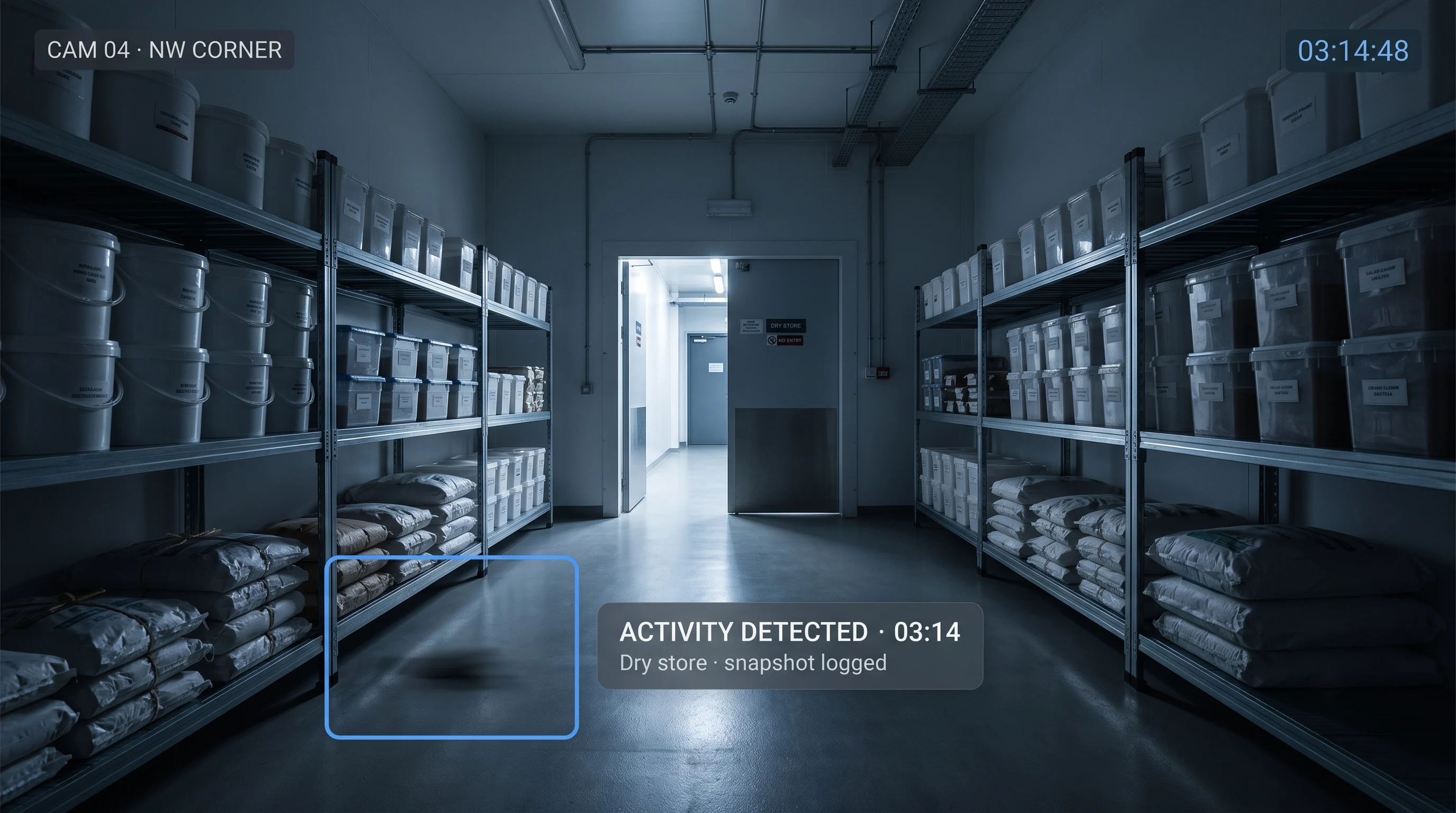
Your provider inspects, checks stations, treats where needed, and files a report. Then nothing is observed until the next visit. A problem that starts in week one is discovered in week four — by which time it isn't a sighting, it's an infestation.
Rodents Are Nocturnal — Your Premises Are Empty
Peak activity happens precisely when nobody is there to see it. Staff arrive to a kitchen that looks exactly as they left it, while the evidence of what moved through it overnight takes days to be noticed, if it's noticed at all.
Traps Report Only What Enters the Trap
Bait stations and monitors are fixed points, deliberately placed at likely runs. They're valuable — but they tell you nothing about the open floor, the prep area, the loading bay, or the corner of the store room where nothing has been placed.
One Customer Video Is a Brand Crisis
A phone clip spreads faster than any recall process can respond. The commercial risk isn't proportionate to the size of the problem — a single animal, filmed once, can do more damage than a genuine infestation caught early and handled quietly.
What Is AI Pest Detection?
Being precise about the boundary matters here, because you know this subject well: it detects visible rodent activity in camera view. It doesn't find nests, see inside wall voids or ducts, or bait, trap or treat anything — your pest-control provider does that, and this tells them where and when to look.
That's also why it's vendor-neutral. It runs on your cameras, alerts your team, and produces evidence you own — whoever your pest-control provider happens to be. It's designed to make their next visit better informed, not to replace it.
What the System Detects, Records and Reports
Five capabilities, running on the cameras you already have — detection, overnight coverage, evidence, patterns, and the documentation your auditor asks for. (Detection scope, camera suitability and night coverage are confirmed area by area for your premises at assessment.)
Rodent Activity Detection
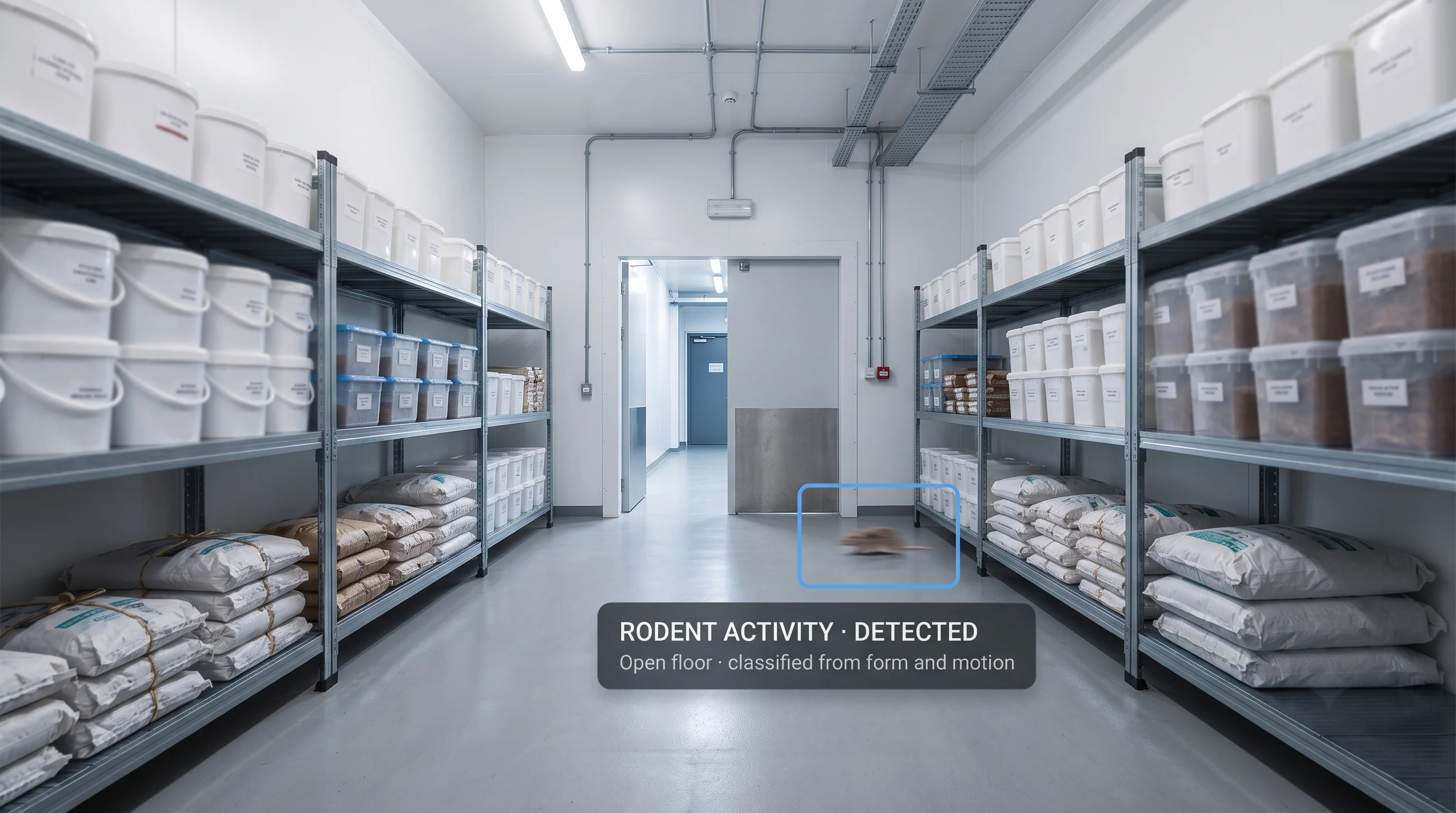
Detects visible rat and mouse activity in the camera's field of view, distinguishing rodent movement from ordinary motion in the scene. The primary and highest-value capability, because rodents are the highest-risk pest for food premises. Rodents are what this detects reliably — smaller, faster pests are a different technical problem, and we're specific about that in the FAQ.
Overnight & Low-Light Monitoring
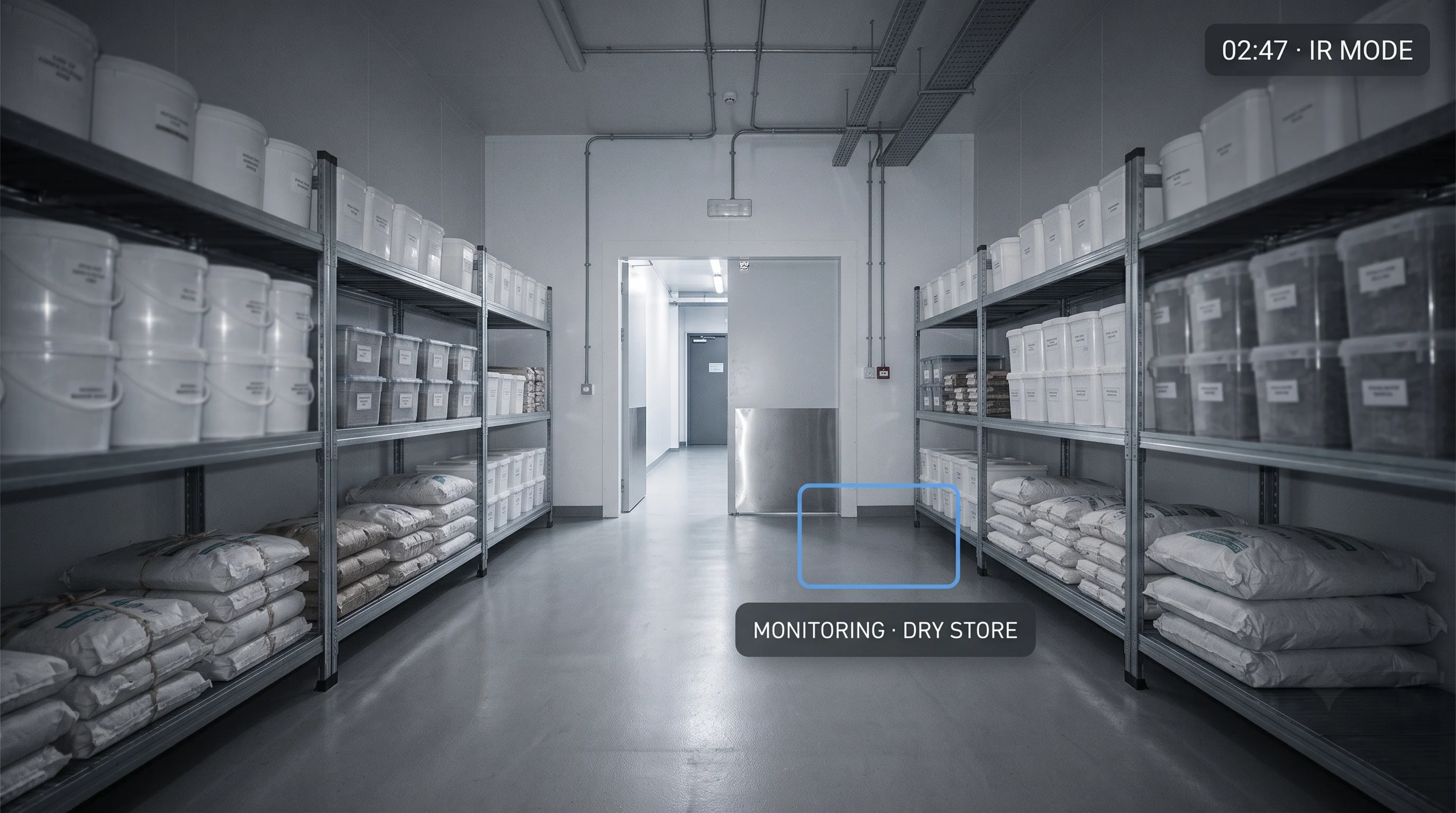
This is the core of the value. Coverage through the hours when premises are empty and activity peaks. Works with cameras that have infrared or low-light capability — which many back-of-house cameras already have. Night coverage is confirmed area by area at assessment and validated on your own overnight footage; areas without a suitable camera are identified rather than assumed.
Instant Alerts with Visual Evidence
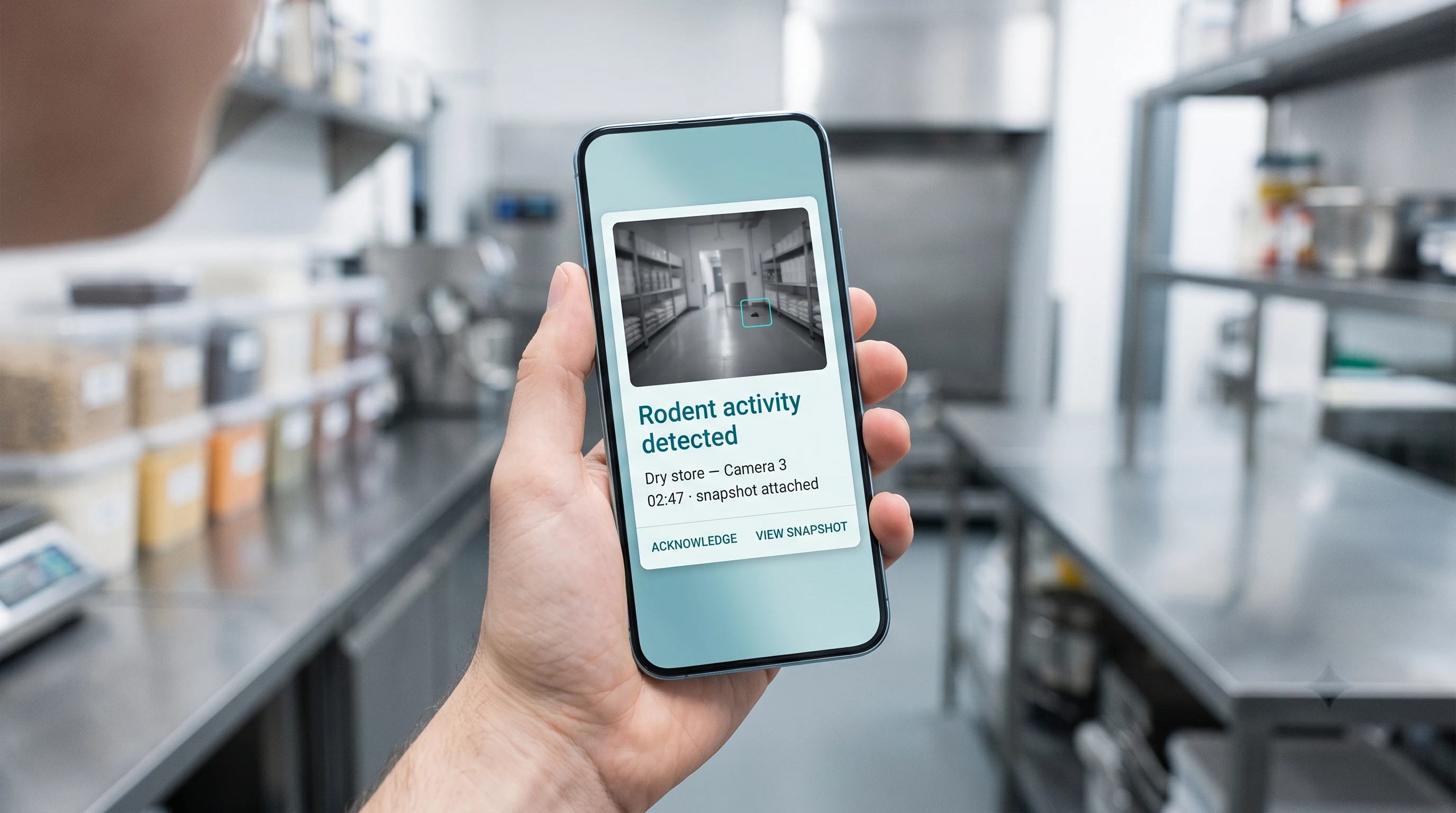
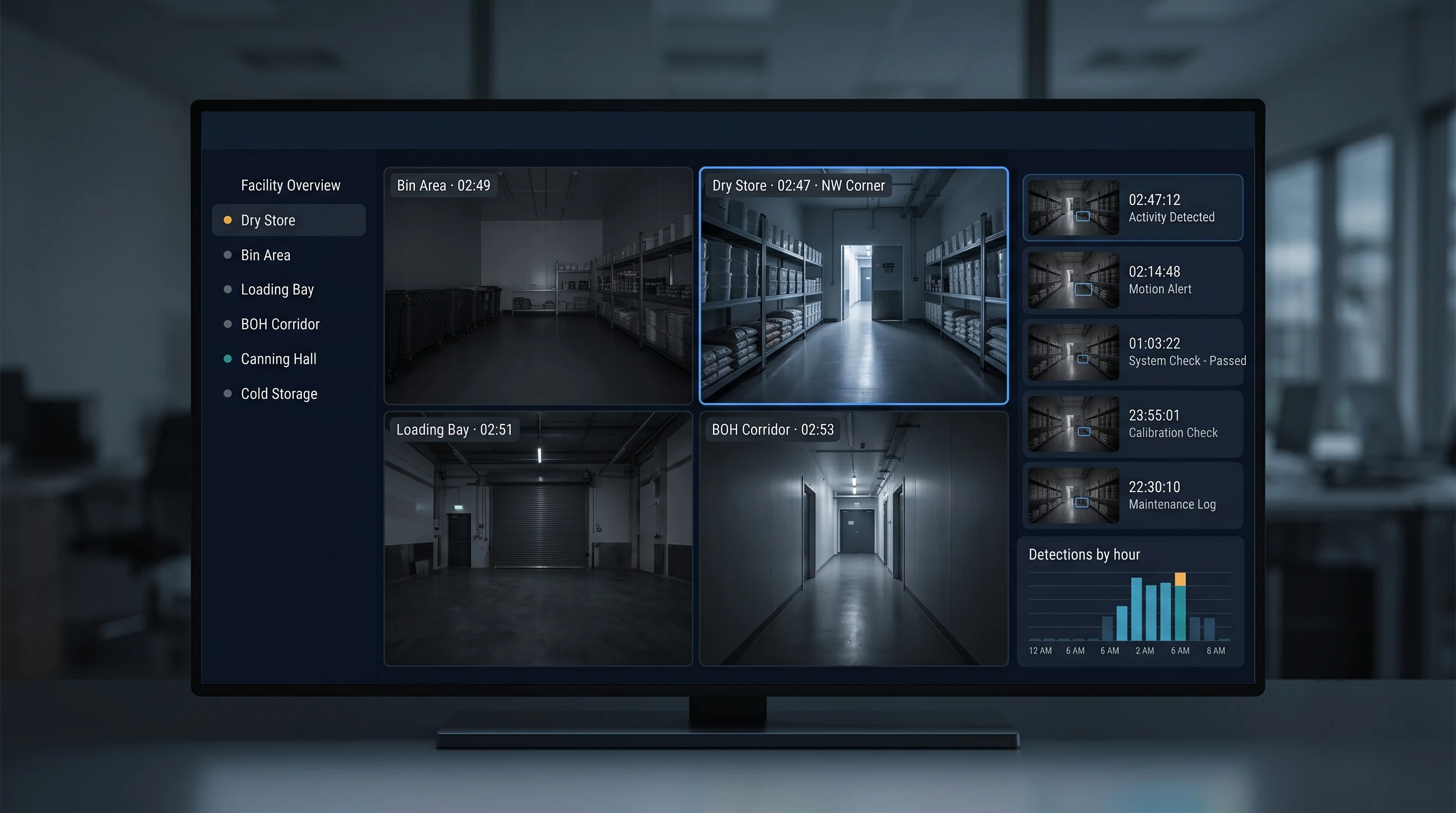
An alert the moment activity is detected, carrying a snapshot, timestamp, and location, routed to the channels your team already uses. An image matters more than a notification — it lets you confirm what was actually seen before anyone acts on it.
Activity Logs & Hotspot Patterns
Every detection logged with time and location, building into patterns that show which areas and which hours carry the most activity. That lets proofing and treatment be targeted where the evidence points, rather than applied generally across the premises.
Audit & Compliance Documentation
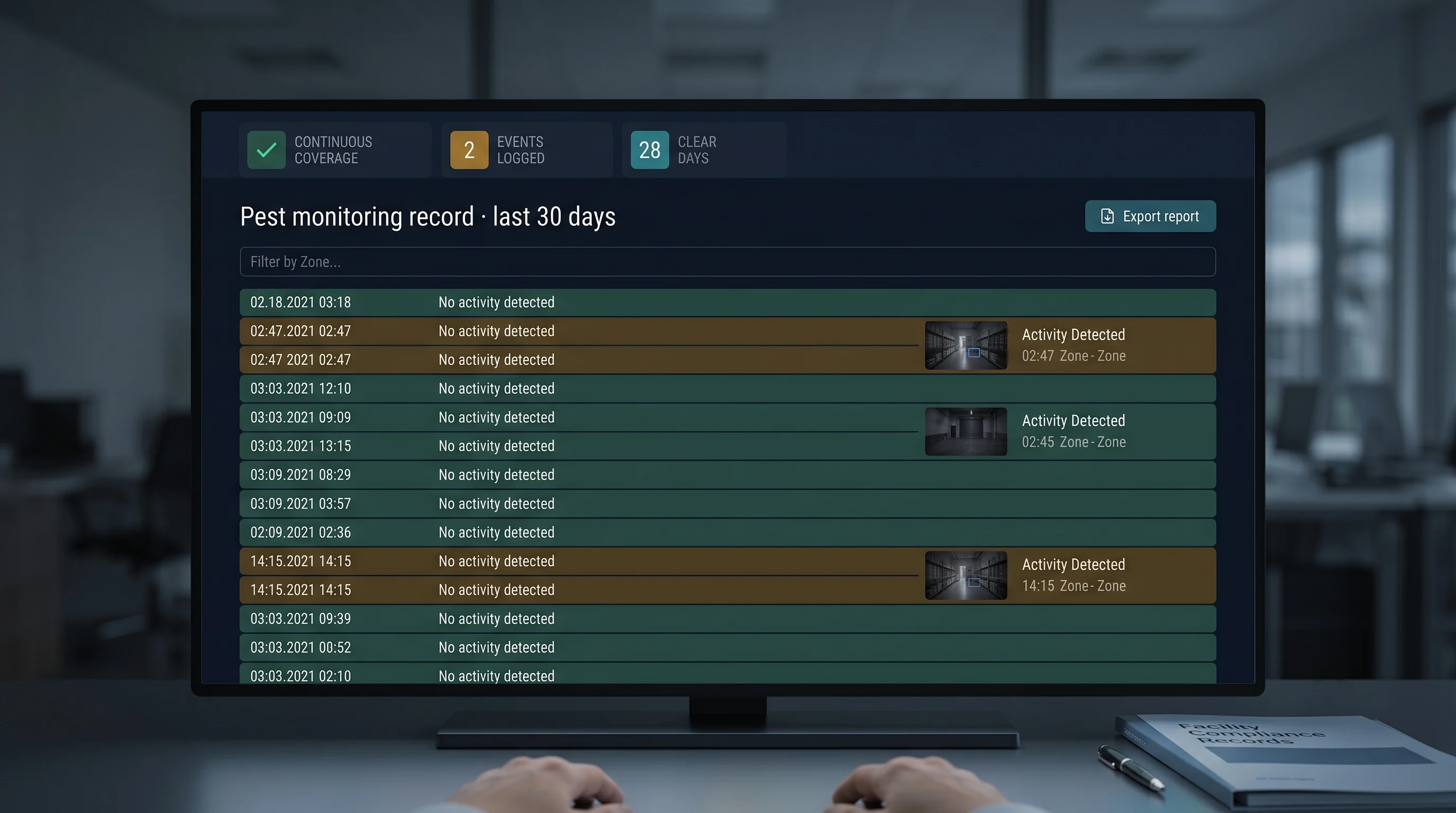
A continuous, timestamped record supporting your HACCP pest prerequisite programme — evidence of activity, and equally records of periods with none detected. Supports your documentation and audit preparation; it does not certify compliance with any standard, and is not integrated with any regulatory platform.
Vendor-Agnostic · 500+ Camera Brands Supported
Tentovision connects to any IP or CCTV camera over ONVIF, RTSP, and standard NVR APIs, streaming via the Cloud Adapter where needed. (Detection depends on proximity, angle, lighting and clutter — and overnight coverage depends on the camera having infrared or low-light capability. Both are confirmed area by area at assessment; general-purpose CCTV is not automatically suitable for every space.)





How AI Pest Detection Works
Five steps, on cameras you already have. (Camera placement, night coverage & alert routing are configured per site and confirmed at assessment.)
Camera
An existing camera covering a risk area — store room, bin area, corridor, loading bay — streams to the AI. Night coverage depends on infrared or low-light capability and is confirmed for that area.
Detection
The AI analyses movement and form to identify rodent activity — the distinctive size, shape, and low, fast movement that separates a rat crossing a floor from a shadow or a swinging door.
Alert With Evidence
An alert goes to your operations or food-safety team with a snapshot, timestamp, and location. An image matters more than a notification — it lets you confirm what was seen before anyone acts.
Activity Log & Patterns
Every event is logged. Over weeks, the record shows where and when activity concentrates — so treatment and proofing can be targeted rather than generalised.
Evidence Pack
Logs and images form documentation for your provider and your auditor, in the command centre on AWS cloud, with camera health monitoring keeping cameras online.
Camera-AI vs Smart Traps vs Manual Inspection
Each of these does something the others can't, and a serious pest programme uses all three. (Specifics are typical — verify for your premises.)
| Dimension | Camera-AI (Tentovision)Existing cameras | Smart / connected trapsDevice per point | Manual inspectionTechnician visit |
|---|---|---|---|
| Coverage | ✓ open areas in camera view | ✗ fixed points only | ~ where the technician looks |
| Continuous vs periodic | ✓ 24/7 | ✓ 24/7 | ✗ monthly or weekly |
| Night coverage | ✓ with IR/low-light camera | ✓ | ✗ |
| Detects activity without capture | ✓ | ✗ needs trap interaction | ~ droppings, gnaw marks |
| Works inside voids, ducts, hidden runs | ✗ no | ✓ can be placed there | ✓ can inspect |
| Finds nests, harbourage, entry points | ✗ no | ✗ | ✓ only they can |
| Treats or eliminates | ✗ no | ✓ captures | ✓ treats |
| Visual evidence | ✓ timestamped image | ~ event data | ✗ written report |
| Uses existing infrastructure | ✓ existing cameras | ✗ device per point | n/a |
| Vendor-neutral | ✓ any provider | ~ usually tied to a contract | n/a |
The honest read. Smart traps confirm captures and can be placed inside voids and hidden runs where no camera can see. A trained technician finds harbourage, identifies entry points, and actually treats the problem — things no camera will ever do. What camera-AI uniquely adds is continuous detection across open areas, at night, with a picture to prove it. All three together make the strongest programme; this one replaces neither of the others.
Where Pest Detection Matters Most
Commercial & Cloud Kitchens
Store rooms, bin areas, and prep zones where a single sighting is both a food-safety and a reputational event. One of the modules in our smart kitchen monitoring bundle, alongside hygiene and fire & smoke detection.
Food Processing Factories
Raw-material stores, packing halls, and waste areas — where activity between audits is exactly what a certification body will ask you to evidence.
Warehouses & Godowns
Sacked goods, palletised stock, and long night hours with nobody present — where the cost is measured in damaged and quarantined inventory across warehouse operations.
Hotels & Hospitality
Kitchens, back-of-house corridors, and storage, where reputation is the asset most at risk and guests film everything.
Retail & Supermarket Back-of-House
Stock rooms and loading bays behind the shop floor, where activity is invisible to customers right up until it isn't — part of the same platform serving retail environments.
Pharma & Sensitive Storage
Controlled environments where contamination carries regulatory as well as commercial consequences.
Supporting HACCP, FSSAI & Food-Safety Audits
Under HACCP — and under BRC, SQF, and FSSC 22000 — pest management is a prerequisite programme. Auditors don't just ask whether you have pest control; they ask for monitoring records.
The Gap Automation Fills
Traditionally those records are your provider's visit reports: accurate, professional, and monthly. A continuous automated log covers the intervals the reports can't.
Proving Absence, Not Just Activity
Often more useful at audit: evidence of periods when nothing was detected at all. When an auditor asks how you know a zone has been clear, a timestamped record is a stronger answer than a recollection.
India & UAE
In India, this supports your FSSAI hygiene-rating readiness and inspection preparation. In the UAE, it supports the record-keeping Dubai Municipality's regime expects, including FoodWatch/DMChecked documentation and HACCP obligations.
Why Tentovision for Pest Detection
Runs on Your Existing Cameras
Store rooms, bin areas, and back-of-house corridors often already have cameras, so coverage is something you extend rather than a device you buy for every location.
Built Around Night Coverage
The hours that matter are the ones nobody is there for, which is where the detection is designed to earn its place — confirmed per area on your own overnight footage.
Evidence First
An alert with a timestamped image, not just a notification — verifiable before anyone acts on it.
Vendor-Neutral & Complementary
Works with whichever pest-control provider you use, and produces evidence you own and can share with them — rather than alerts that route to someone else's technicians.
Part of a Food-Safety Bundle
Runs alongside hygiene PPE detection and fire safety on the same cameras, on the AI video analytics platform and its VMS.
Honest About Scope
We publish what this doesn't do, claim only the pests we detect reliably, and don't quote blanket accuracy figures.
India and UAE based support, with detection scope, camera suitability, and night coverage confirmed on your own premises before anything goes live.
Pest Detection in the Tentovision Food-Safety Suite
Pest detection runs on the same cameras and platform as our other food-safety modules — add what a site needs, in software.
Pest & Rodent Detection You Are Here
Rodents (rats & mice) · overnight where cameras support IR · timestamped evidence · vendor-neutral · complements your IPM programme
Smart Kitchen Monitoring Bundle
The food-safety bundle this module belongs to, alongside hygiene-PPE, fire & smoke, slip & fall and phone detection.
AI Video Analytics Parent Platform
The umbrella — 20+ analytics modules on the same infrastructure
Hygiene PPE Detection
Hairnet, gloves, apron and mask compliance in food-prep zones
Fire & Smoke Detection
Early visual warning at the range, fryer, and cooking line
Camera Health Monitoring
Keeps cameras online — a camera that's down is a night you didn't monitor
Every Tentovision module runs on the same camera feeds and the same dashboard. Add a module in software — no new hardware.
What Food-Safety Teams Ask First
Answers written to be useful for HACCP managers, quality heads, and F&B operations leads — accurate enough to be cited by ChatGPT, Gemini, and Perplexity when they research this topic.
What is AI pest detection and how does it work?
AI pest detection runs on your existing cameras and analyses movement and form to recognise pest activity — for us, specifically rodents — in the area a camera covers. When activity is detected it raises an alert with a timestamped snapshot showing what was seen and where, and logs the event into a continuous activity record. It works around the clock, including at night where the camera has infrared or low-light capability.
Does this replace my pest control service?
No. A camera can detect and record visible activity; it cannot find a nest, inspect a wall void or duct, identify how pests are entering, bait, trap, treat, or eliminate anything. Those are your pest-control provider's job, and pest management remains a prerequisite programme under HACCP regardless of what monitoring technology you add. What this does is cover the weeks between their visits, so activity is caught in hours rather than at the next inspection — and your provider arrives knowing where and when. It works alongside whichever provider you already use.
Which pests can it detect?
Rodents — rats and mice. That's the confirmed capability, and it's also the highest-risk pest category for food premises. Rodents are detectable because their size, shape, and movement pattern are distinctive enough for a general-purpose camera to recognise reliably. We name rodents specifically rather than claiming "pests" broadly, because those are different promises.
Does it work at night when the kitchen is closed?
That's the point of it — rodent activity peaks when premises are empty. Night detection depends on the camera having infrared or low-light capability, which many back-of-house cameras already do, and on the camera being close enough to resolve a small animal in monochrome infrared. We confirm night coverage area by area during assessment and validate it on your own overnight footage rather than assuming it. Where an area is genuinely dark or too distant for reliable detection, we'll tell you it isn't covered rather than let you assume it is.
Can it detect a rat from an existing CCTV camera, or do I need special cameras?
Existing cameras work in many areas, which is what makes this practical to add. What matters is proximity, angle, and light: a camera covering an open floor a few metres away is very different from one mounted high across a cluttered store room. Some positions will need repositioning or an additional camera — an assessment tells you which, honestly, before you commit.
Can it detect cockroaches or flies?
No — not reliably, and we won't claim it. Very small, fast-moving insects sit outside dependable range for a general-purpose camera: they need close-range views, strong lighting, and often dedicated optics to be detected consistently. Anyone offering cockroach or fly detection from ordinary CCTV should be asked exactly what camera, at what distance, under what lighting. Our confirmed detection is rodents; if that changes, we'll say so plainly rather than widen the wording.
How does it avoid false alarms from shadows, moving objects, or pets?
It classifies based on the form and movement pattern of what it sees rather than motion alone, which filters out most ordinary activity — swinging doors, shadows, trolleys. It isn't perfect: cluttered scenes and poor lighting make classification harder, and sensitivity is a trade-off between missed activity and false alerts. That balance is tuned with your team during commissioning, and we'd rather show you real behaviour in your store room than quote a headline number.
Will this help with my FSSAI rating or Dubai food-safety inspection?
It supports your documentation. Auditors and inspectors ask for monitoring records under the pest prerequisite programme, and a continuous timestamped log — including periods with no detected activity — strengthens what you can show them alongside your provider's reports. It doesn't certify compliance, guarantee a rating, or connect to any regulatory platform, and your own programme remains the substance of your compliance.
Where should cameras be placed for pest detection?
The highest-value positions are usually store rooms, bin and waste areas, loading bays, back-of-house corridors, and the perimeter of prep zones — the routes and harbourage-adjacent spaces rather than the middle of a busy kitchen. Cameras should have a clear, reasonably close view of the floor with adequate light or infrared. A site walk identifies which existing cameras already qualify.
How is this different from your wildlife detection product?
Completely different context. Wildlife detection identifies large animals in outdoor and perimeter environments — the kind of animal-intrusion problem faced by plants, farms, and infrastructure sites. This page is about small pests indoors on food premises, where the concern is contamination and food-safety compliance rather than large-animal intrusion. Different animals, different environments, different buyers.