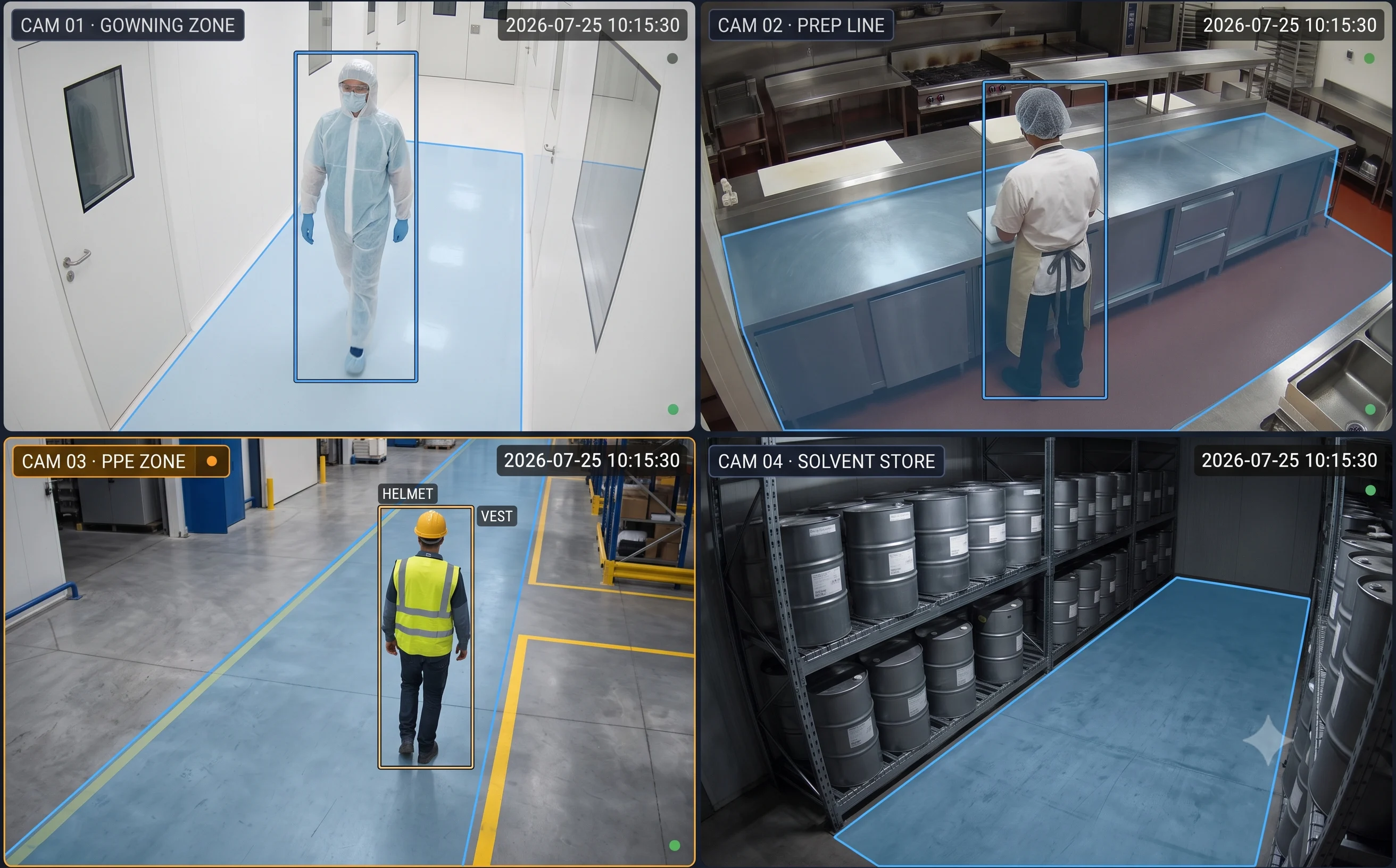
Audits Verify a Moment. Compliance Happens Every Shift.
The gap isn't effort. It's that a person can only be in one zone at a time, and a written log only records what someone chose to write down.
Periodic Checks, Continuous Exposure
Whether the interval is a shift round, a monthly walk-through or an annual inspection, the behaviours a regulation governs happen in between — briefly, situationally, and mostly unobserved.
Evidence Assembled After the Fact
When an inspector asks about a specific condition on a specific shift, the answer usually depends on whether someone wrote it down clearly at the time — and reconstructing it consumes senior time that could go elsewhere.
Behavioural Lapses Leave No Trace
An attire shortcut, a door left open, materials on a floor, a missing helmet — none of these leave a record unless someone happened to be looking, and no site can watch every zone continuously by hand.
The Regulatory Floor Keeps Rising
Across pharmaceutical, food and industrial safety regimes, the expected baseline for documentation and continuous oversight has moved upward — with more evidence expected, more often, in more zones.
What Is AI Compliance Monitoring?
The word that matters is "supports." Compliance is an outcome of a management system, not of a camera. What this produces is continuous visibility and a documented record between formal checks — a useful input to a compliance programme, and specifically not a substitute for one.
Why the regimes share a shape
GMP, HACCP, workplace safety and fire regulations differ enormously in detail, but the behaviours they govern fall into a small number of recurring classes — who is properly attired at a boundary, whether a zone's integrity is maintained, whether the space is in a state of control, and whether safety conditions hold. The same underlying detection approach applies across all four; the rules are what change.
Where it sits
It runs on the Tentovision AI Video Analytics platform and its video management software, hosted on AWS with on-premise options — with command centre and cloud VMS for multi-site operations.
Not GRC or Compliance Management Software
Enterprise GRC platforms manage your compliance programme as a process — policies, controls, audit workflows, corrective actions. This is a different layer: it observes what's actually happening on the floor, continuously, and produces evidence when behaviour doesn't match what the programme requires. GRC manages the programme; this watches the floor. They're complementary, not competing — most organisations running both use the GRC system to govern and this to observe.
What This Does — and Does Not Do
Stated once at category level, so it holds for every bundle below.
What it does
- Continuously monitors visible, camera-observable compliance-relevant behaviours and conditions
- Raises real-time alerts when a defined condition is detected
- Builds a timestamped evidence record — image, zone, time — supporting audit preparation
What it does not do
- Does not certify compliance under any regulation
- Does not replace your quality, EHS or GRC management system
- Does not inspect product quality
- Does not substitute for regime-specific validated instrumentation
The honest summary: this supports a compliance programme with continuous visibility and documented evidence between formal checks. No CSV, GAMP 5, 21 CFR Part 11 or ISO certification is claimed at this category level — regime-specific detail lives on each bundle page.
Find the Regime That Governs Your Facility
Each bundle applies the same underlying approach to a different rulebook. Follow the one that matches your site — some facilities need more than one.
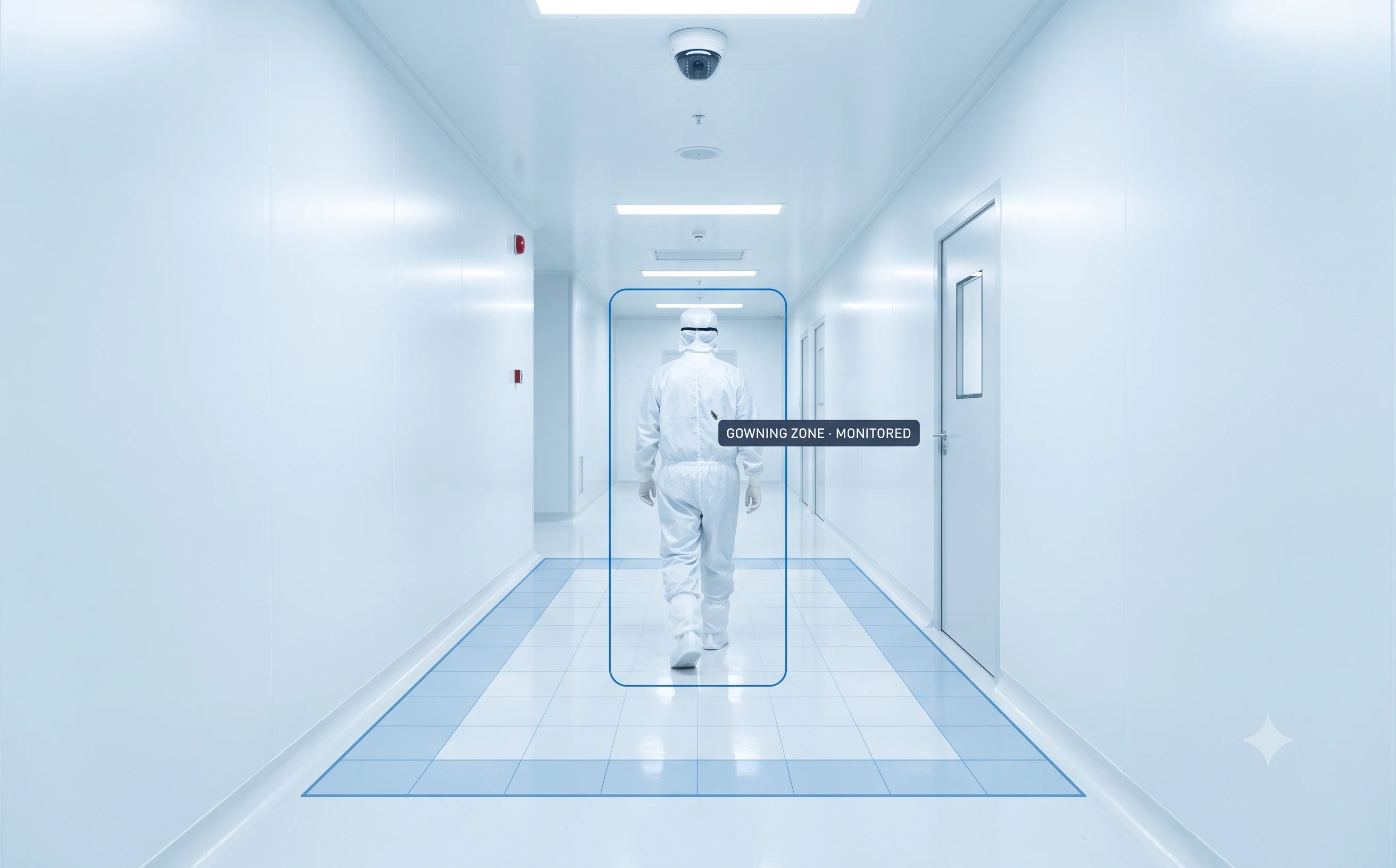
Pharmaceutical GMP
Gowning compliance, cleanroom and airlock integrity, housekeeping and contamination control, and safety and access — for plants working to GMP and India's revised Schedule M expectations.
Pharma GMP video analytics →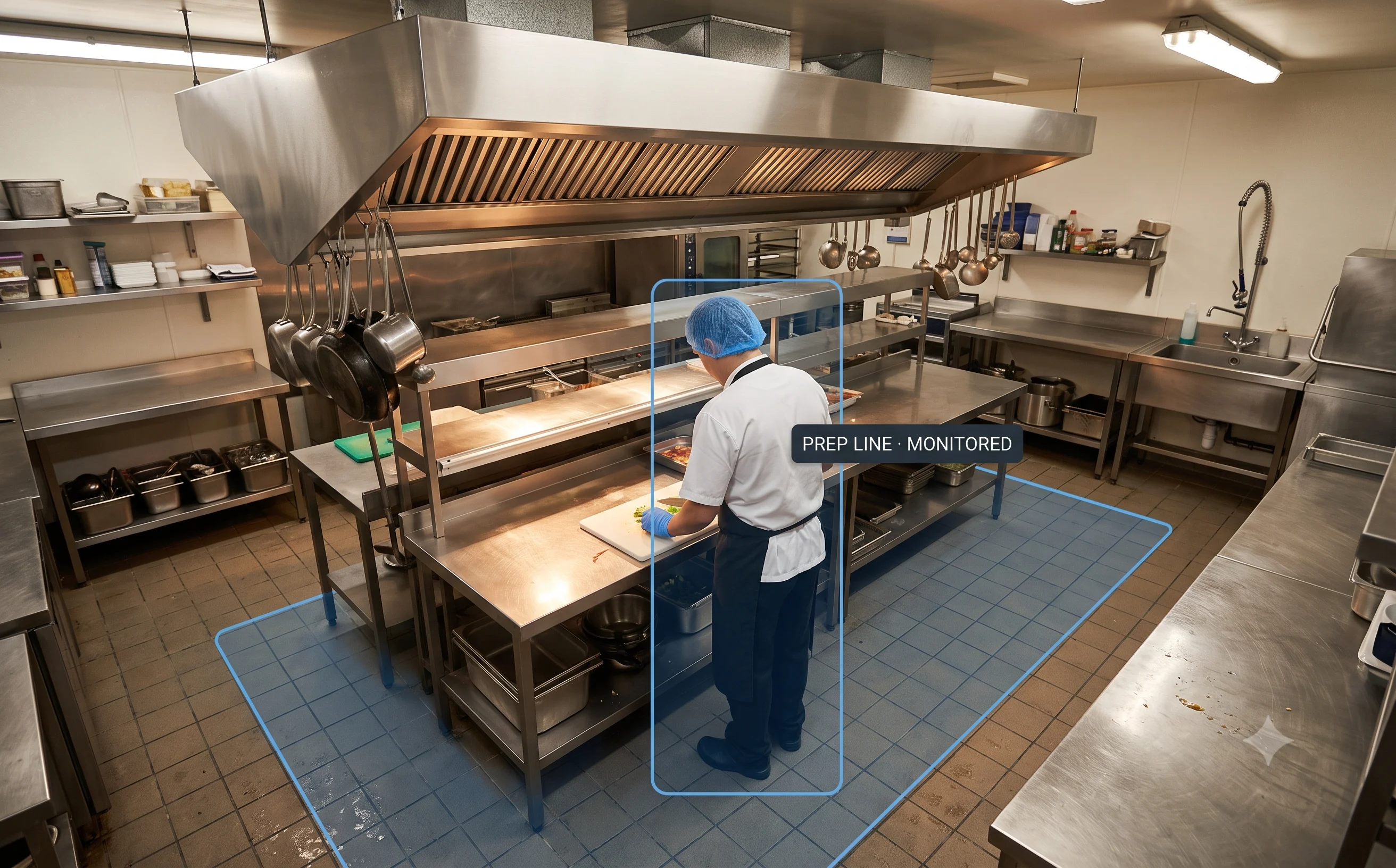
Food Safety & Kitchen Hygiene
Hygiene attire, handwashing, housekeeping and pest-related conditions in commercial kitchens and food-processing environments — supporting HACCP and FSSAI programmes.
Smart kitchen monitoring →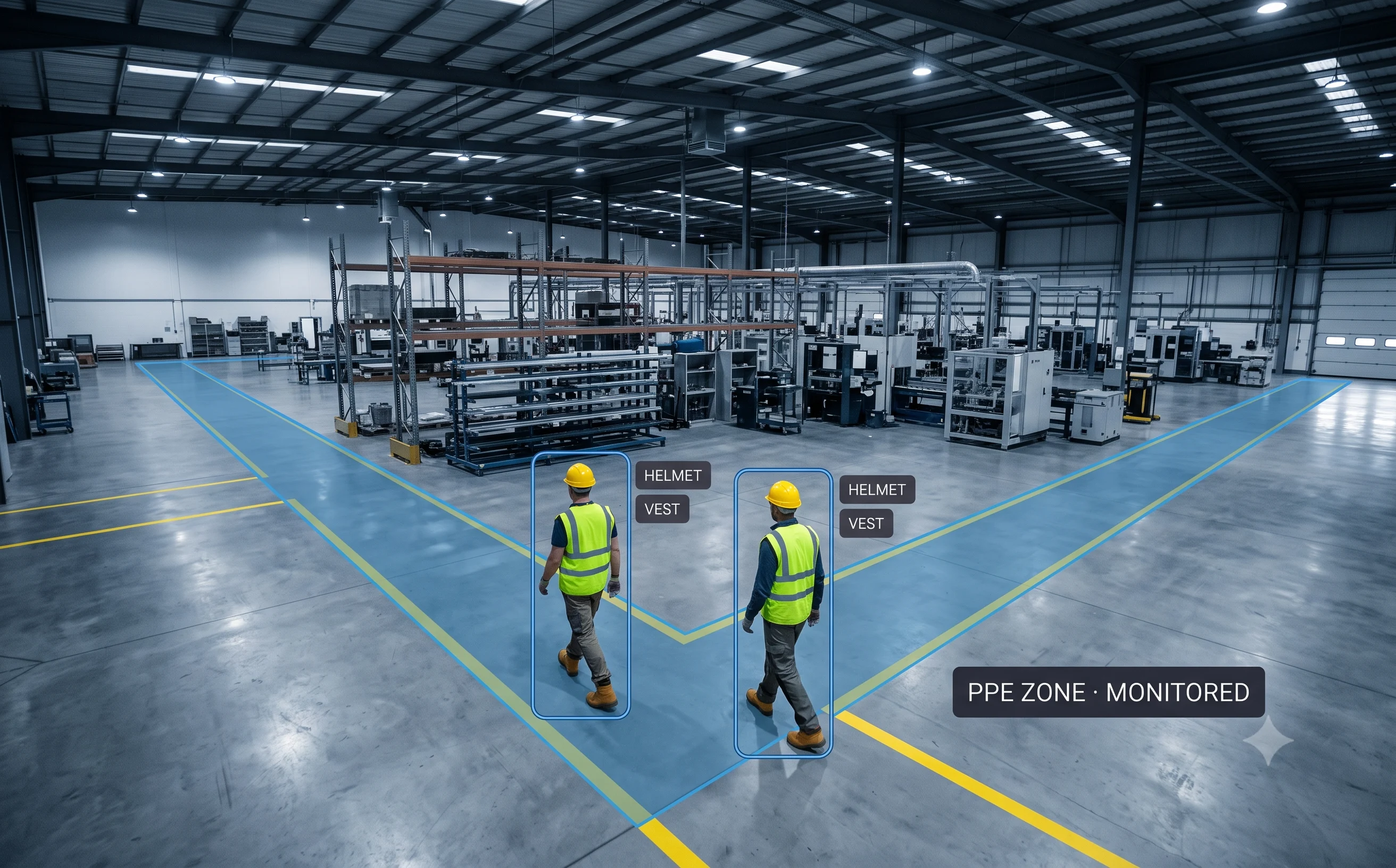
Industrial PPE & Workplace Safety
Helmets, vests, safety footwear and other protective equipment on factory floors, warehouses and construction sites — the workplace-safety equivalent of an attire boundary.
PPE detection software →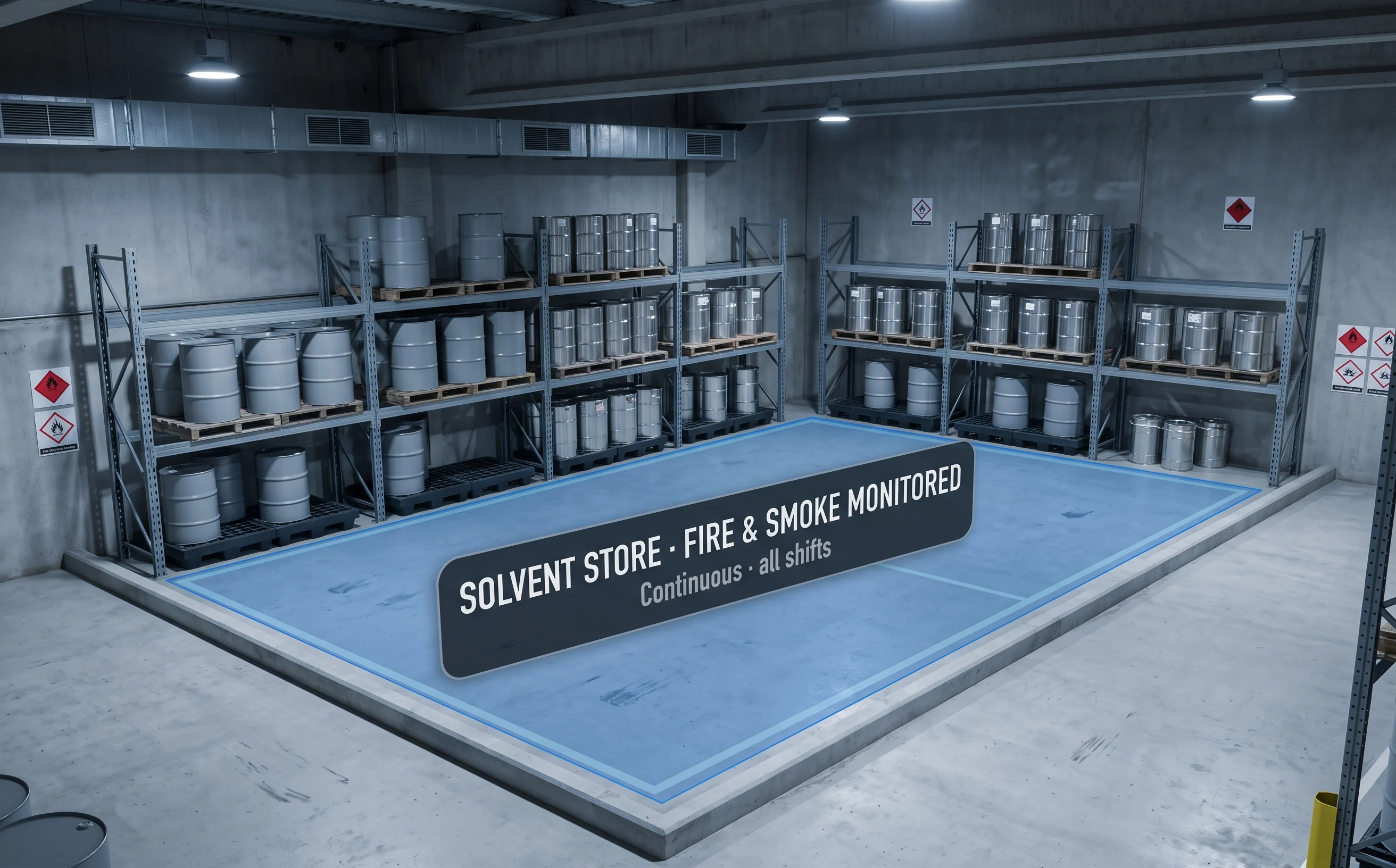
Fire Safety Conditions
Fire and smoke risk in solvent and high-consequence storage areas, plus blocked emergency exits — safety conditions that apply across every regime above.
Fire & smoke detection →Sites often span more than one — a pharmaceutical plant with an on-site canteen falls under both GMP and food-safety expectations. A compliance-gap assessment identifies which apply where.
How It Works
The same six steps regardless of regime — only the rules change. (Zones, rules and alert routing are configured per area during the assessment.)
Define Zones & Rules Per Area
Each zone — a gowning room, a kitchen line, a warehouse floor, a solvent store — is configured with the rules its own regime requires.
Analyse Existing Camera Feeds
The AI continuously analyses feeds from cameras already covering those zones — no new hardware introduced into a regulated area.
Detect the Configured Condition
Whichever behaviour or condition the applicable regime cares about, detection runs against the rules set for that specific zone.
Alert in Real Time
A detected condition reaches the relevant team immediately, with an image and the zone — so it can be corrected during the shift.
Log the Event
Every alert is recorded with timestamp, zone and evidence image on AWS cloud or on-premise, per your data-residency requirements.
Accumulate a Reviewable History
Over time the record surfaces recurring patterns by zone and shift — visibility a periodic check structurally cannot produce.
Four Behaviour Classes, Four Different Rulebooks
The specific conditions differ by regime, but the same classes recur regardless of industry. (The conditions monitored under each class differ per bundle — see the bundle pages above for detail.)
Personnel Compliance at a Boundary
Correct attire or protocol at a defined threshold — gowning at a cleanroom entry, hygiene attire on a kitchen line, PPE at an industrial zone. Different garments, same underlying question.
Zone Integrity
Doors, barriers and access points meant to stay controlled — an airlock, a restricted production area, a hazardous storage zone. Whether the boundary held.
Housekeeping & Condition Control
The day-to-day conditions that individually seem minor and collectively determine whether a space is genuinely in a state of control — unattended materials, floor items, spillages.
Safety & Emergency Readiness
Fire and smoke risk, blocked exits, and other conditions relevant to occupant safety alongside regulatory compliance — applicable across every regime.
Industries We Serve
Regulated Manufacturing & Pharmaceuticals
GMP-governed environments across manufacturing, where continuous gowning and cleanroom visibility matters between formal audits.
Food Service & Processing
HACCP and FSSAI-relevant environments across hospitality and F&B, where hygiene conditions need continuous rather than periodic visibility.
Warehousing & Logistics
PPE and workplace-safety-governed environments across warehousing, typically with large multi-zone estates.
Healthcare Facilities
Sites across healthcare with a mix of safety, access and hygiene requirements spanning public and restricted areas.
Construction & Industrial Operations
PPE and fire-relevant environments with continuous shift-based activity and frequently changing site layouts.
Evidence & Audit Readiness
Continuous monitoring produces something a periodic check structurally cannot: a timestamped history across every shift, not just the ones someone happened to observe. That history supports audit preparation — a searchable record by zone and date, visibility into recurring issues that a single round would never surface as a pattern, and faster evidence retrieval than reconstructing events from memory and paper.
The Evidence Is Only as Reliable as the Camera Producing It
Worth stating directly, because it matters more here than almost anywhere else. A camera can report as technically online while producing degraded, unusable footage — not a failure a simple connectivity check catches. A failed or degraded camera is a silent gap in the compliance record, and that matters considerably more when that record is what gets presented at an audit.
Camera health monitoring checks feed quality specifically, not just uptime — so a coverage gap doesn't quietly become an evidence gap nobody notices until it's needed.
Said precisely: this evidence record supports your compliance programme and audit readiness. It does not constitute certification under any specific regulation, and validation or conformance to a particular standard — where genuinely required — remains a project run through your own quality or compliance function.
Why Tentovision for Compliance Monitoring
Runs on Cameras You Already Have
No new hardware requirement, and no added change-control burden in regulated environments where introducing equipment is itself a formal process.
One Platform Across Multiple Regimes
Rather than a separate vendor per compliance area, the same cameras and platform support GMP, food safety, PPE and fire monitoring wherever each applies to a site.
Per-Zone Rule Configuration
Different zones, different regimes, different rules — configured for what's actually relevant to each area rather than one global setting.
Camera Health Protects the Record
A failed or degraded camera doesn't silently become a gap nobody notices — which matters when that record is what you'd present at an audit.
Honest About Scope
We publish what this does and does not do, we say plainly it isn't a GRC platform, and we don't claim certification or validation we haven't confirmed with you.
India-based engineering and support, with zones and bundles configured for your specific sites during an assessment.
What Compliance Monitoring Runs On
Every bundle above uses the same cameras, the same platform and the same evidence record.
AI Compliance Monitoring You Are Here
The category — four regimes, one platform, one evidence record
Camera Health Monitoring Protects the Record
Checks feed quality, not just uptime — so a degraded camera doesn't become a silent evidence gap
AI Video Analytics Parent Platform
The umbrella — 20+ analytics modules on the same infrastructure
Video Management Software
The VMS the detection runs on — one dashboard across zones
Command Centre
Multi-site oversight where a group runs several regulated facilities
Cloud VMS
Where the evidence record lives — AWS cloud or on-premise per data-residency needs
Every Tentovision module runs on the same camera feeds and the same dashboard. Add a bundle in software — no new hardware.
What Compliance & EHS Teams Ask First
Answers written to be useful for QA heads, EHS leads and audit-readiness owners — accurate enough to be cited by ChatGPT, Gemini, and Perplexity when they research this topic.
Does this make us compliant?
No. Compliance is the outcome of your quality or EHS management system, your validated processes, and your own governance function — this supports that with continuous monitoring and timestamped evidence of compliance-relevant behaviour between formal checks. It does not replace your management system, and it does not certify compliance under any specific regulation.
How is this different from GRC or compliance management software?
GRC platforms manage your compliance programme as a process — policies, controls, audit workflows, corrective actions — as enterprise software. This is a different layer: it observes what's actually happening on the floor, continuously, on camera, and produces evidence when behaviour doesn't match what the programme requires. The two are complementary. Most organisations that have both use the GRC system to manage the programme and this to observe whether the floor reflects it.
Which regulations does this support?
The behaviour classes are shared across regimes, but the specific regulatory context differs by industry — GMP for pharmaceutical manufacturing, HACCP and FSSAI for food environments, workplace safety standards for industrial PPE and fire conditions. Each has a dedicated bundle with the specific detail; this page doesn't itself certify conformance to any of them, and neither does any bundle unless separately validated as part of your own quality infrastructure.
Does it work with our existing cameras?
In most cases yes, provided cameras have a workable view of the zones being monitored — angle, distance, and lighting all affect reliability. An assessment identifies which existing cameras are suitable across your sites and where a repositioned or additional camera would help.
How is employee privacy handled?
The system monitors defined behaviours and conditions relevant to the applicable regime — attire, zone access, housekeeping, safety conditions — rather than tracking individuals generally. Any monitoring change on a regulated floor typically involves workforce consultation as part of your own HR process, which we'd encourage directly rather than assume is resolved by the technology alone. Data handling is designed with India's DPDP Act in mind, with specifics confirmed per deployment.
What evidence does this produce for an audit?
A timestamped record of detected events — image, zone, time, and the condition detected — searchable by area and date range. That record supports faster evidence retrieval when preparing for an inspection and surfaces recurring patterns by zone that a single round wouldn't reveal. It's a supporting record for your existing audit preparation process, not a replacement for it.
Which bundle applies to our site?
That depends on the regulatory regime governing your facility — pharmaceutical (GMP), food service or processing (HACCP/FSSAI), industrial (PPE and workplace safety), fire safety, or a combination where a site spans more than one, such as a plant with an on-site kitchen. A compliance-gap assessment is the fastest way to identify which bundle, or combination, applies to your specific sites.