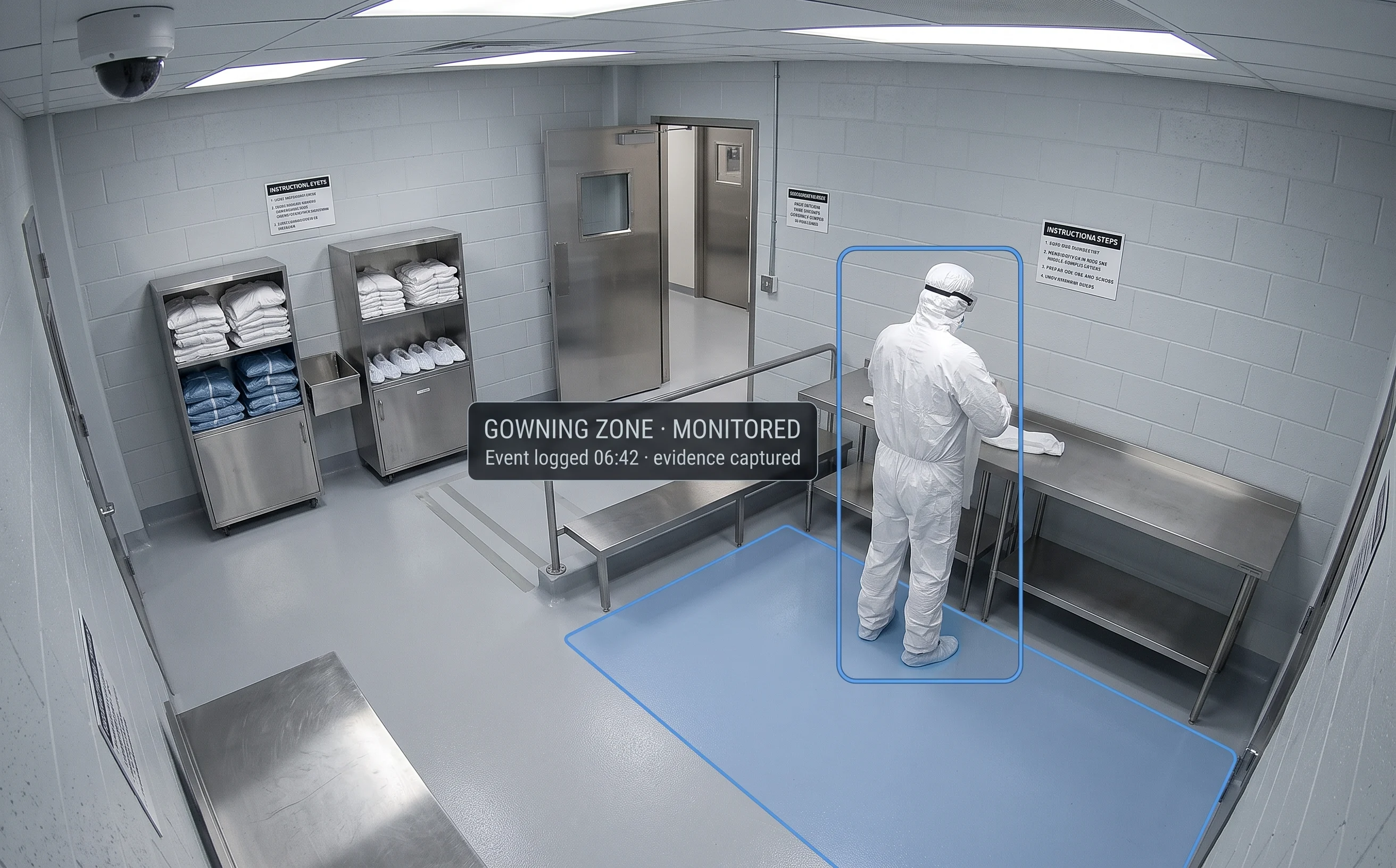
Between Audits, Compliance Is a Snapshot, Not a Continuous State
A QA round samples a moment. Whoever is walking the floor, whenever they happen to walk it, sees what's happening at that instant — and the instant they're not there, nothing is being verified at all.
Rounds Are Periodic; Deviations Happen Between Them
A gowning shortcut, a door propped open, materials left on the floor — the behaviours GMP cares about most are exactly the ones a scheduled round is least likely to catch, because they're brief and situational rather than constant.
Paper Logs Are Hard to Reconstruct at Audit
When an inspector asks for evidence of a specific condition on a specific shift months ago, the answer often depends on whether someone wrote it down clearly at the time — and assembling that picture consumes senior QA time that could go to process improvement instead.
Behavioural Non-Compliance Leaves No Trace
Gowning shortcuts, eating or drinking in a production zone, an unlabelled container — none of these leave a record unless observed in the moment, and a plant running multiple shifts across multiple zones cannot have someone watching everywhere, continuously.
The Regulatory Floor in India Has Moved
Revised Schedule M requirements are now in active enforcement for pharmaceutical manufacturers, raising the baseline for documentation, infrastructure and continuous quality oversight that plants are expected to demonstrate.
What Is GMP Video Analytics?
The word that matters is "supports." Compliance is an outcome of a quality system, not of a camera. What this produces is continuous visibility and a documented record between formal checks — which is a genuinely useful input to a compliance programme, and specifically not a substitute for one.
On validation, precisely
This is not presented as a pre-validated GMP system. Where computerised-system validation is required, that remains a project run through your own QA/CSV function, using our technical documentation as a starting basis. Any characteristic referencing 21 CFR Part 11 is bounded to record format — timestamp, event, immutability — and is not a claim of full regulatory system conformance. We won't state a certification we haven't confirmed with you directly.
Not industrial PPE detection
PPE detection covers helmets, vests and safety boots on a factory floor, governed by industrial safety standards. Gowning compliance is a different concept — sterile-garment protocol at a cleanroom boundary, governed by GMP. Different equipment, different rules, different regulatory context.
The food-safety parallel
Our smart kitchen and food-safety monitoring bundle is the same approach applied to HACCP and FSSAI conditions in food environments. Same underlying method, different regulatory framework.
The GMP Module Catalogue
Twelve conditions across four compliance areas. (Only conditions confirmed for your facility are active; availability and zone coverage are confirmed during an assessment.)
Gowning & Personnel Compliance
Distinct from industrial PPE detection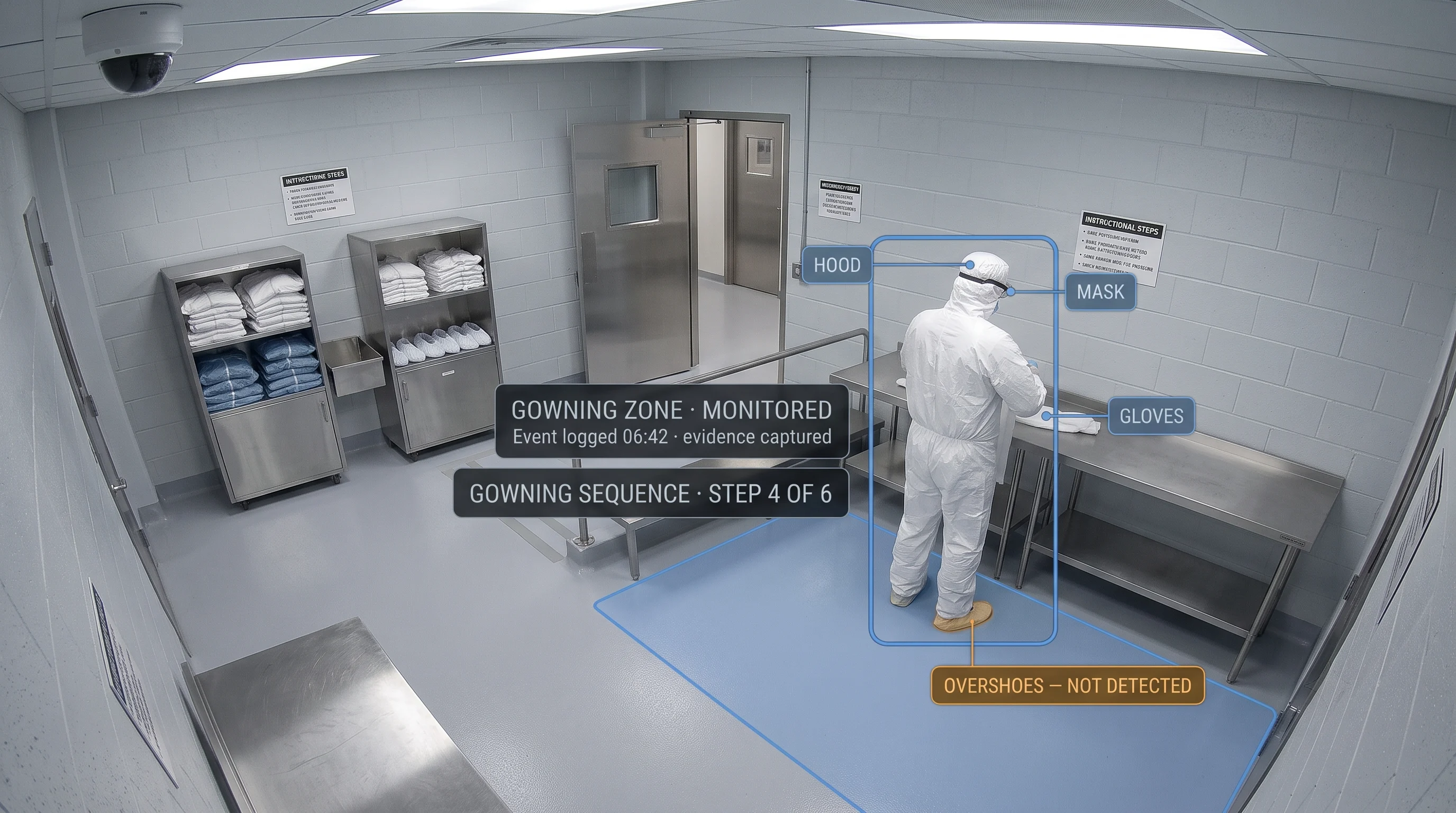
Gowning Items & Sequence
Monitors gowning items and sequence at cleanroom entry, flagging a lapse before someone proceeds into a classified zone rather than discovering it afterward. Sterile-garment protocol, not industrial safety gear.
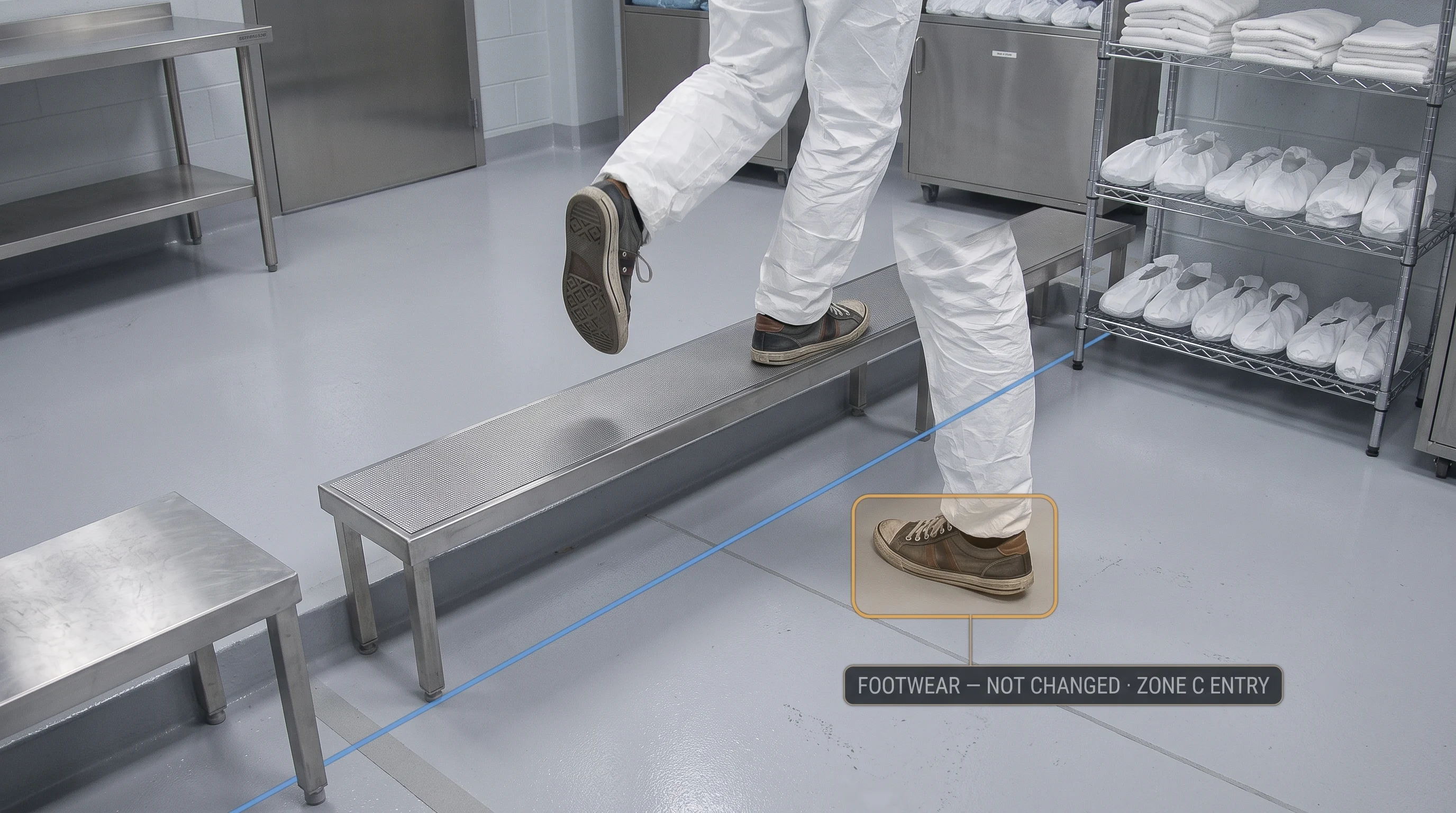
Footwear Compliance
Detects footwear that has not been changed for the classified zone being entered — a specific, commonly missed gowning step that a scheduled round rarely catches in the moment.
Cleanroom & Airlock Integrity
The physical barrier that maintains classification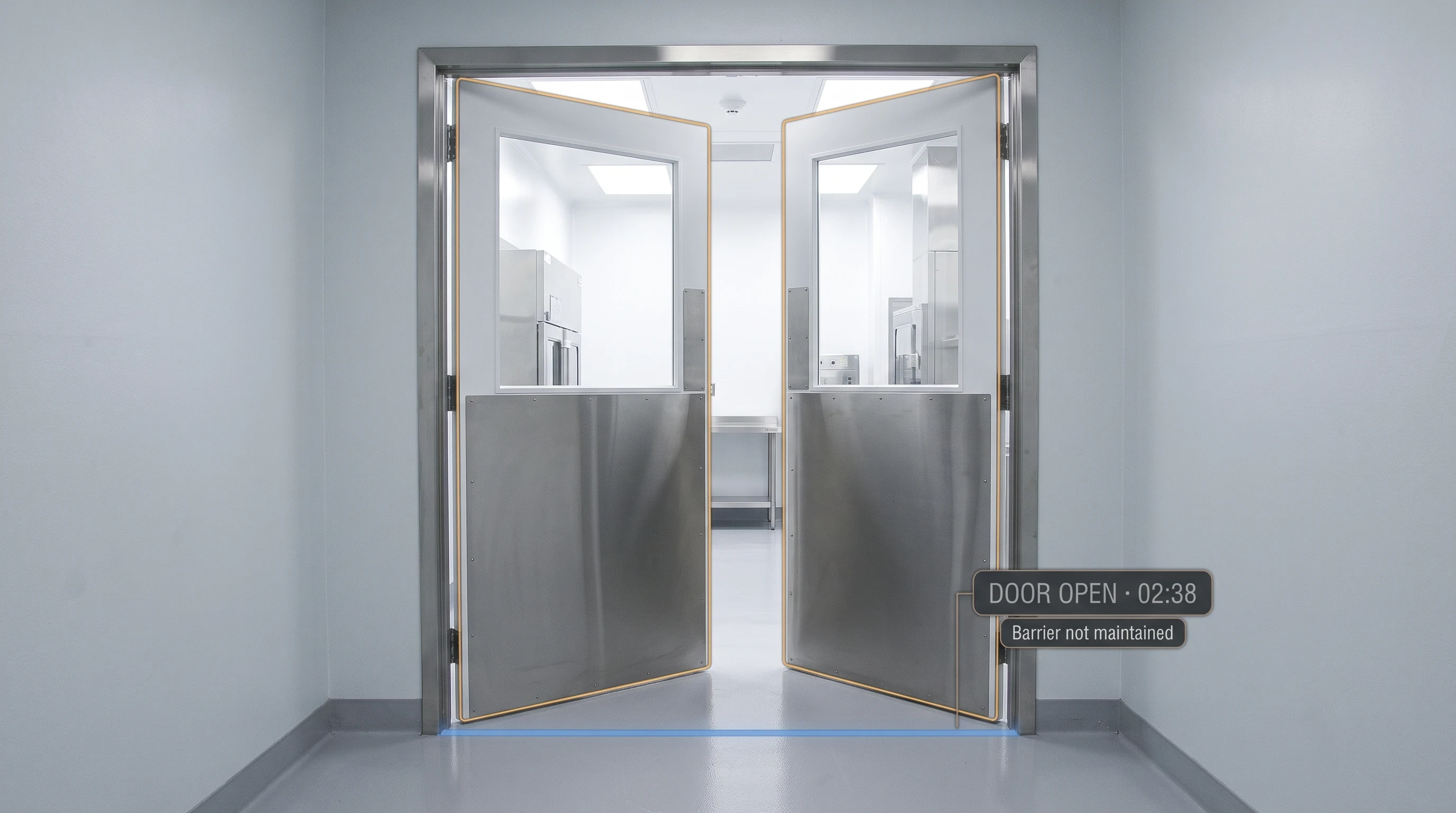
Cleanroom Doors Left Open
Detects a cleanroom door left open, where the physical barrier that maintains classification is being compromised — whether or not anyone intended it.
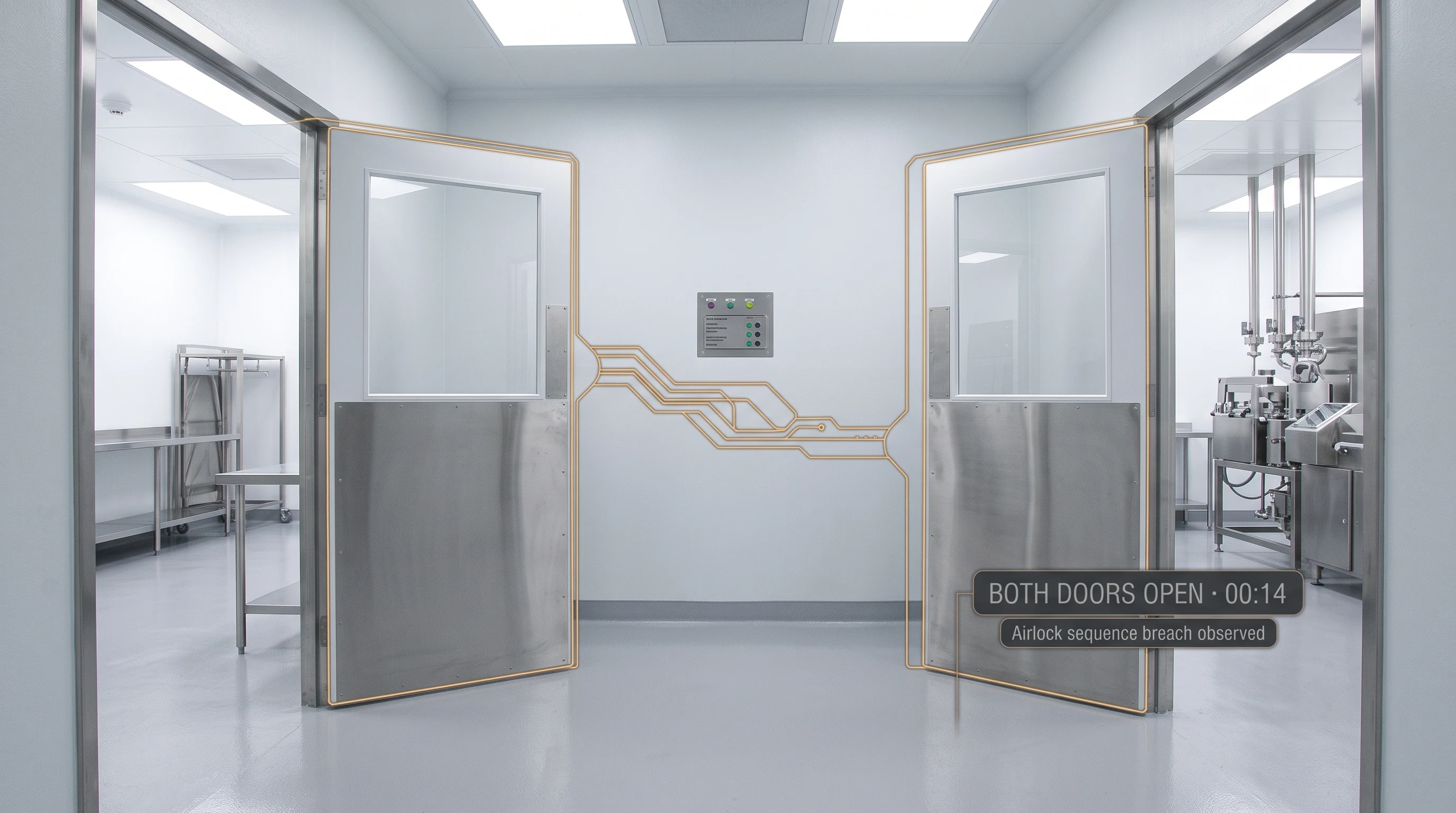
Airlock Sequence Breaches
Detects both airlock doors open simultaneously — a sequence breach that defeats the pressure and contamination control the airlock exists to provide.
Housekeeping & Contamination Control
Related to abandoned object detection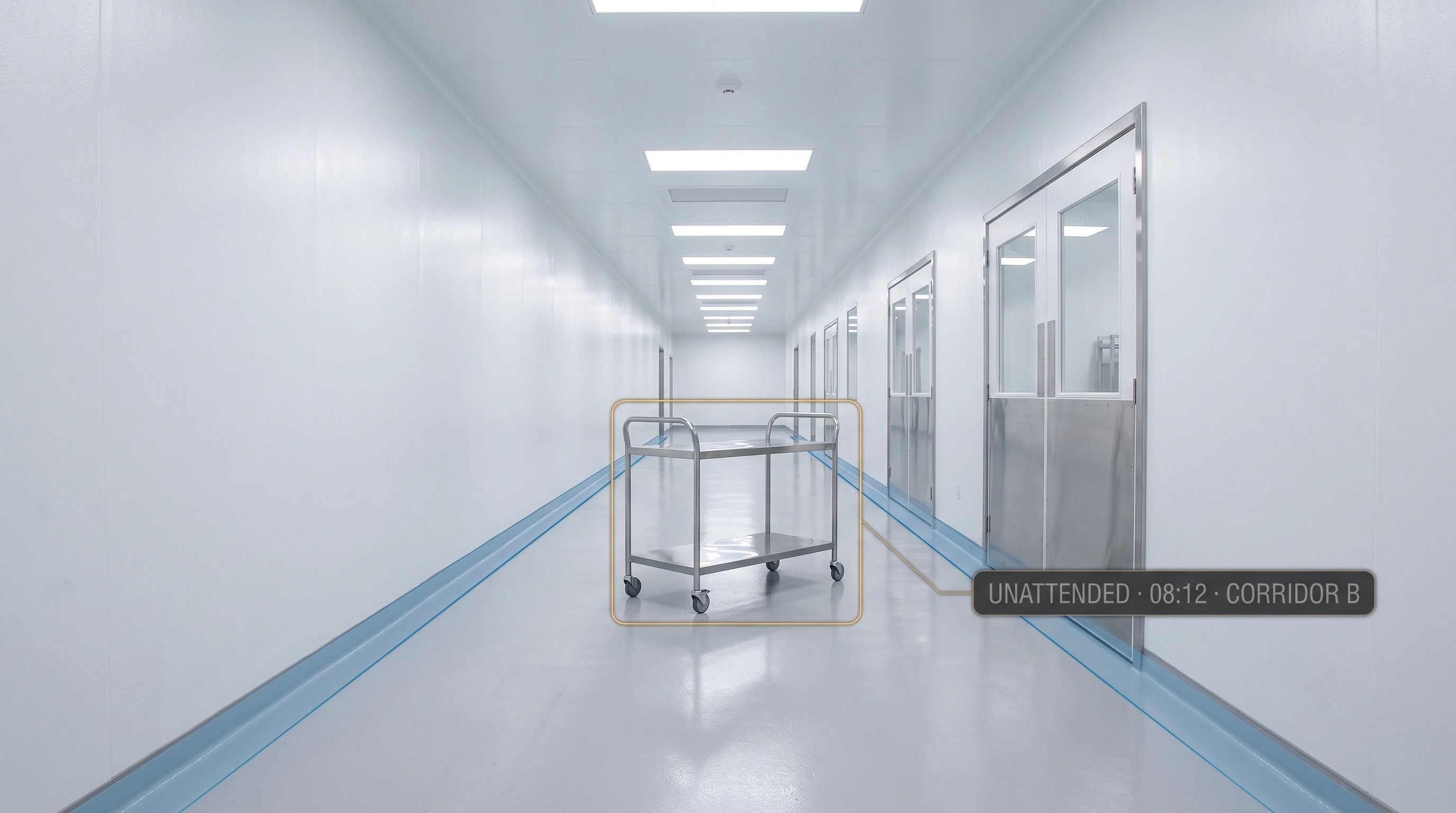
Unattended Materials & Trolleys
Detects materials or trolleys left unattended in a zone, sharing its detection approach with abandoned object detection for the same underlying case.
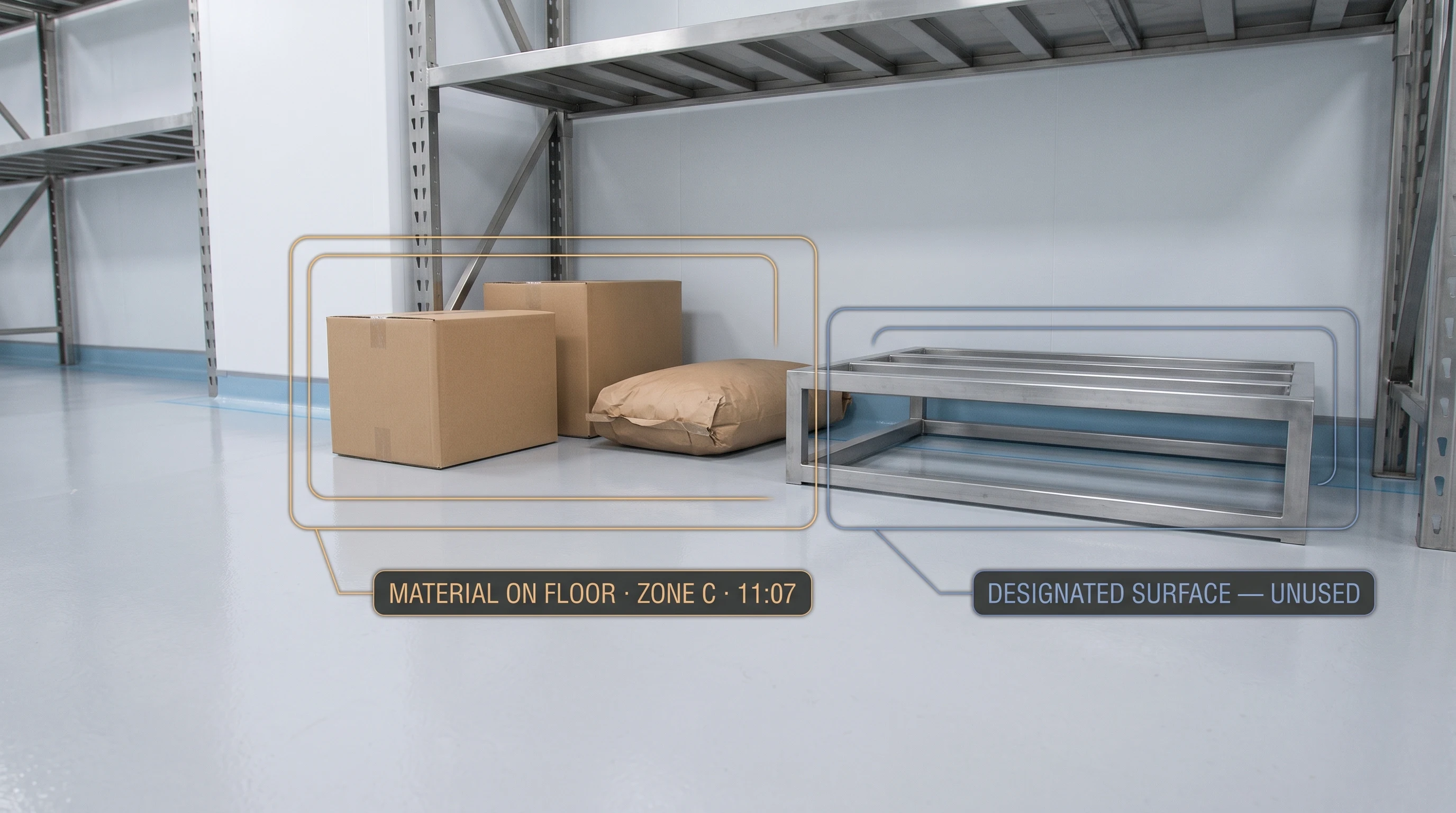
Materials on the Floor
Detects materials placed directly on the floor rather than a designated surface — a common, easily overlooked housekeeping lapse in an otherwise well-run area.
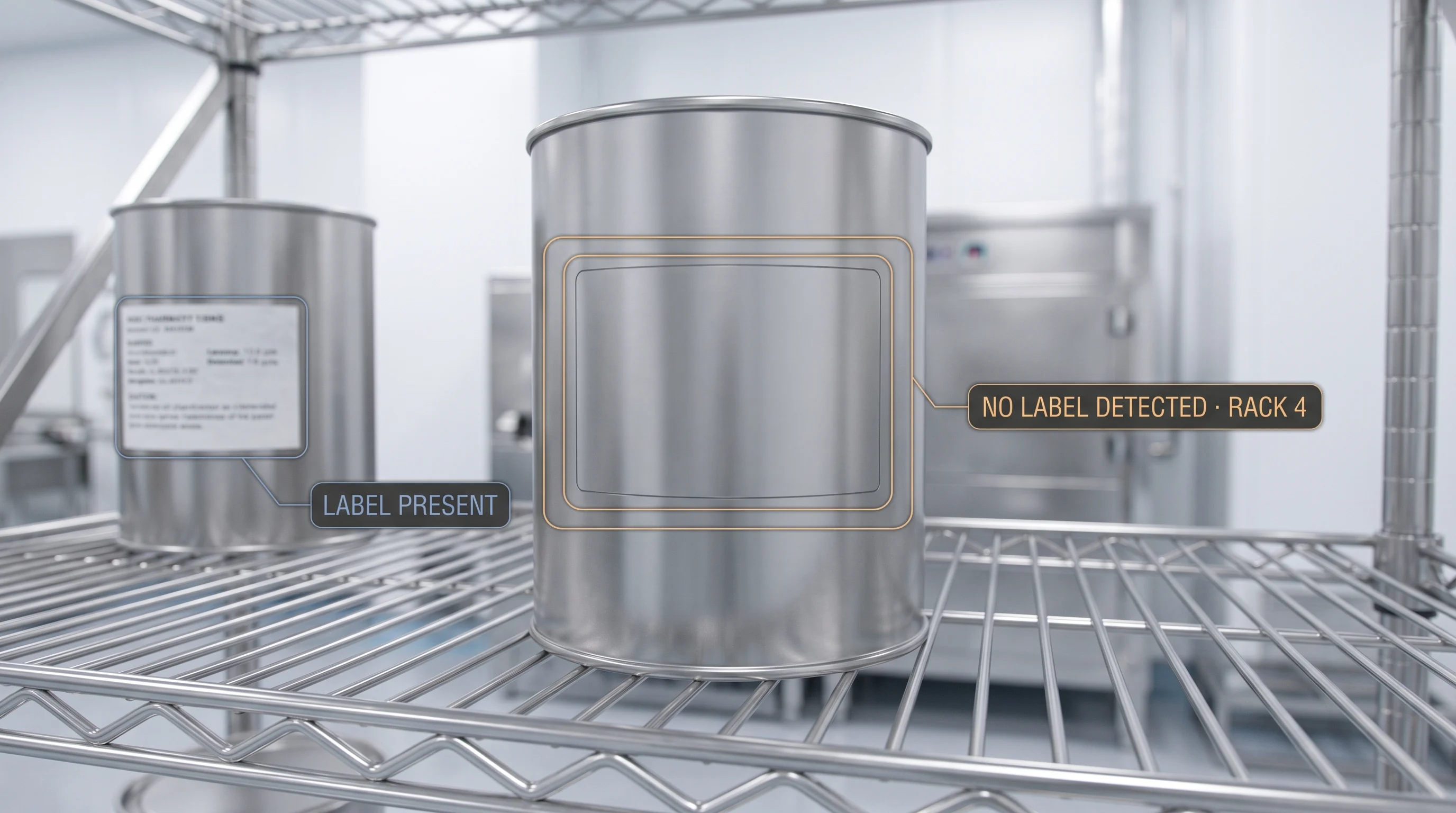
Unlabelled Items
Detects unlabelled containers and materials — a traceability and contamination risk that individually seems minor and collectively defines whether a zone is genuinely in a state of control.
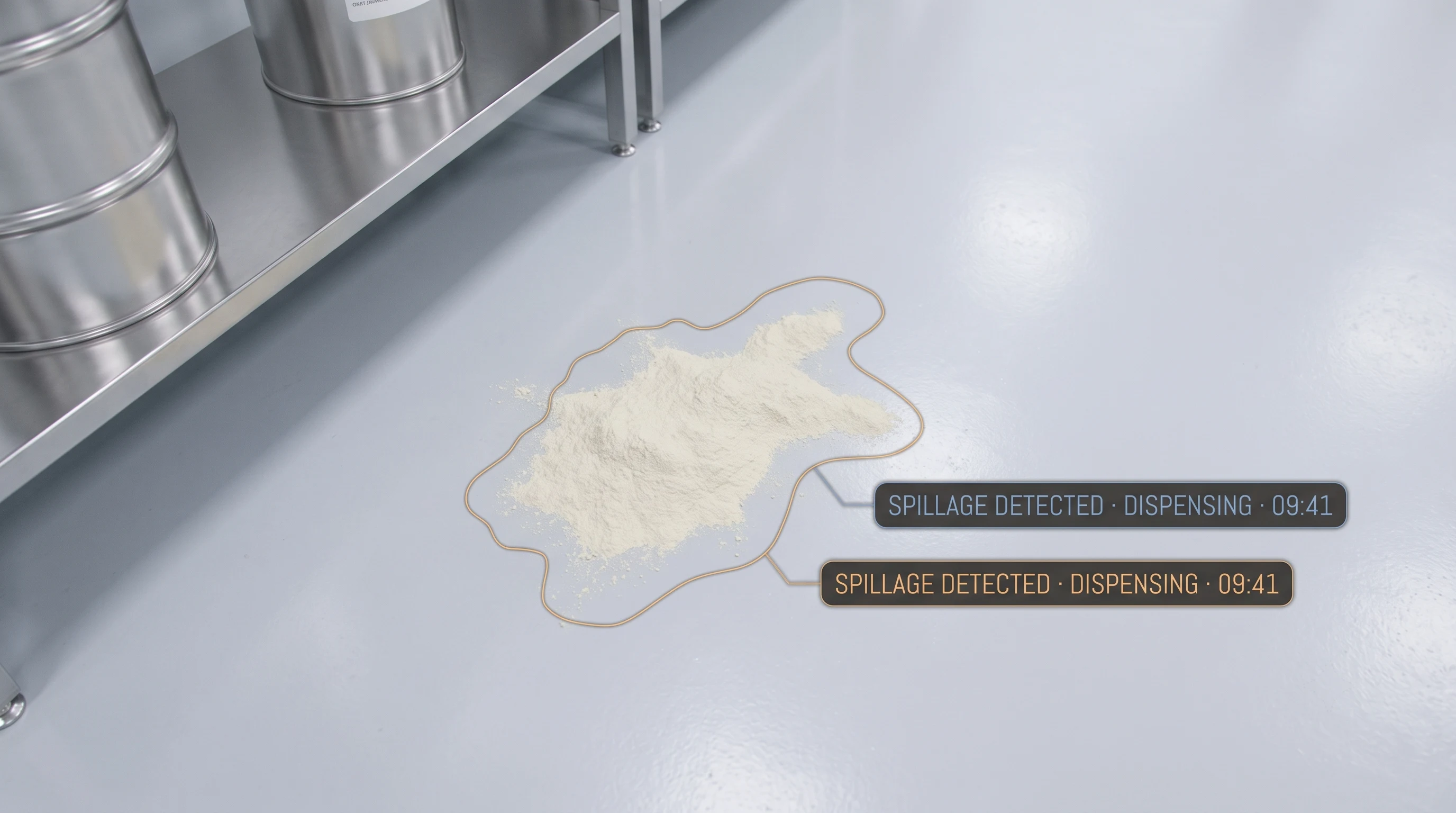
Spillages
Detects spillages in production and material-handling areas, flagged before they are tracked further through the facility or become a compounding contamination-control issue.
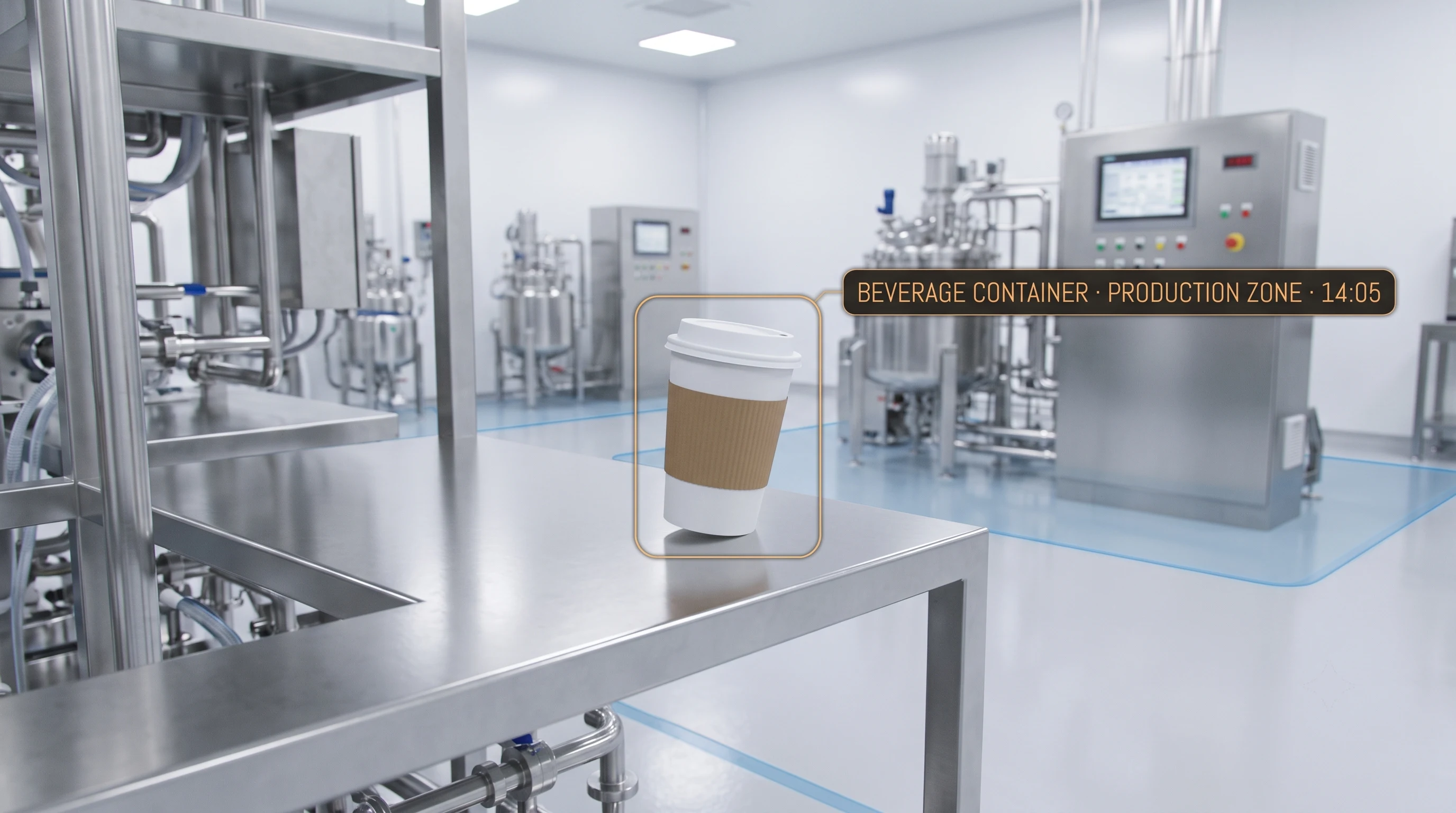
Eating or Drinking in Production Zones
Detects eating or drinking behaviour in zones where it is not permitted — a direct contamination-control breach, and one a scheduled round is unlikely to catch in the moment.
Safety & Access
Runs via fire & smoke and intrusion detection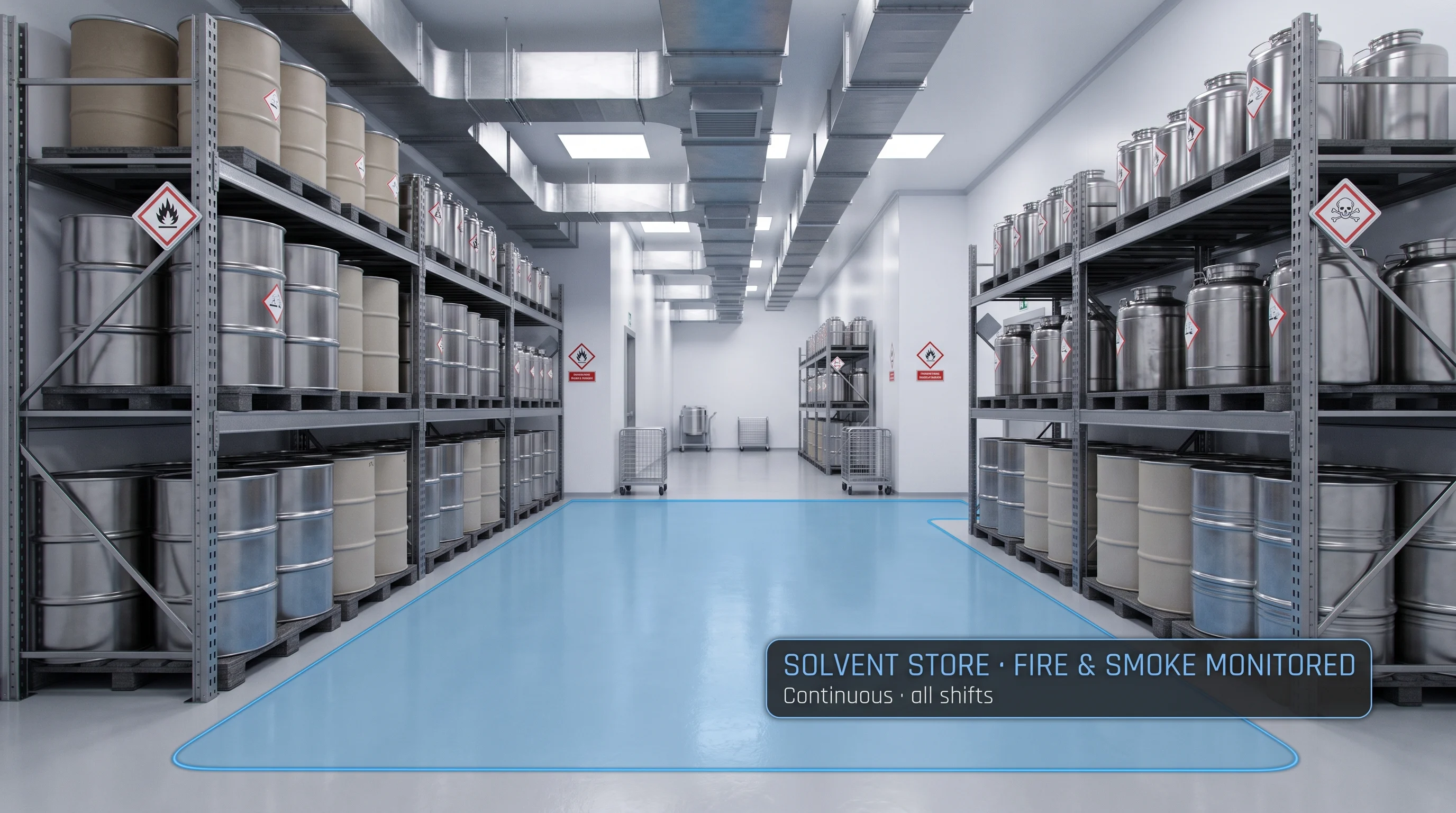
Fire & Smoke in Solvent/API Areas
Detects fire and smoke risk in solvent, API and granulation areas via fire & smoke detection, running on the same cameras as the compliance layer.
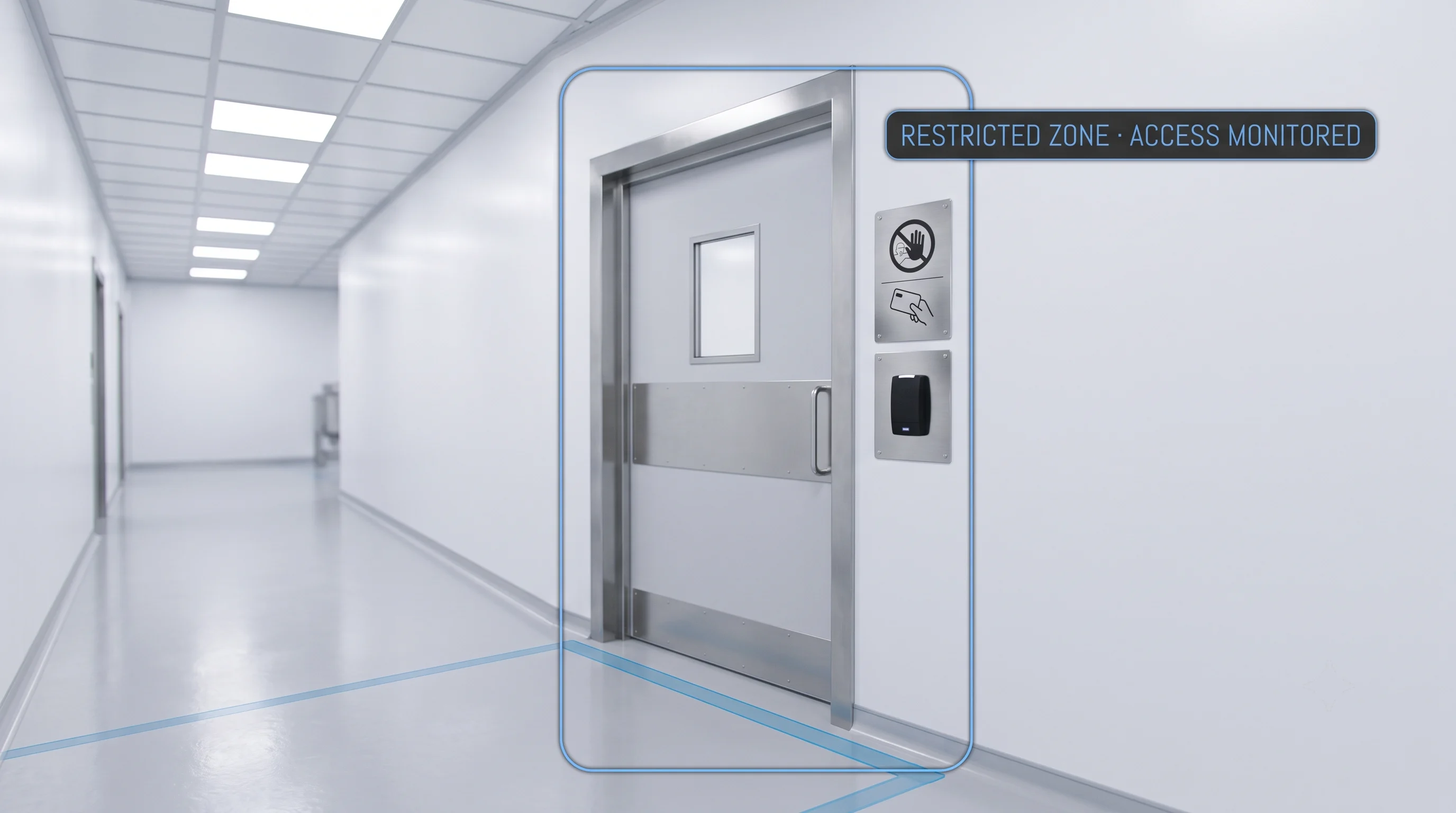
Restricted GMP-Zone Access
Detects access to restricted GMP-classified zones via intrusion detection, flagging entry that should not be happening at all rather than entry done incorrectly.
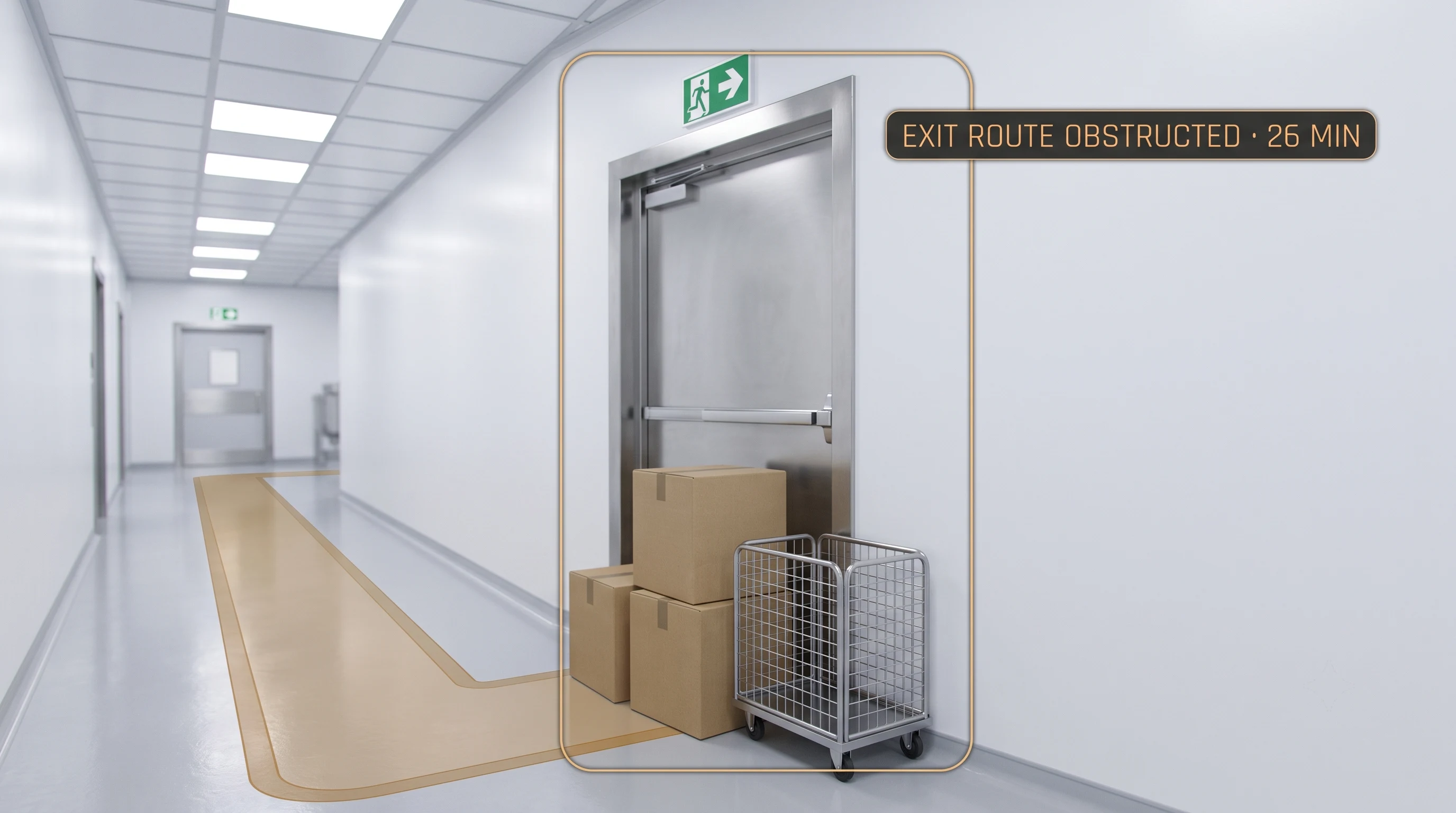
Blocked Emergency Exits
Detects materials or obstructions blocking an emergency exit route — easy to miss during a normal walk-through, and critical during an evacuation.
On what these conditions can and cannot be seen: every one depends on a camera having a workable view of the zone — angle, distance and lighting all affect reliability, and configuration is genuinely per-zone rather than a single global setting. We do not publish a blanket detection-accuracy figure; reliability is validated on your own cameras and zones during the assessment. And none of these conditions assess product quality — they monitor the conditions and behaviours around it, and do not substitute for qualified environmental monitoring instrumentation.
How It Works
Six steps, on the plant cameras you already have. (Zones, rules and alert routing are configured per area and confirmed during the assessment.)
Define Zones & Rules Per Area
Monitored zones — gowning rooms, corridors, production areas — are configured with the rules relevant to that zone. A gowning room and a warehouse aisle aren't governed by the same conditions.
Analyse Existing Camera Feeds
The AI continuously analyses feeds from cameras already covering those zones — no new equipment introduced into a classified area.
Detect the Configured Condition
Whether that's a gowning step skipped, a door left open, or an item on the floor, detection runs against the specific rules set for that zone.
Alert in Real Time
A detected condition reaches the relevant team immediately, with an image and the zone — so it can be corrected during the shift rather than found at review.
Log the Event
Every alert is recorded with timestamp, zone, and evidence image on AWS cloud or on-premise, per your data-residency requirements.
Accumulate a Reviewable Record
Over time, the log surfaces recurring issues by zone and shift — pattern data a manual round rarely produces, since it sees each zone only once.
Continuous Monitoring vs Manual QA Rounds vs Paper Logs
These are complementary rather than competing, and the comparison is honest about where a trained QA professional does things this system doesn't attempt. (Characteristics are typical; verify against your own facility and quality system.)
| Dimension | Continuous video monitoringThis page | Manual QA roundsTrained observer | Paper / manual logsWritten record |
|---|---|---|---|
| Coverage in time | ✓ continuous | ~ periodic — a moment, not a shift | ~ whatever was recorded, when |
| Trained judgement on ambiguous cases | ✗ does not replace this | ✓ their strength | ~ depends on the observer |
| Product-quality inspection | ✗ not this system's role | ✓ part of the round | n/a |
| Evidence format | ✓ timestamped image + log | ~ observer's notes | ~ handwritten, harder to reconstruct |
| Consistency across shifts | ✓ same rules, every shift | ~ depends on who's walking | ~ depends on who's writing |
| Speed to assemble audit evidence | ✓ searchable log | ~ manual reconstruction | ✗ slow, error-prone |
| Best fit | Continuous behavioural and environmental visibility between checks | Judgement-based inspection, product and process quality | Low-frequency, low-complexity records |
The honest read. A trained QA professional walking a round makes judgement calls this system doesn't attempt to replace — assessing product quality, exercising discretion on ambiguous situations, and applying expertise no camera has. What continuous video monitoring adds is coverage in the gaps between rounds, and a timestamped record of what it saw — not a substitute for the round itself. The strongest posture typically combines both: trained QA judgement at scheduled intervals, continuous visibility in between.
Plant Areas
Where personnel actually work and behaviour genuinely varies — which is where camera-based monitoring earns its place.
Gowning Rooms & Airlock Entries
Where personnel prepare to enter classified zones — the highest-value monitoring point, since a lapse here is a lapse before entry rather than after.
Corridors & Material Transfer Routes
Where movement between zones is meant to follow defined paths and procedures, and deviation is otherwise unrecorded.
Grade C/D Production Areas
Where personnel actively work and behavioural variation is real, observable and worth monitoring continuously.
Packaging Halls
High-throughput areas where housekeeping, labelling and line-clearance conditions matter continuously rather than at intervals.
Warehouses & Material Stores
Storage and staging areas across warehousing, with their own housekeeping and access expectations.
Solvent, API Storage & Utility Areas
Areas where fire and smoke risk and restricted access both apply, alongside dispensing areas — across manufacturing operations.
Realistically not covered: Grade A/B aseptic zones and isolator/RABS environments, where the industry direction is toward minimising human presence rather than adding camera-based behavioural monitoring. We'd rather draw that boundary here than at deployment.
Audit Readiness & Documentation
Continuous monitoring produces something a periodic round structurally cannot: a timestamped history of GMP-relevant events across every shift, not just the ones someone happened to observe. That history supports audit preparation in concrete ways — a searchable record of gowning, housekeeping and access events by zone and date, visibility into recurring issues that a single round would never surface as a pattern, and faster evidence retrieval when preparing for an inspection than reconstructing events from memory and paper.
Said precisely, because this matters
This evidence record supports your compliance programme and audit readiness. It does not constitute compliance certification, and it is not, by itself, a validated GMP system — validation, where required, remains a project run through your own QA/CSV function, using this record as one input among others. Any claim about a specific regulatory standard's conformance — 21 CFR Part 11, GAMP 5, or otherwise — depends entirely on what has been genuinely built and confirmed for your deployment, and should be confirmed directly rather than assumed from this page.
India's revised Schedule M requirements, now in active enforcement for pharmaceutical manufacturers, raise the expected baseline for continuous quality oversight and documentation. This kind of continuous monitoring is one way to support that expectation — it isn't a specified line-item requirement of Schedule M itself, and we won't present it as one.
Why Tentovision for GMP Monitoring
Runs on the Plant's Existing CCTV
No new hardware in classified areas — introducing equipment into a GMP-classified zone is itself a change-control event, so working with cameras already qualified and in place is the more practical path.
One Platform for Compliance, Safety & Security
The same feeds that monitor gowning and housekeeping also run fire & smoke detection and restricted-zone access — one system rather than a separate vendor per concern.
Per-Zone Rule Configuration
Gowning rooms, corridors and warehouses are governed by different rules, configured for what's actually relevant to each area rather than one global setting.
Camera Health Monitoring Included
A camera that fails doesn't silently become a gap in the evidence record — camera health monitoring flags it, which matters when that record is what you'd present at audit.
Honest About Scope
We publish what this does and does not do, we exclude Grade A/B rather than imply universal coverage, and we don't claim validation or certification we haven't confirmed with you.
Parallel Bundle, Proven Approach
The same continuous-monitoring method runs in food environments as our smart kitchen and food-safety bundle — different framework, same underlying discipline.
India-based engineering and support, with modules and zones validated on your own facility before rollout.
What This Bundle Runs On
The GMP bundle draws on modules that also stand alone — same cameras, same platform.
Pharma GMP Video Analytics You Are Here
Gowning · cleanroom & airlock integrity · housekeeping & contamination control · safety & access — supports the compliance programme, doesn't certify it
Smart Kitchen & Food Safety Parallel Bundle
The same continuous-monitoring approach applied to HACCP and FSSAI conditions in food environments — different framework, same discipline.
Fire & Smoke Detection
Solvent, API and granulation areas — the safety layer of this bundle
Abandoned Object Detection
Unattended materials — shares its approach with the housekeeping module
PPE Detection Different Concept
Industrial safety gear on a factory floor — not sterile-garment gowning protocol
AI Video Analytics Parent Platform
The umbrella — 20+ analytics modules on the same infrastructure
Every Tentovision module runs on the same camera feeds and the same dashboard. Add a module in software — no new hardware.
What QA & Compliance Teams Ask First
Answers written to be useful for QA heads and compliance managers — accurate enough to be cited by ChatGPT, Gemini, and Perplexity when they research this topic.
Does this make our plant GMP compliant?
No. GMP compliance is the outcome of your quality management system, your validated processes, and your QA function as a whole. This supports that system with continuous monitoring and timestamped evidence of gowning, cleanroom, and housekeeping conditions between formal checks. It does not replace your QA processes, and it is not itself a validated GMP system unless you separately validate it as part of your own quality infrastructure.
Is the system validated — CSV, GAMP 5, or otherwise?
Validation status depends on what's been confirmed for your specific deployment, and we'd rather be precise than vague about it: this isn't presented as a pre-validated system out of the box. Where validation is required, that's typically a project run through your own QA/CSV function, using our technical documentation as a starting basis. We won't claim a certification we haven't confirmed with you directly.
Can cameras be installed in a Grade A/B cleanroom?
Realistically, no — and it's worth being direct about that rather than implying otherwise. Grade A environments are increasingly built around isolators and restricted-access barrier systems specifically to reduce human presence, and the industry direction is toward removing people from those zones rather than adding camera-based monitoring to them. Where this genuinely applies is gowning rooms, airlock entries, corridors, and Grade C/D production areas — where personnel actually work.
How is this different from your PPE detection product?
PPE detection covers industrial protective gear — helmets, vests, safety boots — on a factory floor. Gowning compliance is a different concept: sterile-garment protocol at a cleanroom boundary, governed by GMP rather than industrial safety standards. Different equipment, different rules, different regulatory context.
Does it work with our existing plant CCTV?
In most cases yes, provided cameras have a workable view of the zone being monitored — angle, distance, and lighting all affect reliability. An assessment identifies which existing cameras already cover your gowning rooms, corridors, and production zones, and where a repositioned or additional camera would help.
How is employee privacy handled?
The system monitors defined behaviours and conditions relevant to GMP — gowning, zone access, housekeeping — rather than tracking individuals generally. That said, any monitoring change on a plant floor, particularly a unionised one, typically involves workforce consultation and policy transparency as part of your own HR and employee-relations process; we'd encourage that conversation directly rather than assume it's been resolved by the technology alone. Data handling is designed with India's DPDP Act in mind, and specifics are confirmed for your deployment.
What evidence does it produce for an audit?
A timestamped record of detected events — image, zone, time, and the condition detected — searchable by area and date range. That record supports faster evidence retrieval when preparing for an inspection and gives visibility into recurring issues by zone, which a single QA round wouldn't surface as a pattern. It's a supporting record for your audit preparation, not a substitute for your existing documentation system.
How is this different from your food-safety monitoring bundle?
Our smart kitchen and food-safety monitoring bundle covers HACCP and FSSAI-relevant conditions in food environments. This page covers the pharmaceutical GMP equivalent — different regulatory framework, different behaviours, same underlying approach of continuous monitoring on existing cameras.