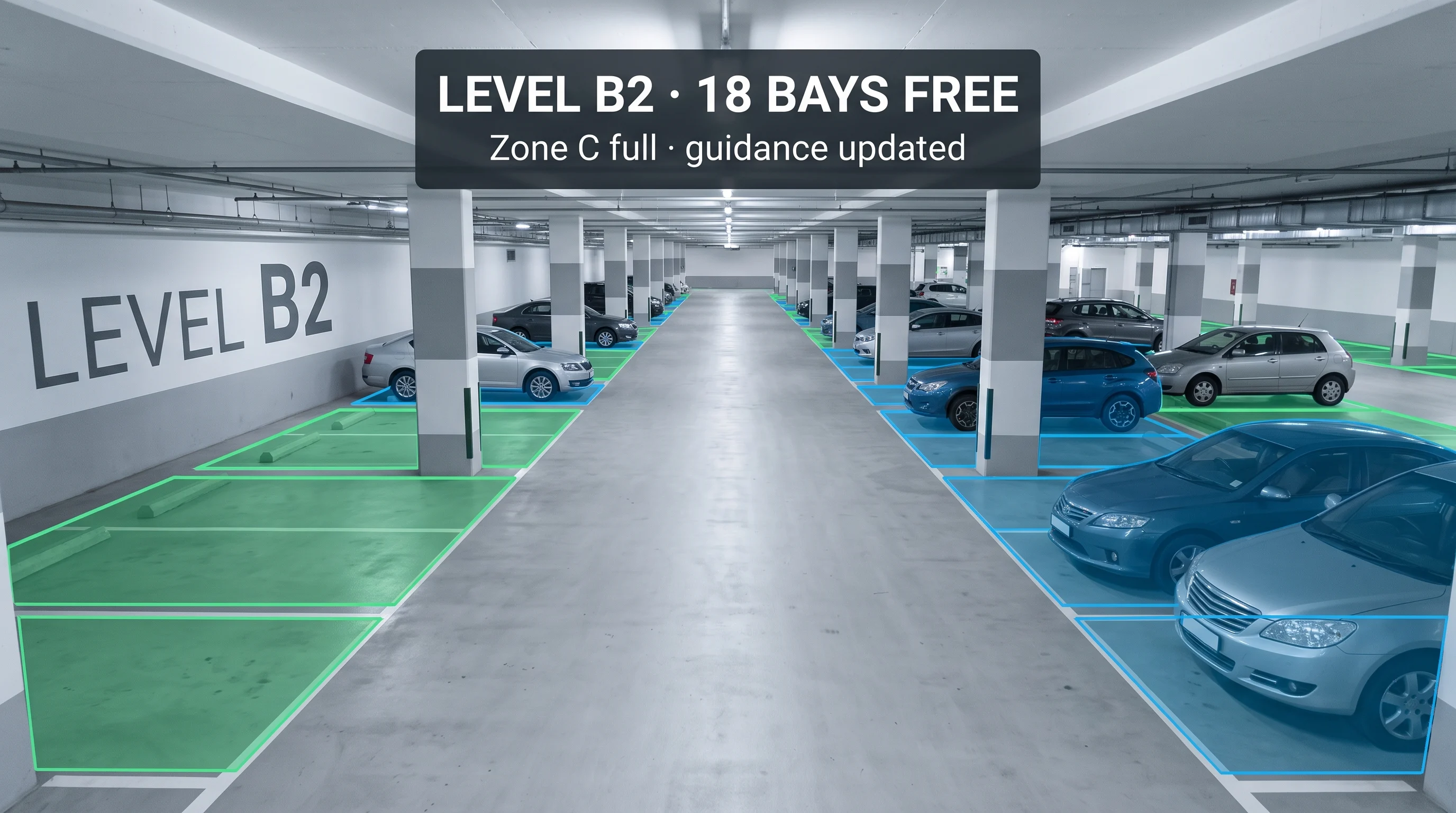
The Car Park Is Full. Except It Isn't.
Ask a facility manager what their parking problem is and you rarely hear "we need more spaces." You hear that people can't find the ones they have.
Drivers Circle for Spaces That Exist
On a multi-level structure the lower floors fill first and everyone queues behind the same ramp while capacity sits unused above. The facility reports as full, the driver experiences it as full, and the empty bays upstairs never enter the conversation.
A Count at the Barrier Is Not Occupancy
Entry systems tell you how many vehicles came in. They can't tell you which bays those vehicles are in, whether a level is genuinely full, or which zones fill first on a Saturday. Operators are managing a spatial problem with a turnstile number.
Violations Happen Where Nobody Is Looking
Reserved bays taken by the wrong vehicle. Accessible bays misused. Double parking at peak. Vehicles that entered at ten and are still there at closing. Each is a small revenue or goodwill leak, and almost none get recorded — because catching them means walking the levels.
No Data to Justify a Decision
When someone proposes changing the layout, adding signage, revising tariffs or converting a zone to EV charging, the evidence available is anecdote and gate counts. Utilisation by zone, by hour, by day — the information that would settle the argument — isn't being collected.
What Is AI Parking Management?
Camera-based detection, in plain terms. A sensor placed in a bay reports on that bay. A camera positioned over an aisle or a zone sees many bays at once and decides, space by space, which are occupied. That single difference drives the economics: coverage is added by positioning cameras rather than by multiplying devices, and it can often use cameras a facility already has.
Why we don't quote a bays-per-camera number
Coverage is decided by geometry — mounting height, angle, lens and layout. A camera overlooking an open lot from height covers far more than one in a low basement aisle. Competitors quote single figures; we think the honest answer is facility-specific, and a survey gives you a real one for your bays rather than someone else's.
Where cameras are the wrong tool
Detection needs a clear view and mains power. Tight basements with heavy pillar obstruction are often better served by per-bay ground sensors or ceiling-mounted zonal sensors, and unlit outdoor surface lots are the weak case. The comparison below is specific about this, and a survey will tell you which parts of your facility fall into it.
Where it fits
It runs on the Tentovision AI Video Analytics platform and its video management software, hosted on AWS with on-site options — the same cameras also supporting after-hours intrusion detection.
What this covers — and what it works alongside
Worth being direct, because "parking management system" means different things to different vendors.
Detects free and occupied bays · guides drivers · catches violations · tracks duration and overstay · reports utilisation and turnover.
It does not process payments, supply boom barriers, issue tickets, handle FASTag, or operate your car park. Most facilities already have those — the system is designed to integrate with them.
Entry and exit typically run through number plate recognition, which handles vehicle identity and duration. Your existing system knows a car came in. This knows where it went, how long it stayed, and whether it should be there.
What the System Sees, Enforces and Reports
Seven capabilities running on cameras covering your bays and entry points. (Every capability is configured per facility; availability and coverage are confirmed during a site survey.)
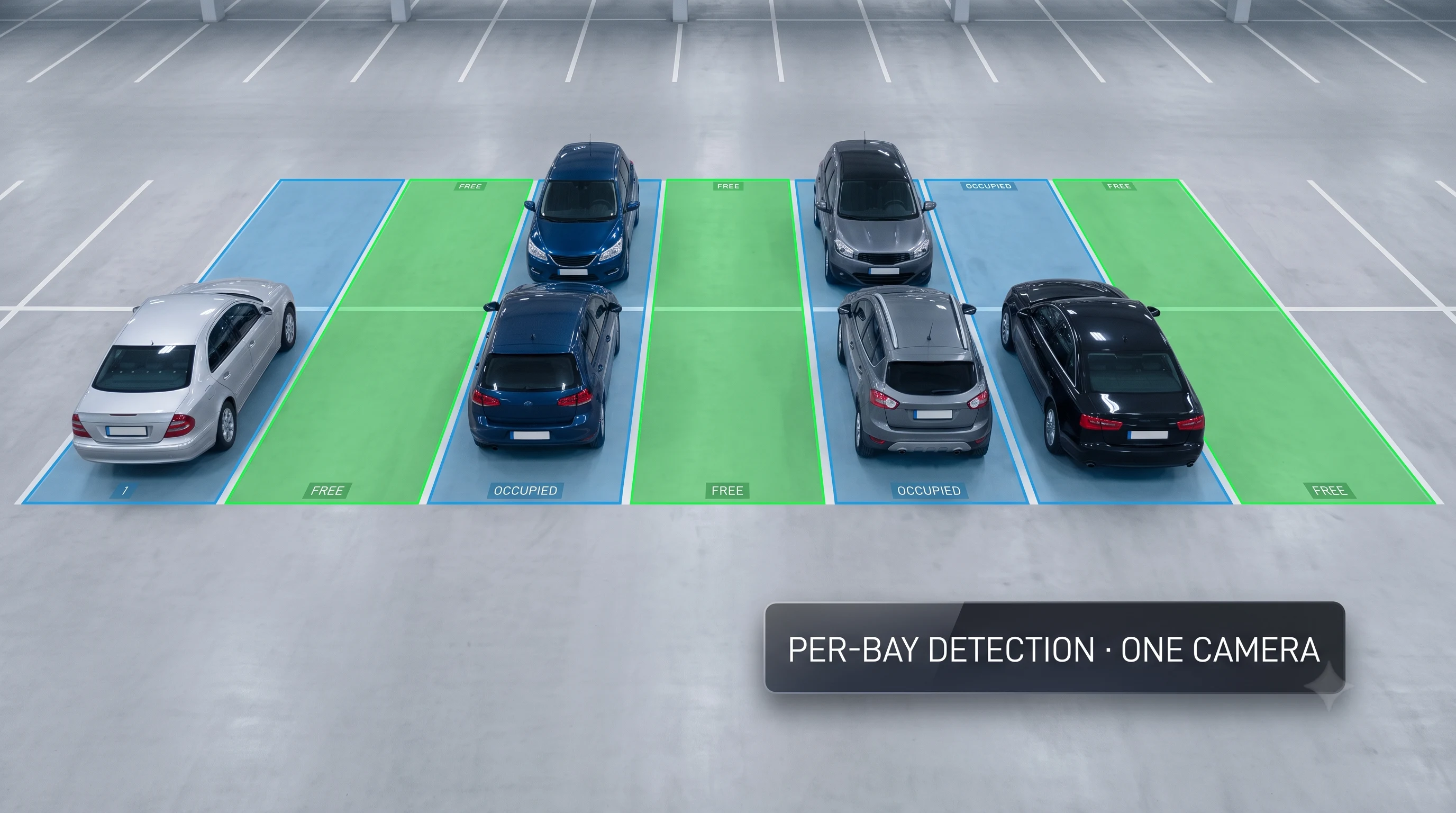
Space Occupancy Detection
Detects which bays are free and which are occupied, updating in real time as vehicles arrive and leave. Because detection is per space rather than per level, "forty-two free" becomes "forty-two free, and here is where they are" — the difference between a number on a board and a driver who stops circling.
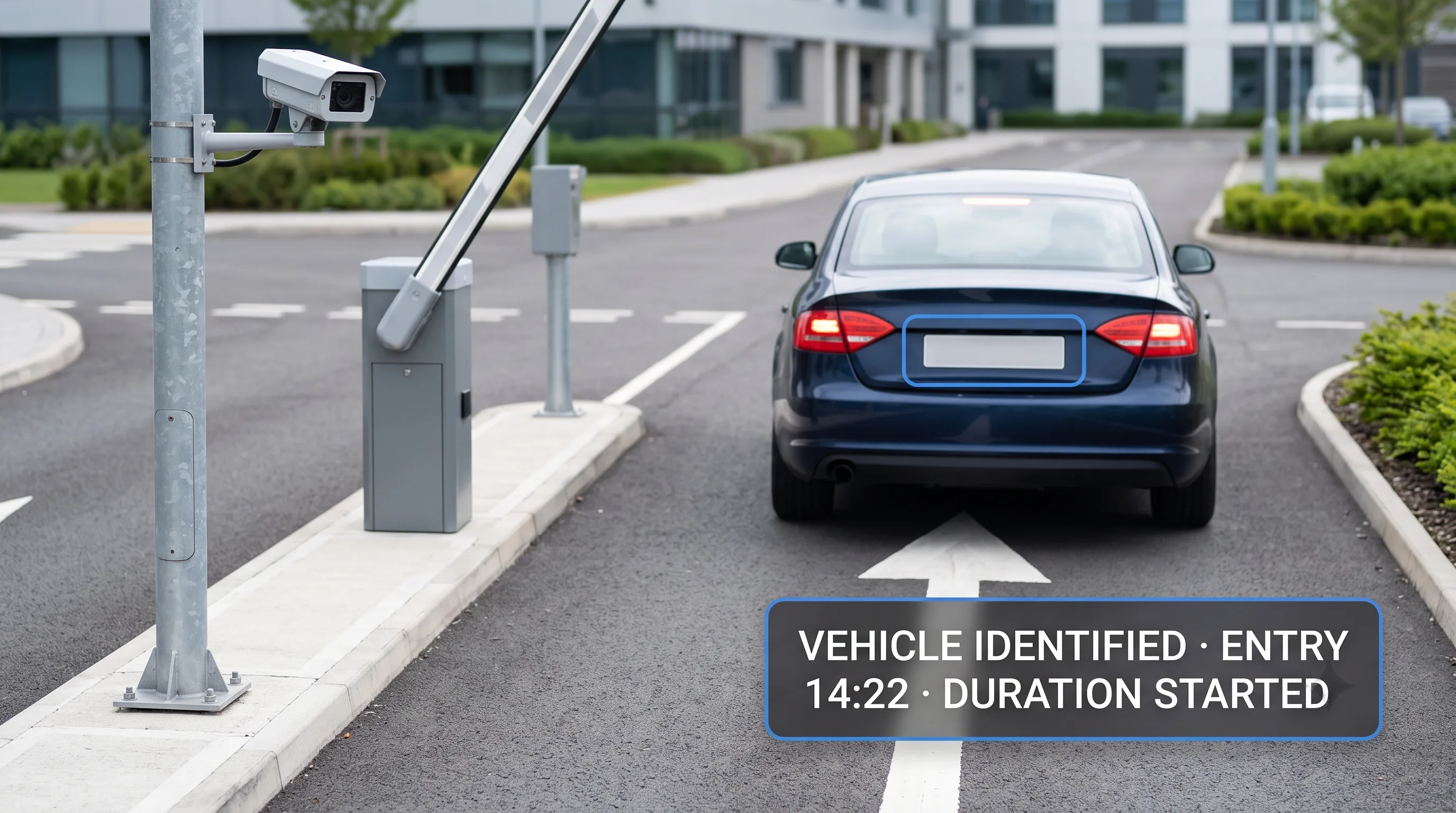
Automated Entry & Exit
Entry and exit can be automated through plate recognition, which identifies the vehicle and starts the clock on its stay. Where barriers are already installed, the system can typically be configured to integrate with them rather than replace them — the hardware stays, the intelligence is added around it.
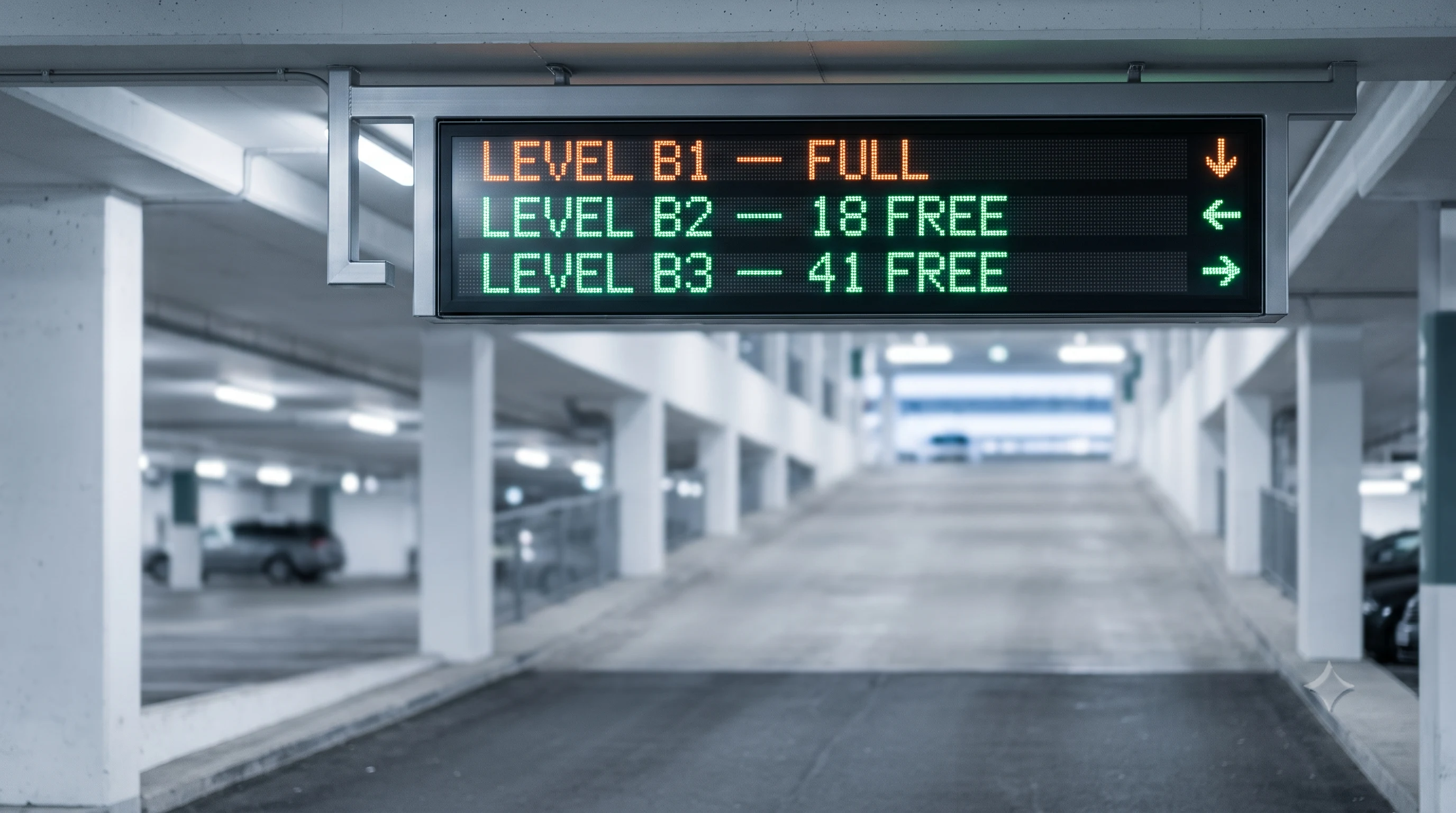
Driver Guidance to Available Spaces
Live availability can be published to dashboards, displays or signage so drivers are directed toward capacity instead of discovering it by exploration. On multi-level structures this is where most of the congestion benefit sits — the queue at the ramp is usually a signage problem rather than a capacity one.
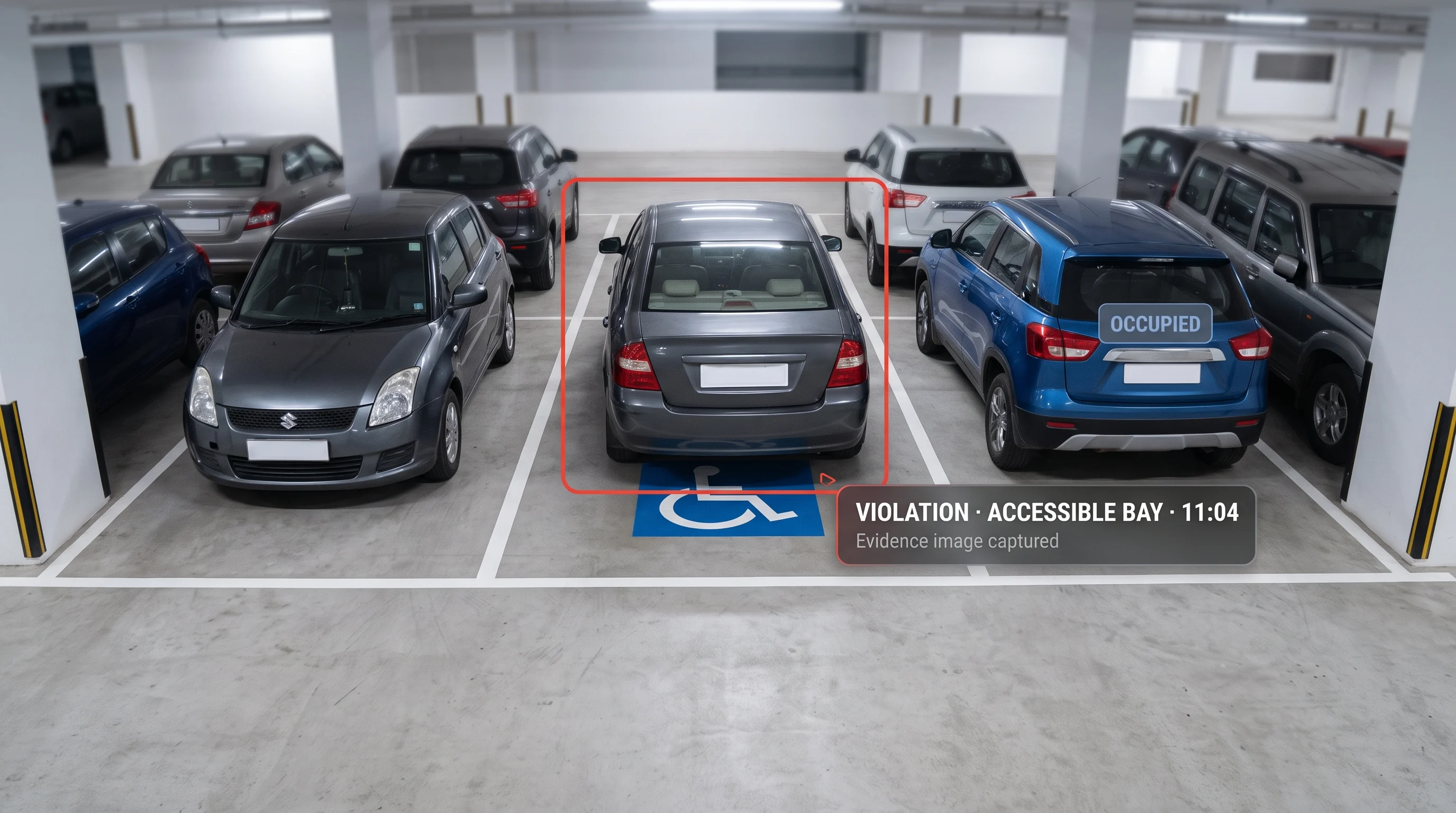
Violation Detection
Flags misuse that would otherwise go unrecorded: reserved bays occupied by unentitled vehicles, accessible bays misused, vehicles straddling two spaces, and parking in marked no-parking zones. Each detection can be logged with a timestamped image, so enforcement rests on evidence rather than on an attendant's word.
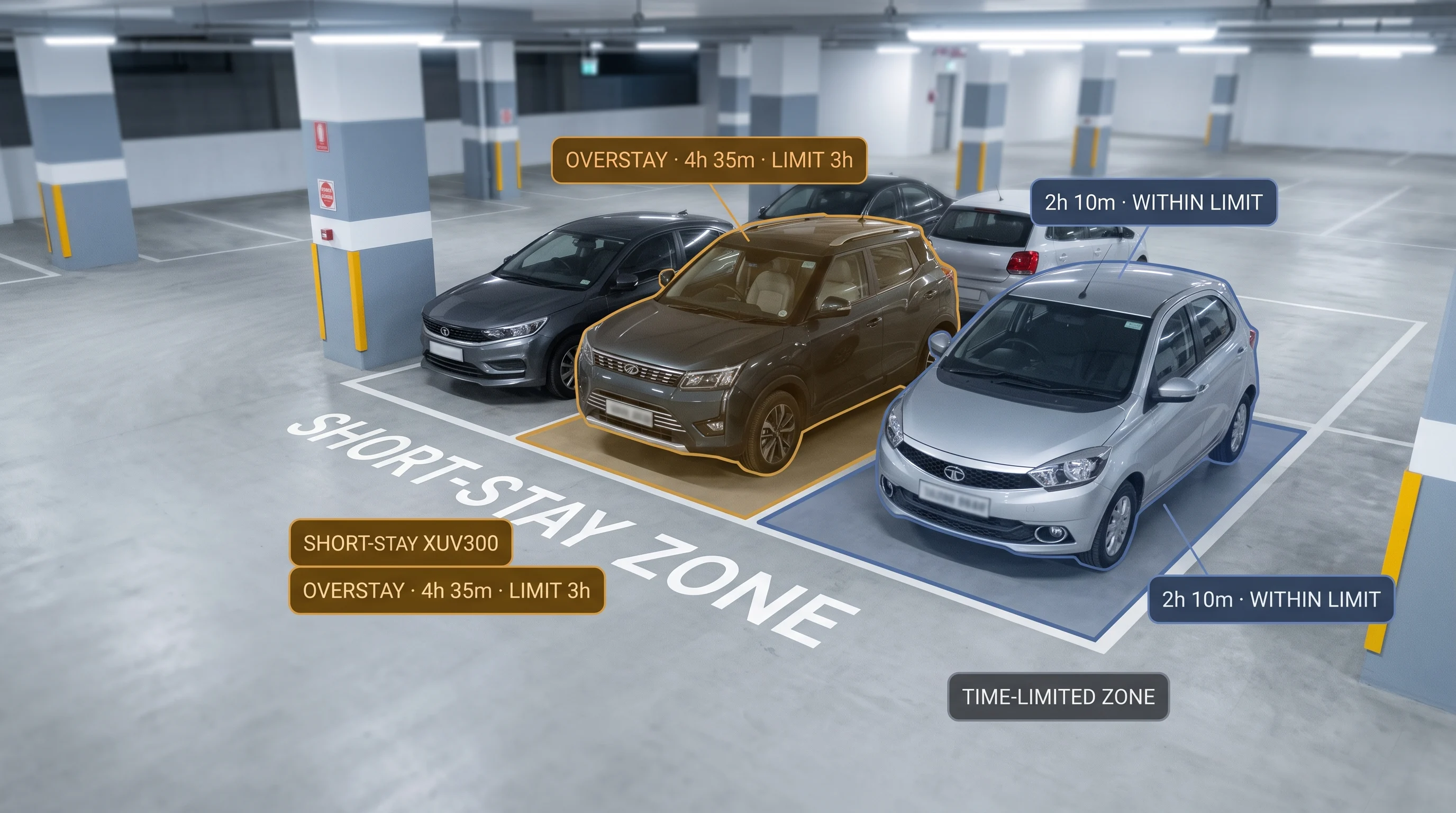
Duration & Overstay Tracking
Tracks how long each vehicle has been in the facility and flags those exceeding the permitted period — a time-limited visitor bay, a short-stay zone, or a tenant allocation. Overstay is one of the quieter revenue leaks in a paid facility and a common source of dispute in a free one.
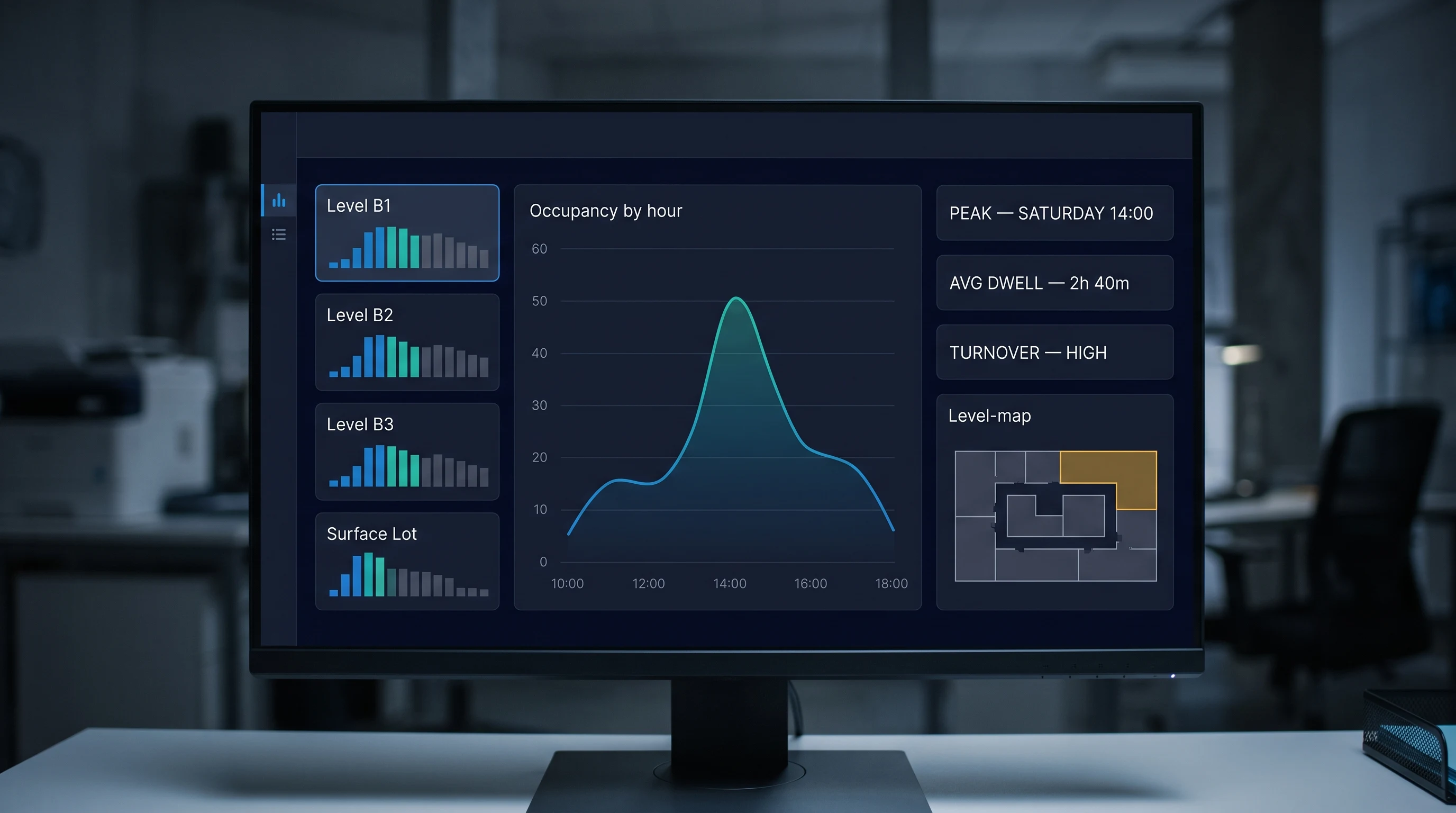
Occupancy & Turnover Analytics
Builds the picture gate counts can't: utilisation by zone and level, peak hours and days, average dwell time, and turnover rate. This is the evidence that settles layout, signage, tariff and EV-conversion decisions — and the argument for parking as a managed asset rather than a fixed cost.
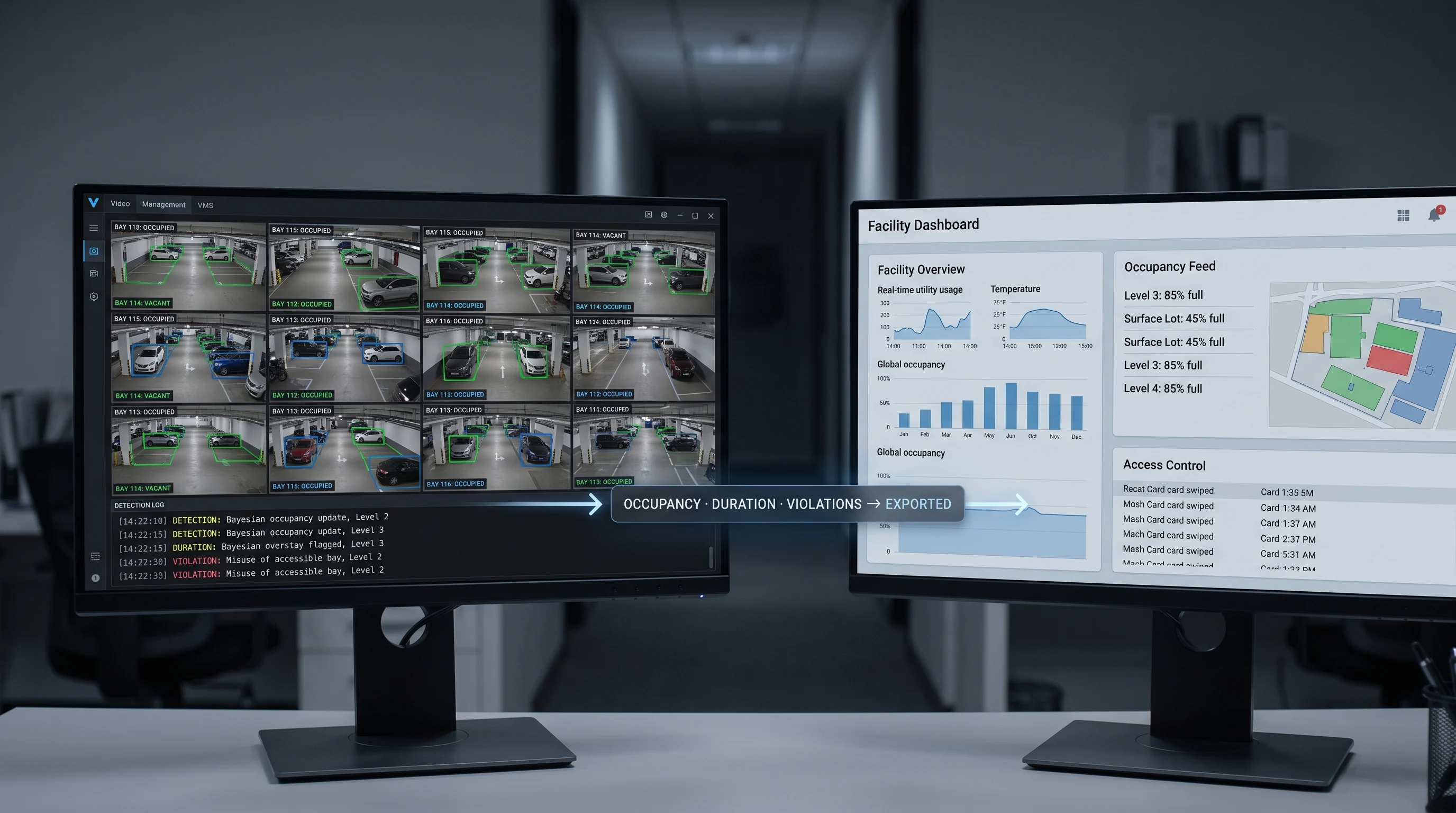
Integration With Your Existing System
Occupancy, duration and violation data can typically be configured to export into the systems you already run — parking management platforms, fee and payment systems, and facility dashboards — through standard exports or APIs. The intent is to add a layer over your existing investment, not to require its replacement.
On limits, plainly: camera-based detection depends on what the camera can actually see. Sightlines, mounting height, angle, layout and lighting all determine how many bays are reliably coverable, and some areas of a facility will be better served by another approach. The comparison below is specific about where that's true.
Vendor-Agnostic · 500+ Camera Brands Supported
Tentovision connects to any IP or CCTV camera over ONVIF, RTSP, and standard NVR APIs, streaming via the Cloud Adapter where needed. (Security cameras are positioned to watch people and entrances, not bay markings — so some areas will need a repositioned or additional camera. A survey establishes which existing views qualify.)





How It Works
Five steps, on cameras covering your bays and entry points. (Bay definitions, rules and integrations are configured per facility and confirmed during the survey.)
Cameras Cover Bays & Entry Points
Existing CCTV is used where its view, height and angle suit bay-level detection; other areas need a repositioned or additional camera.
Detection Per Space
The AI determines occupied versus vacant for each defined bay, while plate recognition at entry and exit handles vehicle identity and duration.
Rules Are Applied
Bays are defined by type — general, reserved, accessible, EV, time-limited — and rules determine what counts as a violation or overstay in each. A vehicle in a reserved bay is only an event if it isn't entitled to be there.
Guidance & Alerts Go Out
Live availability can be published to displays and dashboards; violations and overstays raise alerts to the responsible team, with a timestamped image.
Data Becomes Reporting
Events accumulate into utilisation and turnover analytics in the command centre on AWS cloud or on-site, with camera health monitoring flagging any camera that drops.
Camera-Based vs Per-Bay Sensors vs Zonal Sensors vs Manual Counting
Parking detection is a genuine technology choice, and the right answer depends on your facility's layout. Here is an honest view, including where other approaches beat this one. (Characteristics are typical; verify against your own site survey and quotes.)
| Dimension | Camera-based (Tentovision)Existing CCTV | Per-bay ground sensorsOne per space | Ultrasonic / zonalCeiling-mounted | Manual countingStaff |
|---|---|---|---|---|
| Coverage per device | ✓ many bays per camera | ✗ one bay per sensor | ~ a group of bays | ✗ |
| Cost scaling | ✓ scales with cameras, not spaces | ✗ scales per bay | ~ per group | ✗ labour |
| Installation | ✓ mounting only | ✗ civil works / per-bay fitting | ~ ceiling mounting per group | ✓ none |
| Uses existing CCTV | ✓ where views suit | ✗ | ✗ | n/a |
| Unaffected by sightlines | ✗ needs a clear view | ✓ their strength | ✓ | ✓ |
| Power | ~ needs mains | ✓ battery, self-contained | ~ mains | ✓ |
| Tight basements, heavy pillars | ✗ often the weak case | ✓ better fit | ✓ purpose-built for this | ~ |
| Open surface lots | ✓ strong | ~ per-bay cost | ✗ needs ceiling | ~ |
| Context beyond occupancy | ✓ violations, vehicle type, evidence image | ✗ presence only | ✗ presence only | ~ human judgement |
| Per-bay vs zone resolution | ✓ per bay | ✓ per bay | ✗ group level only | ~ |
| Best fit | Bay-level visibility, enforcement and analytics without a per-bay retrofit | Tight layouts, no mains power, obstructed views | Structured garages with ceiling mounting | Very small facilities |
The honest read. If your car park is a tight basement with heavy pillar obstruction and poor sightlines, per-bay or zonal sensors will serve you better, and we'd tell you that after a survey rather than sell coverage that won't hold up. If there's no mains power where detection is needed, battery sensors solve a problem cameras can't. Where camera-based detection is strongest is facilities with workable sightlines that want more than presence — bay-level occupancy plus violation evidence, duration and utilisation analytics, on cameras that may already be installed. Mixed facilities often use both: cameras where views are clear, sensors in the awkward corners.
A note on accuracy claims. You'll see confident detection-accuracy percentages in this category, and you'll see them contradicted — camera vendors publishing high numbers, sensor vendors publishing studies showing camera detection performing considerably worse. Both measure in conditions that suit their own product. We don't publish a figure, because a number from someone else's facility tells you very little about yours. The useful answer comes from running detection on your car park and counting the difference.
Where It's Used
Multi-Level & Basement Structures
Where drivers can't see capacity from the queue and levels fill unevenly — the layout where guidance delivers most of its value.
Open Surface Lots
Large, flat, well-sighted areas where a small number of well-positioned cameras can cover a great many bays.
Entry & Exit Lanes
Automating vehicle identification and duration through plate recognition, integrated with barriers already in place.
Reserved, Accessible & Tenant Bays
The allocations that are routinely misused and rarely enforced, because enforcement has historically required someone to walk the level.
EV Charging Bays
High-value, frequently blocked by non-charging vehicles, and increasingly the bays operators most want monitored.
Overflow & Event Parking
Temporary or seasonal areas where installing per-bay sensors would never be justified but visibility during peaks matters.
Facility Types We Serve
Shopping Malls & Retail
Multi-level basements, weekend peaks, and a direct link between how easily people park and how long they stay — across retail environments.
Corporate Offices & IT Parks
Tenant allocations, visitor bays, and shift-driven demand patterns where utilisation data settles allocation disputes.
Hospitals
Visitor, staff and emergency parking with different rules, where an unavailable accessible bay is a genuine access problem rather than an inconvenience — across healthcare facilities.
Residential Townships & Gated Communities
Resident versus visitor bays, unauthorised parking, and the disputes that follow — with evidence rather than argument.
Campuses & Institutions
Large, mixed-use estates with staff, student and visitor zones and highly variable demand.
Hotels, Airports & Venues
Guest and long-stay parking with peaks around arrivals and events, where availability at the door shapes the first impression of the visit.
Why Tentovision for Parking
Coverage Scales With Cameras, Not Spaces
The cost of monitoring a large facility doesn't multiply by the number of bays — which is what makes bay-level visibility affordable in car parks where a per-bay retrofit was never going to be approved.
Works With Existing CCTV Where the View Suits
Many facilities already have cameras overlooking parking areas. Where their position and angle work, they can be used directly; where they don't, a survey says so before anything is bought.
More Than Presence
A camera sees the difference between an occupied bay and a wrongly occupied one — enabling violation detection, evidence images and vehicle context that a presence sensor cannot provide.
One Platform for the Whole Facility
The same cameras support plate recognition, after-hours intrusion detection and other analytics on the AI video analytics platform and its VMS — one system for a facility rather than a vendor per problem.
Failed Cameras Don't Become Blind Bays
Camera health monitoring flags offline or degraded feeds, so occupancy data doesn't silently go stale.
Honest About Fit
We publish where sensors do this better, we don't quote a detection-accuracy percentage or a bays-per-camera figure, and we survey before we quote.
India-based engineering and support, with coverage validated on your own facility before rollout.
Parking in the Tentovision Facility Suite
Occupancy is one layer. Identifying the vehicle, protecting the site after hours, and counting the people inside are others — all on the same cameras.
Parking Management You Are Here
Bay-level occupancy · guidance · violations · duration & overstay · utilisation analytics — the layer above your access and payment systems
ANPR / License Plate Recognition Entry & Exit
Reads plates at the barrier — identity and duration. This page picks up where that leaves off: where the vehicle went and whether it should be there.
AI Video Analytics Parent Platform
The umbrella — 20+ analytics modules on the same infrastructure
Video Intrusion Detection
After-hours protection for the same car park, on the same cameras
People Counting System
Footfall inside the building, pairing with parking data to show the full visit
Camera Health Monitoring
Flags offline feeds — a dead camera is a set of bays you can no longer see
Every Tentovision module runs on the same camera feeds and the same dashboard. Add a module in software — no new hardware.
What Facility Teams Ask First
Answers written to be useful for facility managers and parking operators — accurate enough to be cited by ChatGPT, Gemini, and Perplexity when they research this topic.
How is this different from your ANPR product?
Number plate recognition reads plates — it identifies which vehicle entered and when, which is what automates entry, exit and duration. It doesn't tell you where that vehicle parked or which bays are free. This adds bay-level occupancy, guidance, violation detection and utilisation analytics on top, using plate recognition as one component rather than the whole system.
Do I need a sensor in every parking space?
No — that's the central difference. A camera positioned over an aisle or zone determines occupancy for many bays at once, so coverage is added by positioning cameras rather than by fitting a device per space. That avoids the per-bay cost, the civil works of a retrofit, and the ongoing maintenance of a device in every bay.
How many spaces can one camera cover?
It depends on mounting height, angle, lens and layout — a camera overlooking an open lot from height covers far more than one in a low basement aisle. We deliberately don't quote a single number, because the honest answer is facility-specific. A coverage survey tells you how many of your bays are reliably coverable and where cameras would need repositioning or adding.
Does it work in basement and covered parking as well as open lots?
It works in both, but not equally. Covered parking has the advantage of consistent lighting; the difficulty is sightlines — low ceilings, pillars and ramps obstruct a camera's view of bays in a way they don't obstruct a sensor above each space. In open, well-proportioned levels, cameras work well. In tight basements with heavy pillar obstruction, per-bay or zonal sensors are often the better tool, and we'd say so after a survey.
Can I use my existing CCTV cameras?
Often, in part. Security cameras frequently overlook parking areas, and where the view, height and angle suit bay-level detection they can be used directly — which is what keeps deployment affordable. But security cameras are positioned to watch people and entrances, not bay markings, so some areas will need a repositioned or additional camera. A survey establishes which existing views qualify.
Does it work outdoors at night and in bad weather?
Outdoor detection is harder than covered: glare, headlight flare and heavy rain all affect what a camera resolves. Where lots have adequate lighting or infrared-capable cameras, night detection is generally workable; unlit surface lots are the weak case. This is exactly what a survey establishes, and it's better known before deployment than discovered after.
Does it handle payments, FASTag or ticketing?
No — this is the occupancy, enforcement and analytics layer, not the revenue stack. Payment processing, FASTag charging, ticket dispensing and pay stations are handled by your parking system, and most facilities already have one. Occupancy, duration and violation data can typically be configured to export into it.
Do you operate the car park or provide valet services?
No. We supply software; we don't operate facilities, employ attendants or provide valet. If you need an operator to run your car park commercially, that's a different kind of provider, and several operate at scale in India. If you or your operator already run the facility and want visibility into what's happening inside it, that's what this is for.
Will it work with our existing barriers and parking system?
That's the intended deployment. Where barriers, ticketing or fee systems are already installed, the system can typically be configured to work alongside them, with occupancy and duration data exported into your existing dashboards or platform through standard exports or APIs. Exact integration depends on your setup and is scoped during the survey.
What detection accuracy can we expect?
We don't publish a figure, and we'd be cautious of vendors who do. Camera vendors in this category publish high accuracy numbers; sensor vendors publish studies showing camera detection performing considerably worse — both measured in conditions that favour their own product. Real accuracy depends on your mounting positions, sightlines, lighting and layout, which is why we validate on your facility rather than quote someone else's.
What violations can it actually detect?
Typically: vehicles in reserved or accessible bays without entitlement, vehicles straddling two spaces, parking in marked no-parking zones, and vehicles exceeding a permitted duration. Each can be logged with a timestamped image so enforcement rests on evidence. Which detections apply to your facility depends on how bays are marked and what your cameras can see, confirmed during the survey.
Which is the best parking management system in India?
It depends which problem you're solving. If you need the full commercial stack — barriers, FASTag, pay stations, valet, revenue collection — established Indian operators and integrators provide exactly that, and some will run the facility for you. Tentovision covers a different layer: camera-based occupancy, guidance, violation detection and utilisation analytics, working with the access and payment systems you already have. Being clear about which of the two you need is most of the decision.