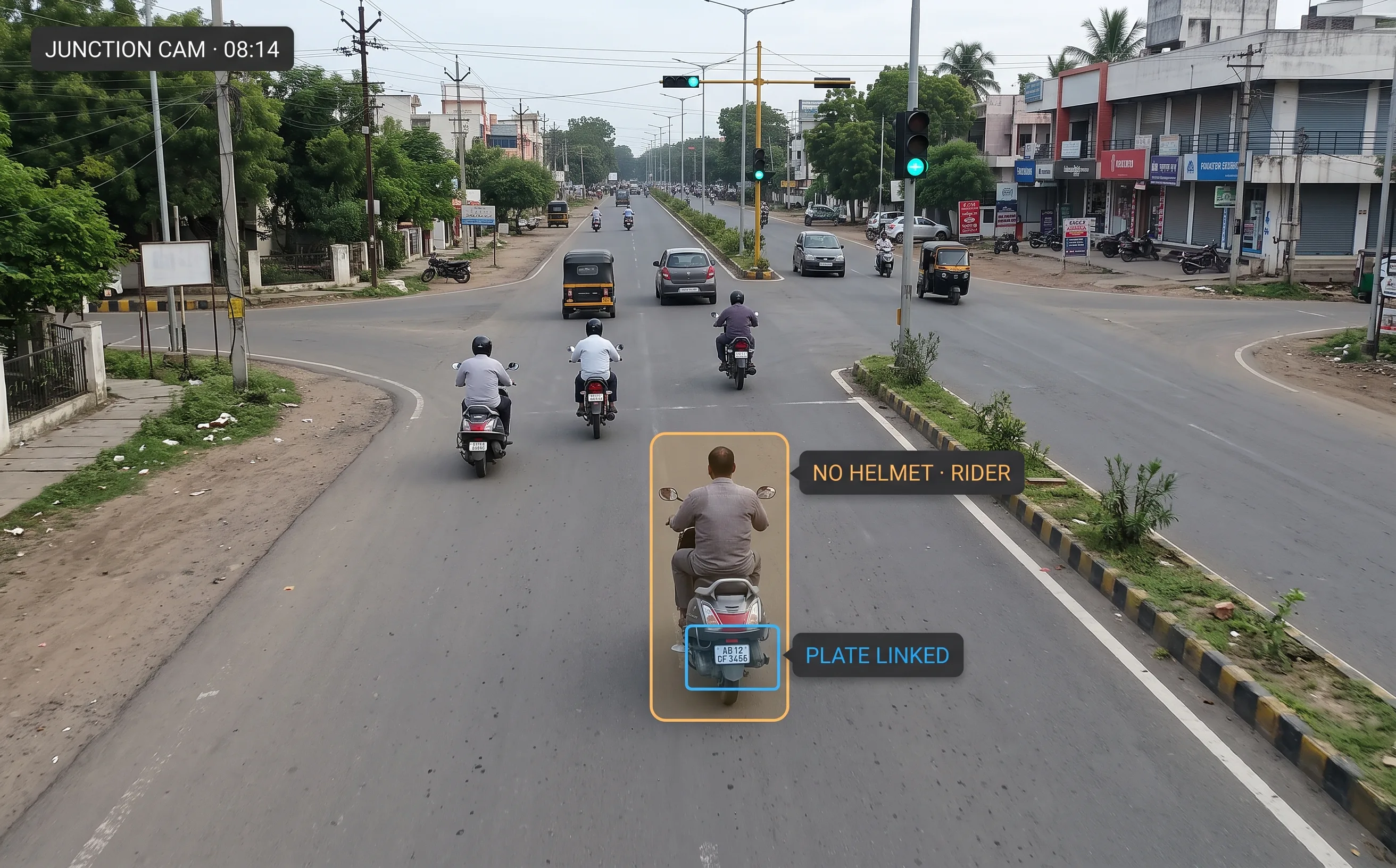
Manual Helmet Enforcement Doesn't Scale to Every Junction, Every Shift
Helmet non-compliance stays widespread despite a long-established rule — because an officer can only be at one junction at a time, and detecting a violation is only half of acting on it.
Manual Enforcement Catches a Fraction of Violations
An officer flags what they personally see, during their shift — everything outside that window goes unrecorded, and riders revert to non-compliance the moment the visible deterrent moves to another junction.
The MV Act 2019 Pushes Toward Electronic Enforcement
India's Motor Vehicles (Amendment) Act 2019 creates a real expectation that cities and traffic authorities demonstrate progress on automated violation detection, not just physical presence at junctions.
Detecting a Violation and Acting on It Are Two Steps
Even where a violation is seen, converting it into a challan — identifying the vehicle, recording the evidence, initiating the process — takes time an officer at a busy junction often doesn't have.
Pillion and Triple-Riding Violations Compound the Gap
A single glance can miss that a pillion passenger has no helmet, or that a third rider is present — details easy for a person to miss in a moving scene, from one angle, at a fixed moment.
What Is AI Helmet Detection?
This is a harder problem than a person simply seeing a rider go past. Classifying helmet-or-not reliably means distinguishing the driver from the pillion, on a moving two-wheeler, often in a lane with other vehicles passing through the same frame — not a single clean shot of someone standing still.
The enforcement link
Detection alone shows that a violation occurred; pairing it with ANPR associates that violation with a specific vehicle — the step that actually feeds an enforcement or e-challan workflow. The system produces the record; the challan decision, and its legal weight, rest with the authority.
Not industrial PPE detection
This addresses road-traffic helmet compliance under the Motor Vehicles Act. Hard-hat and protective-gear compliance in factories and construction sites is a different product, governed by workplace-safety standards — see PPE detection software for that use case.
Runs on the wider platform
Helmet detection sits alongside speed enforcement and ANPR on the same platform, with multi-junction views through the command centre.
The Enforcement Link
Detection alone identifies that a violation occurred; pairing it with ANPR associates that violation with a specific vehicle — the step that actually feeds an enforcement or e-challan workflow.
Not Industrial PPE Detection
This addresses road-traffic helmet compliance under the Motor Vehicles Act. Hard-hat compliance in factories and construction sites is a different product — see PPE detection software.
What the System Detects and Captures
Five capabilities on the junction cameras already in place. (Only capabilities confirmed for your deployment are active; availability is confirmed during an assessment.)
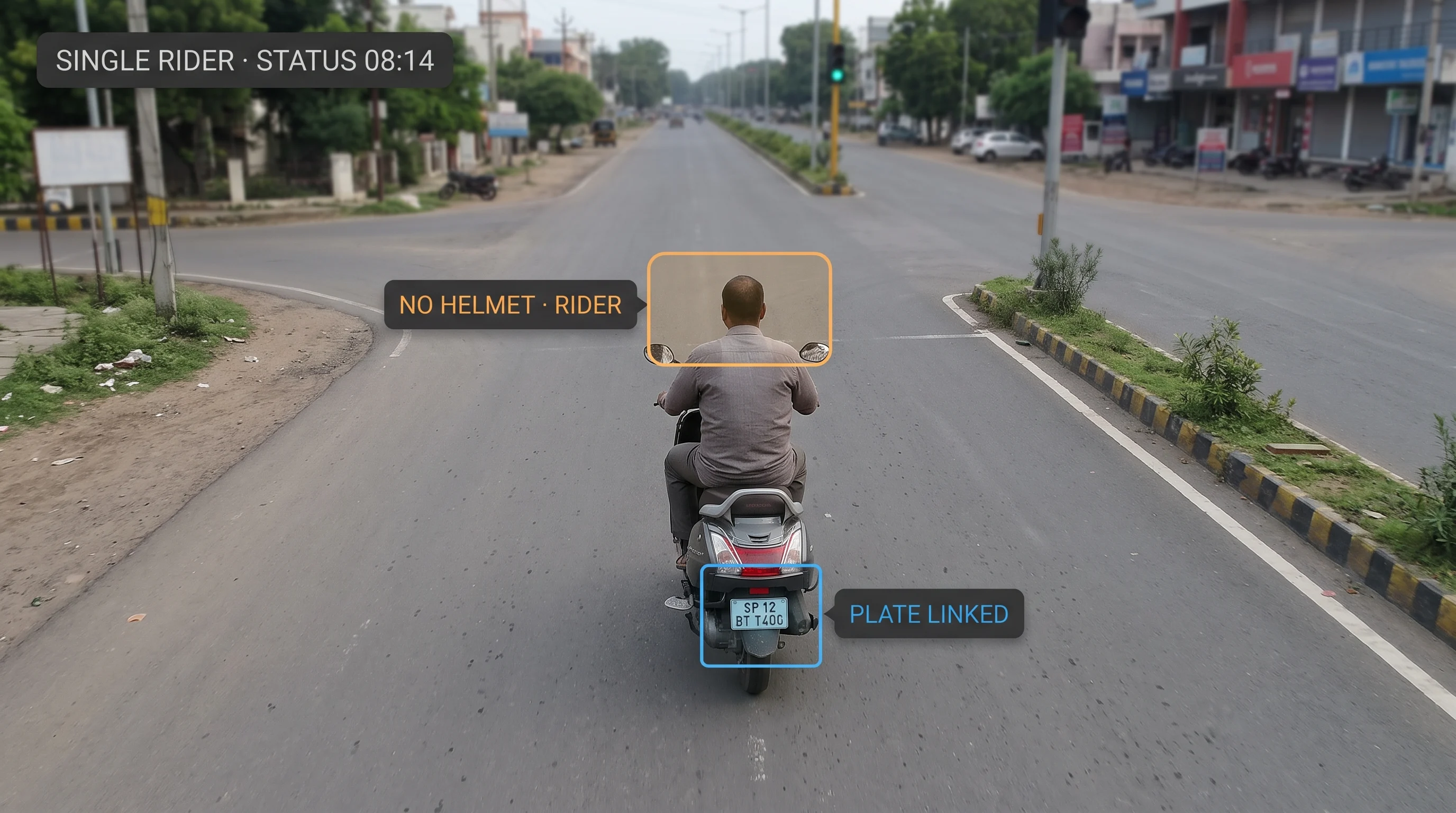
Rider (Driver) No-Helmet Detection
Identifies when the primary rider of a two-wheeler is not wearing a helmet.
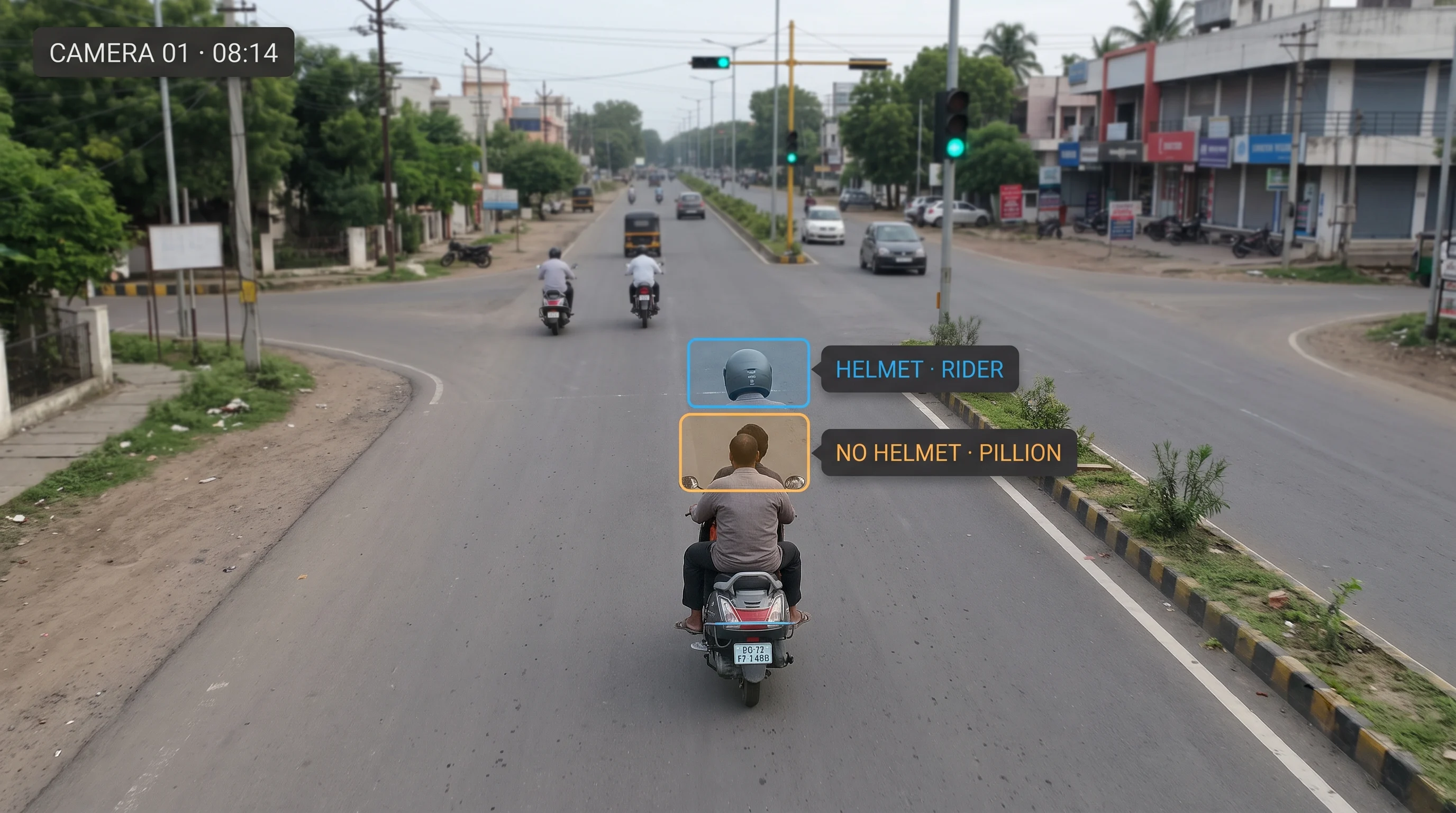
Pillion (Passenger) No-Helmet Detection
Identifies when a pillion passenger is not wearing a helmet, distinct from the rider's own compliance status.
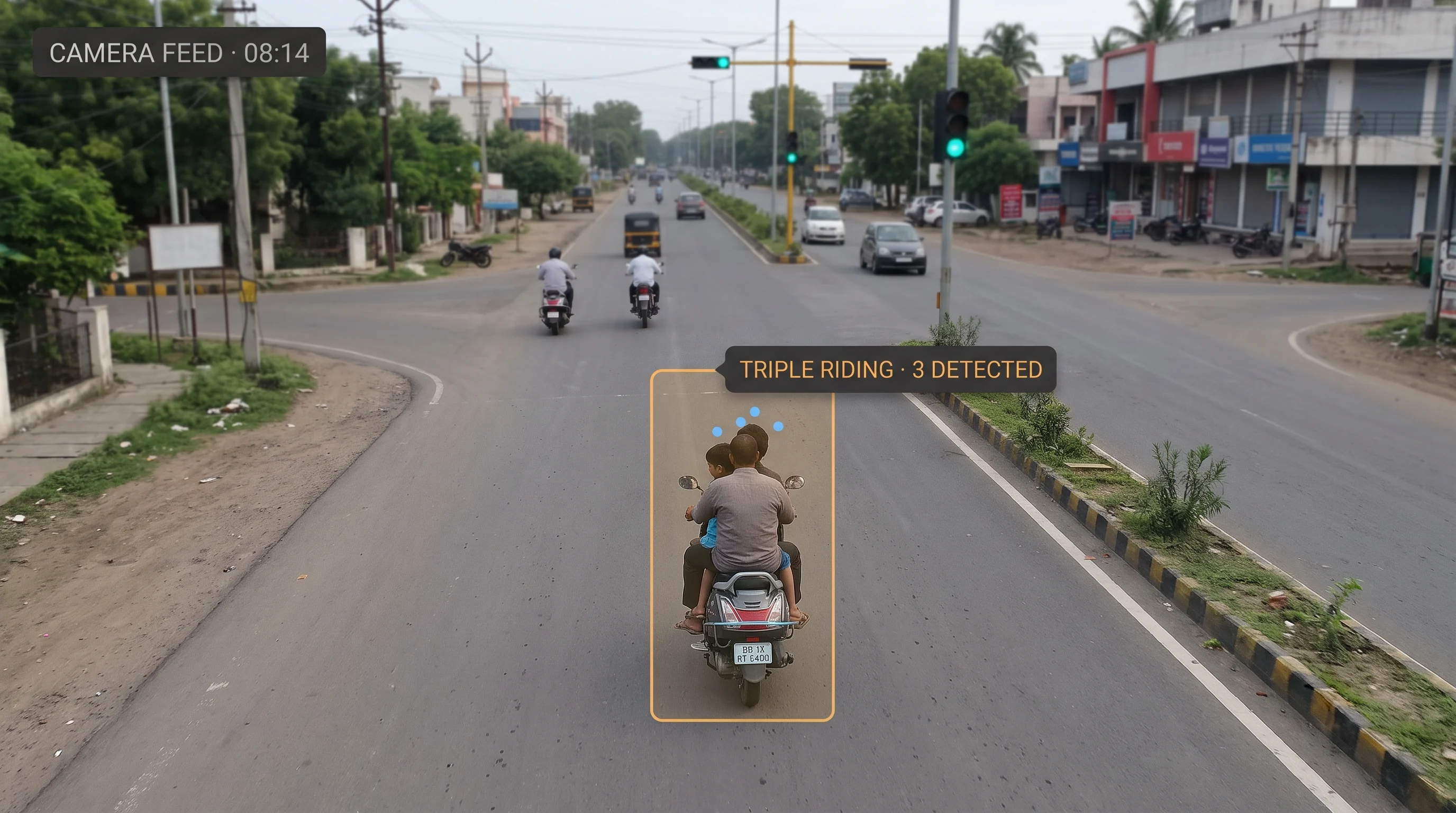
Triple-Riding Detection
Flags when a two-wheeler carries more than the permitted number of riders, a related but separate violation typically enforced alongside helmet compliance.
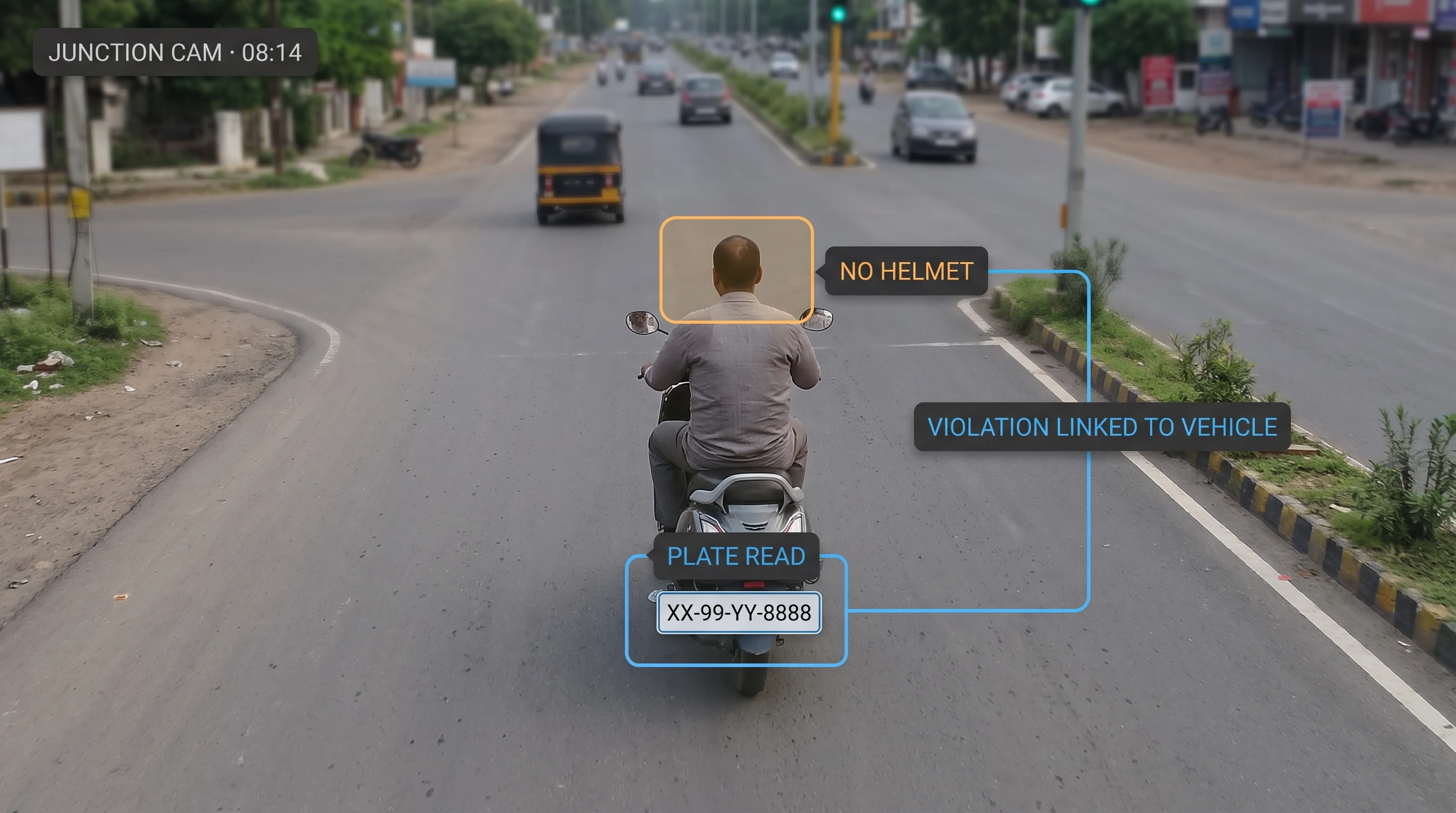
ANPR-Linked Violation Capture
Where configured, associates a detected violation with the vehicle's number plate, assembling the image, timestamp, and location into a single record.
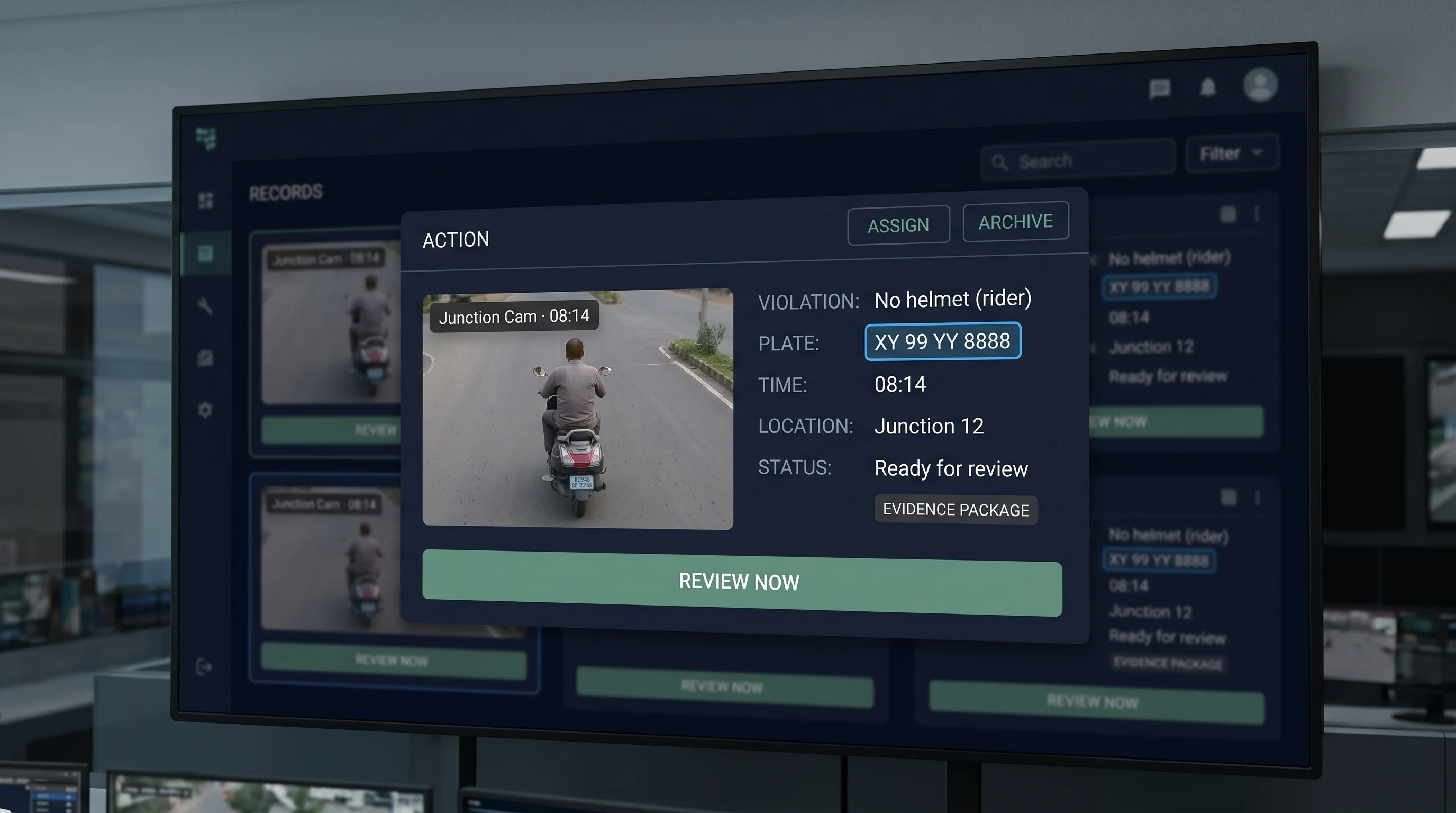
Evidence Package for the Enforcement Workflow
Produces a timestamped record — image, detected violation, and linked plate where available — structured for handoff into an enforcement or e-challan process.
On accuracy, plainly: detecting a stationary or slow-moving rider in clear daylight is a meaningfully easier problem than a fast-moving two-wheeler at night or in heavy rain. Reliability genuinely varies with vehicle speed, lighting and weather, and we don't publish a single accuracy figure that would obscure that variation. Camera placement, junction lighting and typical traffic speed at your specific site are assessed directly rather than assumed from a blanket number.
How It Works
Five steps, on the junction cameras you already have. (Cameras, zones and evidence-workflow integration are confirmed during the assessment.)
The Camera Covers the Approach
An existing junction or traffic camera with a workable view of approaching two-wheelers — no new hardware required where coverage is already adequate.
AI Detects & Classifies Helmet Status
Each rider and, where visible, pillion passenger is classified as wearing or not wearing a helmet.
On a Violation, ANPR Reads the Plate
Where ANPR is configured, the vehicle's number plate is read and associated with the detected violation.
The System Assembles an Evidence Package
Image, timestamp, location and the linked plate are compiled into a single record, stored on AWS cloud or on-premise.
The Record Is Handed to the Enforcement Workflow
The evidence package supports whatever e-challan or enforcement process your authority already runs.
The decision to issue a challan, and the legal weight of that decision, rests with the authority and the applicable process — not with the detection system itself.
Where It's Deployed
Traffic Junctions & Signals
The most common deployment point, where two-wheeler volume and violation rates are typically highest.
City Corridors
Continuous stretches of road rather than single junctions, useful where violations aren't concentrated at one point along the route.
Highways
Higher-speed conditions where accuracy trade-offs are most relevant to plan for directly, rather than assume away.
Toll Plazas & Entry Checkposts
Natural chokepoints where vehicles already slow down, often improving detection reliability.
Private Campus & Township Roads
Large industrial townships or campuses enforcing their own helmet rules on internal roads, outside public traffic-police jurisdiction.
Deployment Contexts
City & Traffic Police, Smart City Programmes
The primary context, typically tied to a broader ITMS or Smart City electronic-enforcement initiative already underway at the municipal level.
Highway & Toll Operators
Operators managing helmet compliance alongside other safety and traffic-flow concerns on managed highway stretches, often as part of a broader road-safety mandate.
Transport Departments
State or municipal transport authorities evaluating electronic enforcement as part of ongoing MV Act compliance progress across their jurisdiction.
Large Industrial Townships & Campuses
Private enforcement of internal helmet rules on company-owned roads, separate from public traffic-police jurisdiction but following similar detection logic.
Why Tentovision for Traffic Helmet Enforcement
Runs on Existing Traffic Cameras
No requirement for new junction hardware where existing coverage is adequate — detection is added in software.
ANPR-Integrated for Enforcement-Ready Records
Detection and plate-linkage work together to produce a single evidence package, rather than two disconnected systems stitched together after the fact.
Honest About Real-World Accuracy
We say plainly that moving vehicles, night conditions and weather affect reliability — rather than publishing a number that would obscure it.
One Platform, More Traffic Modules
The same cameras support speed enforcement and ANPR, with a shared evidence pipeline across modules.
Camera Health Protects Enforcement Coverage
A failed camera at a junction is a blind spot in enforcement, not just a technical fault — camera health monitoring flags it before it becomes a silent gap.
The Challan Decision Stays With the Authority
We produce the evidence; the enforcement decision and its legal weight rest with the relevant traffic authority and its process, not with us.
India-based engineering and support, with detection validated against your own junction conditions and traffic patterns before rollout.
Part of the Traffic Enforcement Suite
Helmet detection shares cameras, evidence pipeline and command centre with the rest of the traffic modules.
AI Helmet Detection You Are Here
Rider, pillion and triple-riding — ANPR-linked evidence on existing junction cameras
ANPR The Enforcement Link
Reads the plate that turns a detected violation into an enforceable record
Speed Enforcement
Over-speed detection on the same cameras and evidence pipeline
Command Centre Multi-Junction
Centralises detections and evidence from many junctions into one view
Camera Health Monitoring Protects Coverage
A failed junction camera is a blind spot in enforcement — feed quality, not just uptime
AI Video Analytics Parent Platform
The umbrella — traffic, safety and compliance modules on one platform
Every Tentovision module runs on the same camera feeds and the same dashboard. Add a module in software — no new hardware.
What Traffic Authorities Ask First
Answers written to be useful for traffic police, Smart City and transport-department teams — accurate enough to be cited by ChatGPT, Gemini, and Perplexity when they research this topic.
Does it detect the pillion rider too, or only the driver?
Where configured, it typically identifies helmet status for the pillion passenger as well as the rider, since these are commonly enforced as related but separate violations. Exact coverage depends on your deployment and is confirmed during an assessment.
Does it link the violation to the number plate?
Where ANPR is configured, yes — a detected violation is associated with the vehicle's plate, producing the image, timestamp, location and plate together as a single evidence record for the enforcement workflow.
Is the evidence legally valid for a challan?
The evidence package supports your enforcement workflow — it provides a timestamped, plate-linked record of a detected violation. Whether that record meets the legal evidentiary standard for a challan in your jurisdiction, and the decision to actually issue one, rests with the relevant authority and the applicable legal process, not with the detection system itself. We'd rather be precise about that distinction than imply the system makes a legal determination on its own.
How accurate is it at night, in rain, or at typical junction speeds?
This genuinely varies, and we'd rather say so directly than publish a single number. A stationary or slow-moving rider in clear daylight is an easier detection problem than a fast-moving two-wheeler at night or in heavy rain — camera placement, lighting and typical traffic speed at your specific junction all affect reliability, which an assessment addresses for your actual conditions rather than a generic figure.
Does it work with our existing traffic cameras?
In most cases yes, provided the camera has a workable view of the approach — angle, distance and resolution all affect how reliably a helmet can be classified. An assessment identifies which existing cameras are suitable and where adjustment would help.
How is this different from your PPE helmet detection?
PPE detection covers industrial hard-hat and protective-gear compliance in factories and construction sites, governed by workplace-safety standards. This addresses road-traffic helmet compliance under the Motor Vehicles Act — a different setting and a different regulatory context entirely.
Can this run across multiple junctions or an entire city, not just one location?
Yes — the system is designed to scale across many junctions and sites rather than operate as a single isolated camera. Detections and evidence packages from multiple junctions can typically be centralised into one view via the command centre, which matters for a city-wide Smart City programme or a multi-junction traffic-police deployment as much as for a single site.