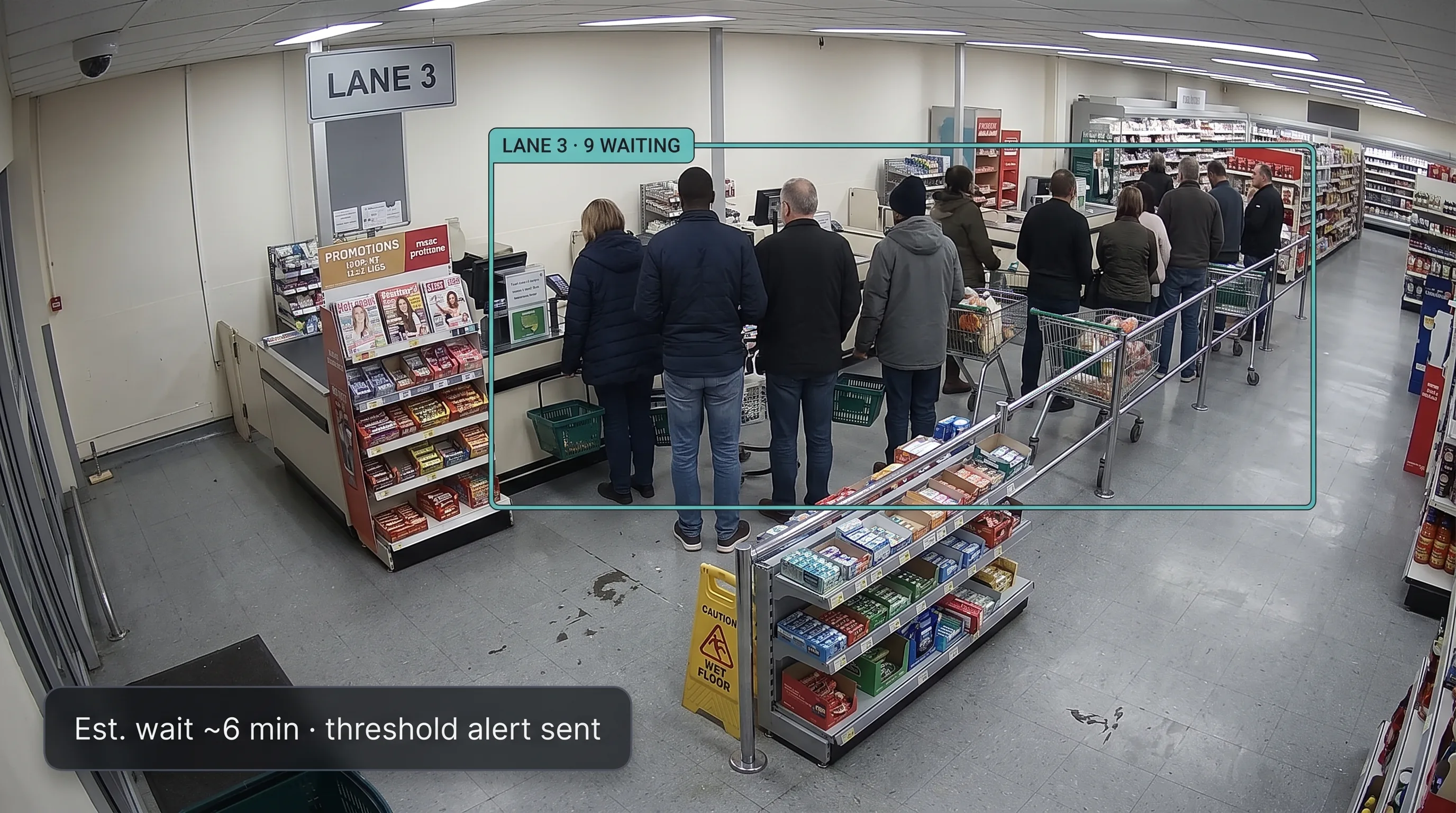
The Queue Builds While Nobody Is Watching It
By the time a long line is obvious, the damage is done — the customer who was going to leave has already decided to.
The Walkout Is Silent
A customer who joins a long line, waits, and gives up doesn't fill in a feedback form. They put the basket down and leave, and nothing records it. A customer who walks away doesn't file a complaint — they just don't come back, and the lost sale never appears in any report.
By the Time a Manager Notices, It's Late
Queues are managed reactively — someone sees the line, someone radios for another till. But a queue that's already visibly long has already cost you the impatient customers. The moment to act is when it's building, not when it's built.
Staffing Is Guesswork Without Queue Data
How many tills to open at 6 p.m. on a Friday is usually a matter of habit and instinct, because the data that would answer it — when queues actually form, and how long they last — isn't being collected. Rotas are built on footfall at best, and footfall isn't the queue.
The Numbers You Have Aren't the Queue
Sales-per-hour tells you what you sold, not what you nearly lost. A gate count tells you who came in, not who's stuck at the counter. The one metric that predicts a walkout — the length of the line, right now — is usually the one nobody is measuring.
What Is AI Queue Management?
Two numbers, and only one of them is measured. Queue length — the count of people waiting — is a direct visual observation, and it's reliable. Wait time is derived from it: queue length divided by the rate people are being served. A camera can see the line, but it can't see each person's transaction clock — so we present wait time as an estimate, never as a measured figure. Being straight about that distinction is the whole basis on which the rest should be believed.
Not a token or ticketing system
This is worth stating plainly because the term "queue management" is often used for token systems — the ones that issue a number and call you when it's your turn. Those organise service order. This measures the physical line: how long, how fast it's growing, when it peaks. They're complementary, and where you already run a token system, this measures the real-world queue alongside it. If organising who's served next is the need, that's a token system's job, not ours.
Anonymous by design
The system counts people in the queue area — it doesn't read faces, identify anyone, or follow a person between cameras. The output is a number, not an identity. That's both a deliberate privacy position and simply how the detection works.
Where it fits
It runs on the Tentovision AI Video Analytics platform and its video management software, hosted on AWS with on-site options, sharing cameras with people counting and retail video analytics.
Why we're careful about the word "wait." A token system timestamps every ticket, so it knows exactly how long each person waited — that's a measured number, and for wait time specifically it will beat a camera. What a camera gives you instead is the live length of the physical line, on cameras you already have, with no ticket to issue. We estimate wait from that, honestly labelled as an estimate. The comparison below is explicit about which tool wins on which metric.
What the System Measures, Flags and Reports
Five capabilities running on cameras that view your queue areas. (Every capability is configured per site; coverage and thresholds are confirmed during a short assessment.)
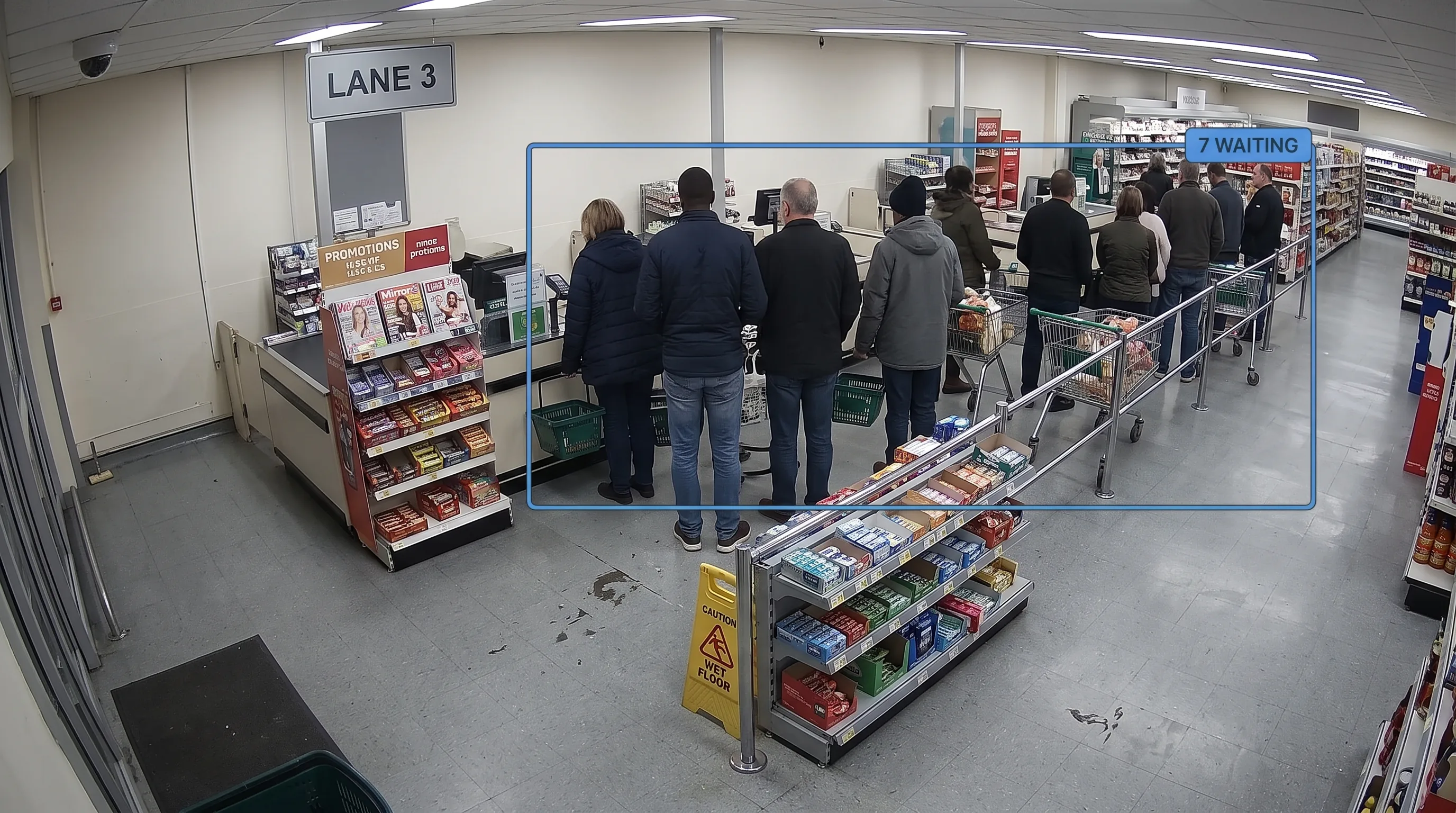
Real-Time Queue Length Detection
The core measurement, and the reliable one. A direct count of how many people are waiting in a defined queue area, updating live as the line grows and shrinks. This is a visual observation rather than an inference — the camera sees the line and counts it — which is why it's the number everything else builds on.
Derived Wait-Time Estimation
Estimates how long a person joining now is likely to wait, from queue length and the observed rate of service. Presented as an estimate, deliberately — a camera sees the line but not each transaction clock, so this is a well-founded projection, not a measured figure. Useful for a "≈6 min" display or a wait-based alert threshold; not offered as a stopwatch.
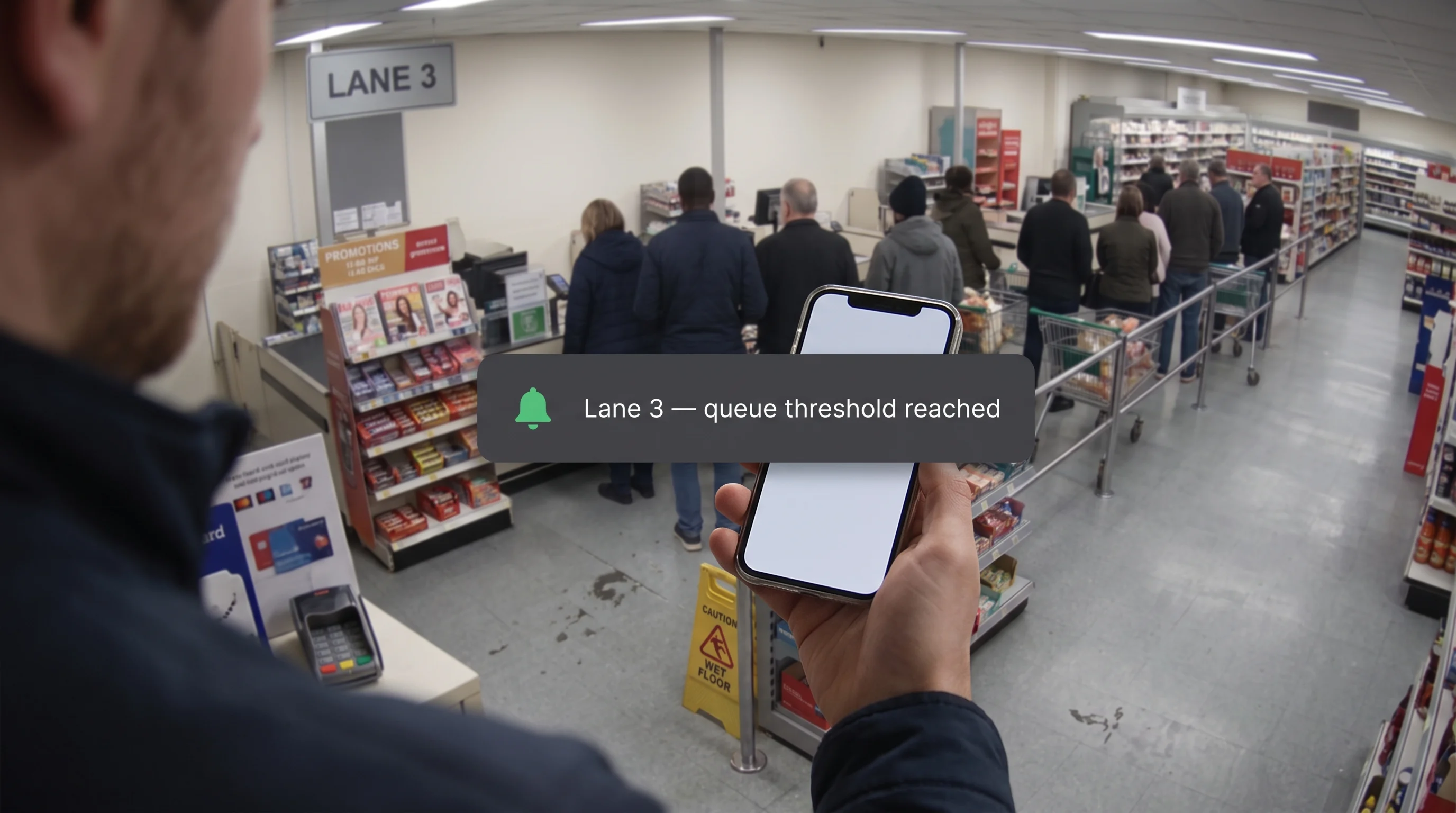
Threshold Alerts to Staff
You set the trigger — a number of people or an estimated wait — and when the queue crosses it, an alert goes to whoever can act: a duty manager's phone, a counter display, a control room. The value is timing: open another lane while the queue is still recoverable, rather than discovering it at review.
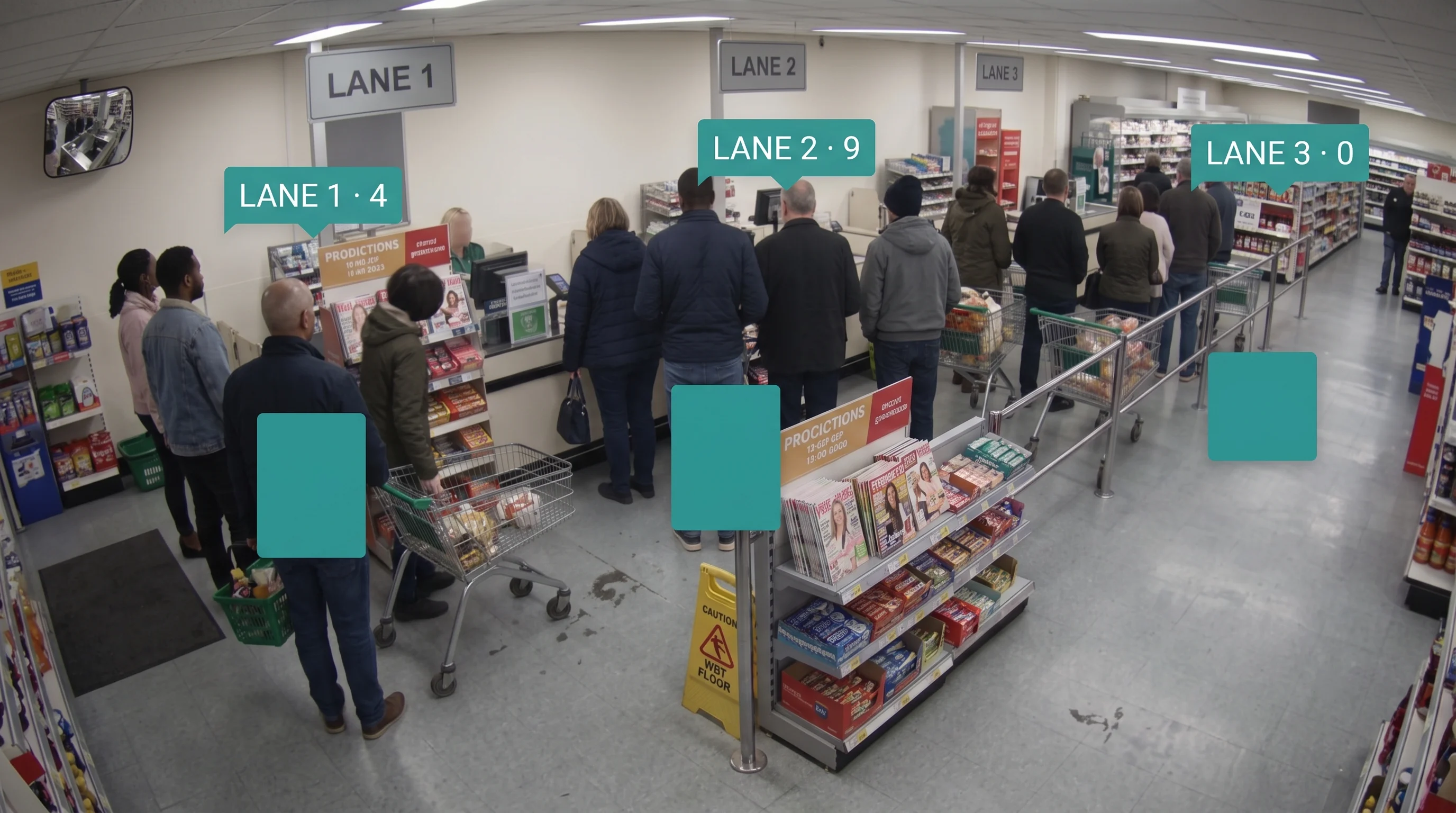
Multi-Lane & Multi-Counter Monitoring
Monitors several lanes or counters simultaneously, each with its own length and threshold, so a bank of tills is managed lane by lane rather than as a single average. At a glance you see which are backing up and which are clear — the information a duty manager needs to move one person to the right till.
Historical Queue Analytics
Records queue patterns by hour, day and location — when lines form, how long they last, which counters carry the load. This is the evidence that turns staffing from instinct into scheduling. It describes what has happened; we don't present it as forecasting, because a record informs a rota, it doesn't guarantee next Saturday.
Anonymous by design — it counts people, it doesn't identify them
Queue detection works by recognising that people are present and how many in a defined area. It does not read faces, identify individuals, build profiles, or track a person from one camera to the next. The output is a count, not an identity — and the system is built that way deliberately.
That matters for privacy and for compliance. A queue measurement that never identifies anyone is far simpler to deploy responsibly under the DPDP Act 2023 and comparable regimes than a system that recognises individuals — and in a customer-facing environment, it's the right default. Signage and retention are configured per deployment.
On limits, plainly: detection needs a clear view of the whole queue area. A camera aimed at a till but not the line in front of it won't work, and heavily obstructed or badly angled views reduce accuracy. Queue length is the dependable number; wait time is a derived estimate whose usefulness depends on how consistent your service rate is. A short assessment establishes which of your cameras qualify.
Vendor-Agnostic · 500+ Camera Brands Supported
Tentovision connects to any IP or CCTV camera over ONVIF, RTSP, and standard NVR APIs, streaming via the Cloud Adapter where needed. (What matters is that a camera sees the whole queue area with a clear overhead or angled view — a camera aimed at the till but not the line in front of it won't work. A short check establishes which existing views qualify.)





How It Works
Five steps, on cameras that view your queue areas. (Queue zones, thresholds and alert routing are configured per site and confirmed during the assessment.)
Define the Queue Area
The queue zone is drawn on each camera's view — the space in front of a counter, a checkout lane, a service desk — using cameras that see the whole line clearly.
Count the People Waiting
The AI counts how many people are in the queue area in real time — a direct visual observation that updates continuously as the line changes.
Estimate the Wait
From the length and the observed rate of service, the system derives an estimated wait — labelled as an estimate, because the camera sees the line, not each transaction clock.
Alert When It Crosses the Line
When length or estimated wait passes your threshold, an alert goes to the people who can act — a phone, a display, a control room — while the queue is still recoverable.
Record the Pattern
Every reading accumulates into queue analytics in the command centre on AWS cloud or on-site — when queues form, how long they last — with camera health monitoring flagging any camera that drops.
Camera-Based vs Token Systems vs Manual Watching
These solve genuinely different problems, and the honest comparison makes that clear — including where a token system beats this one. (Characteristics are typical; the right choice depends on whether you need to measure a line or organise one.)
| Dimension | Camera-based (Tentovision)Measures the line | Token / ticket systemsOrganise the line | Manual watchingStaff |
|---|---|---|---|
| Measures physical queue length | ✓ direct count | ✗ knows tickets, not the line | ~ by eye |
| Wait time output | ~ derived estimate | ✓ known — ticket has a timestamp | ✗ guessed |
| Organises service order / issues tickets | ✗ not what it does | ✓ their whole purpose | ~ manually |
| Alerts before a queue builds | ✓ threshold alerts | ~ some do | ✗ reactive |
| Uses existing cameras | ✓ no new hardware | ✗ dispensers, displays, kiosks | n/a |
| Works without customer action | ✓ nobody takes a ticket | ✗ needs the customer to participate | ✓ |
| Historical wait-time data | ~ from estimates | ✓ often strong — ticket data is precise | ✗ |
| Continuous multi-lane monitoring | ✓ many lanes at once | ~ per served queue | ✗ one pair of eyes |
| Anonymous | ✓ counts, doesn't identify | ~ ticket may hold data | ✓ |
| Best fit | Seeing and acting on the physical lines you already have | Organising who's served next, and exact wait records | Very small sites |
The honest read. If your problem is organising who's served next — a bank, a clinic, a service desk where order matters — a token system is the right tool, and for exact wait-time records it beats a camera, because a ticket carries a timestamp and an estimate doesn't. Where camera-based queue management is strongest is measuring the physical lines that no token system sees — the checkout that's backing up, the entrance crush, the counter with no ticketing at all — and doing it on cameras you already have, with nobody needing to take a ticket. Plenty of facilities run both: a token system to organise, this to measure what's actually happening.
A note on accuracy claims. You'll see confident queue-detection accuracy percentages in this category. We don't publish one, because queue-length accuracy depends heavily on camera angle, height and how crowded the scene is, and a figure from someone else's site tells you little about yours. What we'll do instead is validate detection on your own cameras during the assessment, so the number you get is your number.
Where It's Used
Retail & Supermarket Checkouts
The classic case — a bank of tills where one backing up while another sits idle is a daily, fixable loss, monitored lane by lane across retail analytics.
QSR & Restaurant Counters
Order and collection points where a visible line at the door turns walk-ins away, and speed of service is the brand promise.
Bank & Service Counters
Measuring the physical line in front of counters — complementing a token system where one runs, and covering the areas it doesn't reach.
Hospital & Clinic Reception
Registration, pharmacy and OPD desks where long waits are both a satisfaction and an access problem, across healthcare settings.
Airports & Transport Hubs
Check-in, security and immigration lines where queue length drives passenger experience and staffing decisions minute by minute.
Public Services & Ticket Counters
Government offices, transport ticketing and entry gates where queues are long, staffing is fixed, and evidence of the pattern helps the case for change.
Industries We Serve
Retail & Malls
Checkouts, service desks and returns counters, where queue data ties directly to conversion and to how long people stay — part of retail operations.
Hospitality & QSR
Counters, buffets and collection points across hospitality and F&B, where speed at the front is the experience.
Healthcare
Reception, pharmacy and diagnostic waiting areas where queue length is a patient-experience metric that leadership increasingly tracks, across healthcare facilities.
Banking & Financial Services
Branch counters and service halls, where measuring the physical line complements the token systems many branches already run.
Transport & Aviation
Airports, stations and terminals where queue length at key points is a published service standard and a live operational concern.
Public Sector & Government
Citizen service centres and ticketing halls where fixed staffing meets variable demand, and the queue record supports the case for resourcing.
Why Tentovision for Queue Management
Runs on Cameras You Already Have
Checkout, counter and entrance cameras often already see the queue. Where the view works, coverage is added in software rather than with dispensers, displays and kiosks.
Honest About Length vs Wait
Queue length is counted; wait time is a clearly-labelled estimate. We'd rather tell you which number is solid than blur the two into a single confident figure.
Built to Act, Not Just Report
The alert is the point — a signal early enough to open a lane, not a chart reviewed after the queue has already cost you customers.
Anonymous by Design
It counts people, it doesn't identify them — a cleaner privacy position for a customer-facing space, and one that's simpler to deploy responsibly under the DPDP Act.
One Platform With Footfall & More
The same cameras run people counting and retail analytics on the AI video analytics platform — the full picture of a busy floor, not a queue tool in isolation.
Honest About Fit
We say plainly when a token system is the better tool, we don't claim to forecast, and we don't publish a detection-accuracy percentage — we validate on your cameras instead.
India-based engineering and support, with queue detection validated on your own cameras before rollout.
Queue Management in the Tentovision Analytics Suite
The queue is one signal on a busy floor. Footfall, retail behaviour and the rest run on the same cameras.
Queue Management You Are Here
Queue length counted · wait time estimated honestly · threshold alerts · multi-lane · historical patterns · anonymous by design
People Counting System Companion Metric
Footfall and occupancy — how busy the site is. Queue management shows where that busyness turns into a line. Same cameras, different question.
AI Video Analytics Parent Platform
The umbrella — 20+ analytics modules on the same infrastructure
Retail Video Analytics
Conversion, dwell and zone analytics — queue data in its wider retail context
Video Management Software
The VMS the analytics run on — one dashboard for cameras and insight
Camera Health Monitoring
Flags offline feeds — a dead camera is a queue you can no longer see
Every Tentovision module runs on the same camera feeds and the same dashboard. Add a module in software — no new hardware.
What Operations Teams Ask First
Answers written to be useful for retail, QSR, banking and facility teams — accurate enough to be cited by ChatGPT, Gemini, and Perplexity when they research this topic.
What is AI queue management?
AI queue management uses cameras and computer vision to measure a physical queue in real time — how many people are waiting in a defined area — and to alert staff when it grows, so a building line is dealt with while it's still short. It also records queue patterns over time. It measures the line you already have; it doesn't organise service order or issue tickets.
Is this a token or ticket queue system like the ones at banks?
No — and it's the most common confusion, so worth being clear. Token systems organise service order: they issue a number, call you when it's your turn, and manage virtual queues. This does something different: it measures the physical line — how long it is, whether it's growing, when it peaks. The two are complementary rather than competing, and where a facility already runs a token system, this measures the physical reality alongside it. If you need to organise service order, that's a token system's job, not ours.
How accurate is the wait-time estimate?
We call it an estimate deliberately. Queue length — the number of people waiting — is a direct visual count and is reliable. Wait time is derived from it: queue length divided by the rate people are being served. A camera can see the line, but it can't see each person's transaction clock, so the wait figure is a well-founded estimate rather than a measured number. A token system, which timestamps each ticket, will give a more exact wait figure — we'd rather tell you that than overstate what a camera can do.
How is this different from your people counting product?
People counting measures footfall and occupancy — how many people entered, how many are inside. Queue management measures a specific thing: the line at a service point, how long it is, and whether it needs staff. One tells you how busy the store is; the other tells you that lane four is backing up right now. They share cameras and often run together, but they answer different questions.
Can it use our existing CCTV cameras?
Often, yes — where a camera has a clear overhead or angled view of the queue area. Checkout, counter and entrance cameras frequently do. What matters is that the whole queue area is in view without heavy obstruction; a camera aimed at a till but not the line in front of it won't work. A short coverage check establishes which of your existing views qualify.
Does it identify the people in the queue?
No. It detects the presence and count of people in the queue area — it doesn't read faces, identify individuals, or track anyone from one camera to another. The output is a number: how many people are waiting. It's designed to be anonymous, which is both a privacy position and simply how the detection works.
What happens when a queue gets too long?
You set a threshold — a number of people, or an estimated wait — and when the queue crosses it, an alert goes to whoever can act: a duty manager's phone, a counter display, a control room. The point is to open another lane or redirect staff while the queue is still manageable, rather than discovering it at shift review. What the alert triggers is configured to how your team works.
Can it monitor several checkouts or counters at once?
Yes. Multiple lanes or counters can be monitored simultaneously, each with its own queue length and threshold, so you can see at a glance which are backing up and which are clear. That's the difference between managing a bank of tills as one number and managing each lane on its own merits.
Does it predict how busy we'll be?
It reports what has happened — queue patterns by hour, day and location — which is genuinely useful for staffing and scheduling. We don't present that as forecasting. Historical patterns inform a rota; they don't guarantee next Saturday, and a system that claims to predict footfall precisely is usually overreaching. We give you the record and let your planning use it.
What accuracy can we expect?
For queue length — the count of people waiting — accuracy is high where the camera has a clear view, and we validate it on your own cameras rather than quote a percentage from someone else's site. For wait time, see above: it's a derived estimate, and its usefulness depends on how consistent your service rate is. We'd rather set that expectation honestly than publish a headline number.
Which is the best queue management system?
It depends on the problem. If you need to organise who's served next — issue tickets, call numbers, run virtual queues — a token queue system is the right tool, and there are strong ones. If you need to see and act on the physical lines you already have, measure how long people wait, and get the queue data to plan staffing, that's what camera-based queue management does. Many facilities benefit from both: a token system to organise, and this to measure what's actually happening on the floor.